Baldwin County Commission Approves Belforest Rezoning Over Neighbors’ Objections
Baldwin County commissioners approved a rezoning near Route 181 for a lawnmower sales and storage business, despite objections from Rebel Road residents.
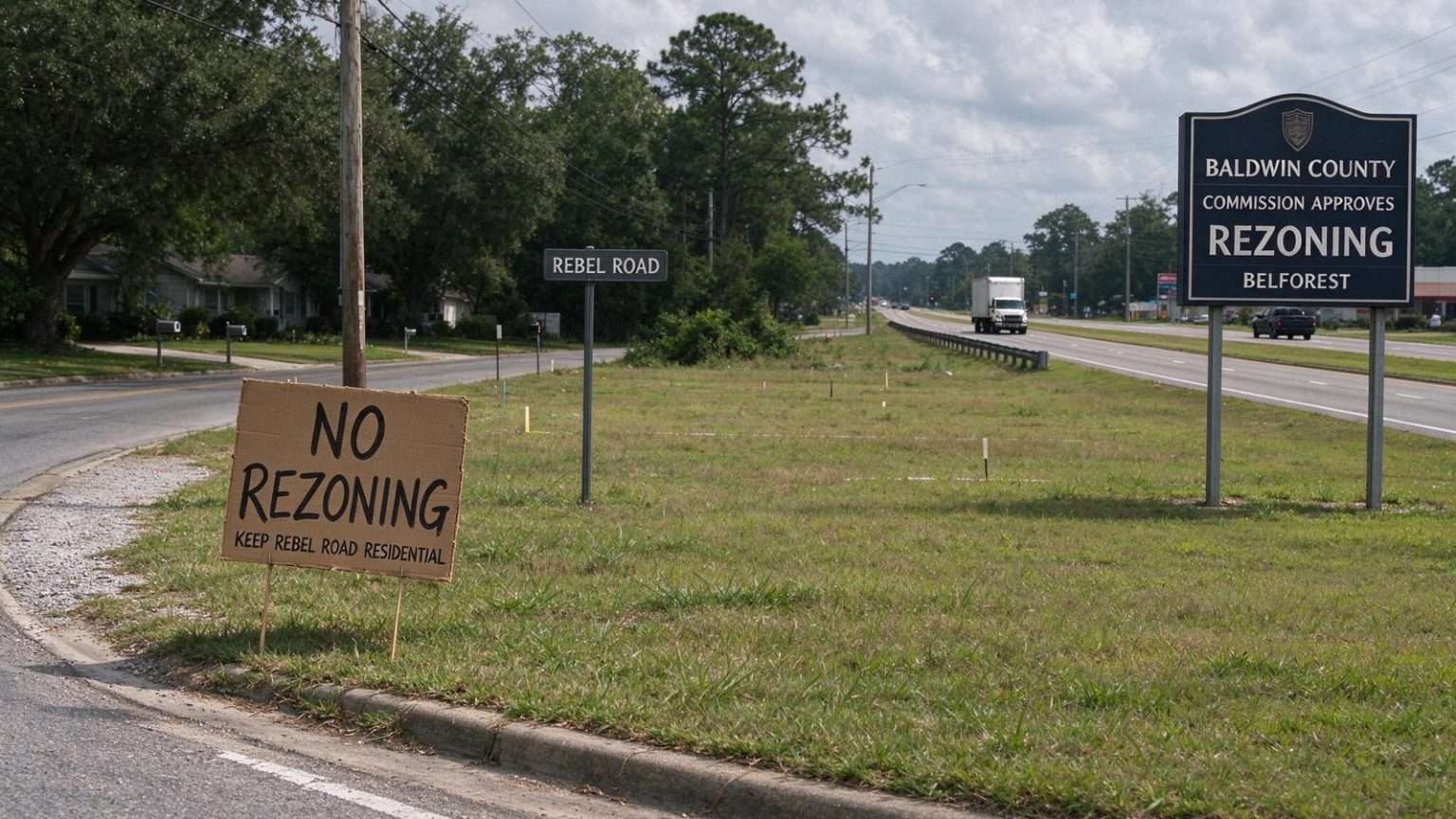
A stretch of quiet residential road in unincorporated Belforest is set to see new commercial activity after the Baldwin County Commission approved a rezoning request over the objections of nearby homeowners.
The commission voted unanimously to change the classification of roughly four acres of vacant land along Rebel Road, a small residential street that feeds into the heavily traveled Alabama Route 181. The change clears the way for a self-storage company to develop a lawnmower repair, sales and storage operation, including a 4,000-square-foot retail showroom.
The vote was brief, but it capped a process that residents had tracked with growing alarm. Zoning decisions in unincorporated Baldwin County rest with the county commission, meaning homeowners in communities like Belforest have no municipal council of their own to petition — the commission is the only elected body with authority over how their neighborhoods develop. That structural reality shapes every rezoning fight in the county’s unincorporated areas, where residents watch growth decisions made by a board that represents one of the fastest-developing counties on the Gulf Coast.
The Neighbors Make Their Case
The decision did not sit well with several residents who packed the commission meeting to plead their case. One longtime resident who grew up near Route 181 and has lived on Rebel Road for more than a decade said the arrival of commercial development threatened the character of the neighborhood.
“With the expansion of 181, we see our quaint and quiet community going away,” he told commissioners.
A petition signed by about a dozen Rebel Road residents outlined their concerns, which ranged from rental trailers traveling the residential street to stormwater runoff and the prospect of an unsightly storage facility sitting next to their homes. In a letter to the commission, the residents acknowledged Belforest’s growing appeal for commercial development but argued the project was a poor fit for their street.
Each of those concerns maps onto a common rezoning dispute. Construction and delivery traffic bound for a commercial site tends to favor the straightest route, which on a small street means residential driveways and sidewalks share the road with heavy trailers. Stormwater is an equally familiar worry in low-lying coastal county land, where adding rooftop and pavement to a drainage basin sends more water toward the neighbors downstream. And the visual shift — from backyards to storage bays and showroom signage — is the change residents say is hardest to reverse once it is made.
The Commission’s View
The commissioner representing the area defended the vote, framing commercial growth as an inevitable byproduct of the county’s expansion. He called the proposed business an appropriate use for the vacant land, situated along a major four-lane collector road, and said he did not expect it to significantly affect traffic. He noted the project resembled another storage facility already operating farther south along Route 181.
That reasoning follows the county’s long-standing pattern of directing commercial development toward arterial corridors. Land on a collector road is where the county expects businesses to locate, and commissions typically reason that a well-designed commercial project on an arterial edge is preferable to the scattered commercial strips that develop without planning. To the neighbors on Rebel Road, though, the classification of the land as vacant overlooked the fact that the parcels back directly onto established homes.
Route 181: The Corridor That Redrew the Map
Route 181 has drawn steady interest from developers since the highway was widened from U.S. Route 90 to Baldwin County 64 in 2011. That first phase brought more residential development and, with it, heavier traffic.
The widening transformed what had been a two-lane rural connector into a four-lane spine running through the heart of the county’s Eastern Shore growth zone. Four lanes changed the mathematics of development: higher traffic counts support retail, offices and service businesses, and higher accessibility raises land values along every parcel with frontage. Communities like Belforest, Daphne and Spanish Fort have watched the corridor’s land market shift accordingly, with vacant tracts that once sat unnoticed now appraised with commercial potential.
Local planners have been pressing state transportation officials to consider extending the widening farther, toward Baldwin County 48 near Fairhope, though additional phases remain years away and have been slowed by funding constraints. Transportation projects of that scale compete against every other highway need in the state, and Baldwin County’s rapid growth has kept its delegations lobbying for a share of a construction budget that never seems to catch up with the county’s population curve.
When Growth Outruns the Roads
The added lanes have already reshaped travel patterns in the corridor. One Daphne public works official recently described morning traffic near a key intersection as resembling “a racetrack,” with drivers reaching highway speeds as they roll out of nearby subdivisions.
The observation captures a safety paradox familiar to rapidly suburbanizing areas. A road widened to move more traffic faster passes more driveways and more subdivisions, and drivers calibrate their speed to the road rather than the surroundings. Residents of the connecting neighborhoods absorb the consequences: harder crossings for school buses, more aggressive turns onto collector streets, and cut-through traffic on the small roads that were never built to carry it. Rebel Road residents’ complaints about rental trailers echo exactly that pattern, with commercial and construction traffic finding the shortest path between the highway and the job site.
Storage and repair businesses illustrate the trade-off in miniature. They generate less traffic than retail, but they need truck access, outdoor storage and visible frontage — characteristics that make arterial roads and their residential side streets the practical locations. A four-acre tract on Rebel Road offers all three, which is precisely what the self-storage company saw, and precisely what the neighbors feared.
The Recurring Argument in Baldwin County
The rezoning reflects a broader tension playing out across fast-growing parts of Baldwin County, where longtime residents increasingly find themselves weighing the region’s economic momentum against the quieter neighborhoods they moved in to enjoy.
Baldwin County’s population growth has made it one of the fastest-growing counties in Alabama for years running, and that growth funds itself — each new roof contributes to the tax base that pays for the schools, roads and services the county must build. The friction arrives at the neighborhood scale, where the abstractions of growth economics become a storage facility at the end of the street.
How Unincorporated Zoning Works
Residents watching the Rebel Road decision unfold encountered the machinery of county zoning, which works differently from city hall. Unincorporated communities like Belforest operate under the county’s zoning map and regulations, administered through a planning commission that reviews requests before they reach the county commission. Public hearings are part of the process, which is how the Rebel Road petition and the neighbors’ letter became part of the official record.
The system gives property owners and neighbors the right to be heard, but not the right to decide. A rezoning applicant makes the case that the proposed use fits the county’s comprehensive plan and the surrounding land pattern; opponents make the case that it does not; and the elected commissioners weigh both against the county’s broader interest. Unanimous votes like this one suggest the board saw the question as settled by policy — arterial frontage, corridor growth and a precedent facility already operating along the same highway.
What happens next follows the applicant’s own timeline. Rezoning approval does not obligate construction, and tracts approved for commercial use sometimes wait years for development. But for the neighbors, approval converts a question into a fact: the four acres are commercial now, regardless of when the bulldozers arrive, and every future use of the land must fit within the new classification.
Living Alongside the Corridor Economy
Belforest sits inside one of the most consequential development corridors on the Eastern Shore, close enough to the Route 181 and U.S. 90 networks to be convenient, and far enough from incorporated city limits to have no local government of its own. Its neighborhoods expanded during the same years Route 181 was widened, drawing families who priced themselves toward the county’s interior while staying within commuting range of Daphne and Mobile.
The result is a community built of newcomers and old-timers sharing streets that are changing faster than any of them expected. The longtime resident who addressed the commission described watching a place he had known since childhood turn over, subdivision by subdivision and now lot by lot. The commission, for its part, considered the same landscape through the framework of land use policy, where four lanes of traffic argue louder than any petition.
Both views are accurate, and both will shape the corridor in the years ahead. The storage and lawnmower operation will add its showroom and storage bays to Rebel Road; the widening of Route 181 farther south will return to the planning agenda when funding allows; and the residents of Belforest will keep organizing, petitioning and showing up at commission meetings — the one channel through which an unincorporated community speaks to the government that governs it.
For now, the Rebel Road decision stands as Baldwin County’s latest answer to the question every fast-growing county faces: when development arrives at the edge of a quiet street, who gets to say how it fits — and what does the neighborhood get in return for the change?