Council President Gina Gregory Outlines 2015 Priorities for District 7
Mobile City Council President Gina Gregory highlighted infrastructure, sidewalks and community volunteer efforts as priorities for District 7 in 2015.
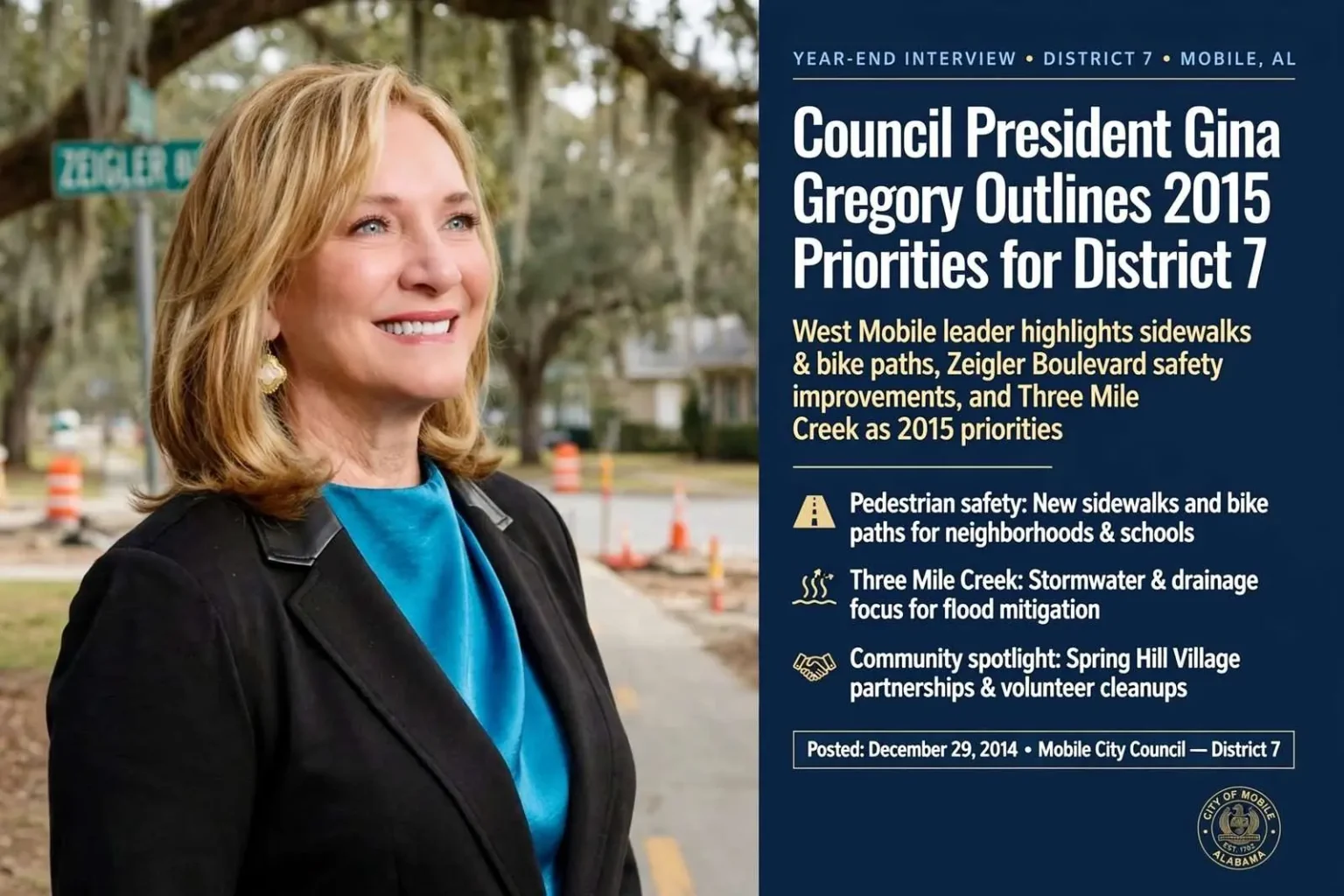
Mobile City Council President Gina Gregory spent much of a recent conversation about her legislative priorities praising the volunteer spirit of District 7 before turning to the infrastructure projects she wants to see move forward in 2015. The year-end interview offered a preview of how the council’s leader plans to balance her citywide role with the neighborhood-level needs of the district she represents in west Mobile.
Gregory, who frequently speaks about the importance of cooperation across Mobile’s council districts for the city’s overall progress, said her own district’s needs center on quality-of-life improvements, including sidewalks, bike paths and continued attention to areas like Zeigler Boulevard and Three Mile Creek. Those projects sit at the heart of District 7’s agenda for the new year, alongside the community work that Gregory argues sets her district apart.
Before outlining those specific projects, Gregory credited the residents and community groups of District 7 for what she described as an unusually strong culture of civic involvement. “We are blessed in District 7 to have residents who give back to their community and city financially and through their volunteer efforts,” she said.
The projects on the list
Sidewalks and bike paths may sound like small items on a municipal budget, but in a district built largely around automobile travel they represent a shift in how neighborhoods connect. Gregory has pointed to pedestrian infrastructure as a way to make District 7’s residential areas safer for children walking to school, for older residents who no longer drive at night and for the growing number of Mobilians who want to walk or ride rather than drive every trip.
Zeigler Boulevard, a major east-west corridor in west Mobile, has carried growing traffic volumes as the city’s population has spread westward, and improvements to the road and its intersections have been a recurring ask from residents in the area. Continued attention to the corridor means intersection work, signal timing and safety measures that keep a busy road functional for both commuters and the neighborhoods it threads through.
Three Mile Creek presents a different kind of challenge. The creek and its watershed drain a wide swath of central and west Mobile, and its history includes flooding, stormwater problems and long-running discussions about how the city manages the waterway that runs through some of its oldest neighborhoods. For Gregory, continued attention to areas along the creek means staying engaged with drainage and water-quality issues that affect property owners far beyond any single district’s lines.
Gregory’s dual role as council president and district representative shapes how that list advances. As president, she sets the council’s agenda and manages its meetings; as the District 7 representative, she fields the calls about potholes, dumped tires and drainage ditches that make up the daily business of a council office. The combination means her district’s projects carry both the weight of constituent demand and the visibility of being championed from the council’s chair.
The priorities reflect the reality that District 7 is among the city’s largest and fastest-growing, stretching across west Mobile neighborhoods where new development keeps arriving and older subdivisions age alongside it. Infrastructure that seemed adequate a generation ago — two-lane connectors, missing sidewalk links, aging drainage — now needs sustained investment to keep pace.
The Village of Spring Hill
Gregory pointed to the Village of Spring Hill as a model example, saying its public-private partnerships have already transformed the area and that residents can expect additional improvements there in 2015 thanks to continued community-driven investment. The Spring Hill commercial village, centered on the historic heart of one of Mobile’s oldest neighborhoods, has in recent years seen streetscape work, signage and beautification carried out through partnerships between the city, businesses and neighborhood organizations.
The Village concept reflects a wider trend in American cities: rather than waiting on a single large redevelopment, communities organize around their existing commercial corners and improve them incrementally — new lighting, sidewalks, landscaping and design standards that make a district feel like a place rather than a pass-through. Spring Hill’s version of that work has made it a frequently cited example when other Mobile neighborhoods ask how to organize similar efforts.
The neighborhood’s identity runs deep. Spring Hill is home to Spring Hill College, founded in 1830 as the oldest college in Alabama, and its tree-shaded streets and historic homes have long made it one of the city’s most distinctive areas. The village improvements have sought to reinforce that character rather than replace it, a distinction Gregory has emphasized in describing why the partnership model works there.
Volunteers as infrastructure
Gregory also highlighted the Athey Road Community Action Group, whose volunteers regularly spend hours picking up litter and clearing illegally dumped tires from neighborhood streets. Illegal dumping is a persistent problem across Mobile’s outlying neighborhoods, where dead-end roads and unlit corners attract everything from household trash to construction debris, and organized volunteer cleanups have become the primary countermeasure in areas where code enforcement alone cannot keep up.
Other groups drew similar praise. Gregory noted the work of the Mobile Terrace Community Development Corporation, which she said supports its neighbors year-round by distributing back-to-school supplies, delivering meals to homebound residents at Thanksgiving and providing gifts during the Christmas season. Organizations of that kind operate on modest budgets and volunteer labor, but their calendars map directly onto the moments when neighborhood need is highest — the start of the school year and the holidays.
Community groups of that kind depend on a rotation of neighbors willing to organize, and Gregory’s praise carries a practical purpose: recognition keeps volunteers engaged. Cleanups and food distributions run on the same small engine of local leadership, and a council member who names and thanks those groups in public helps sustain the recruitment that keeps them running year after year.
The council president’s argument is that this volunteer network is itself a form of civic infrastructure, as real as sidewalks and drainage. A district where organized groups fill gaps — cleaning roadsides, feeding homebound residents, supplying schoolchildren — is a district where city government can focus its money on capital projects, because the community carries much of the human load itself.
A district-by-district look
Gregory’s comments came as part of a series of year-end interviews with all seven members of the Mobile City Council, each discussing priorities for their respective districts heading into the new year. The series offered residents a district-by-district look at the infrastructure, safety and community development issues council members plan to focus on, and it put the council president’s own district under the same microscope as the rest.
Mobile’s seven-district council structure divides the city geographically, from the historic downtown and the peninsula districts to the growing western reaches. The council president’s position — elected by fellow council members — carries procedural power over the council’s agenda and a citywide platform, but each member’s district list remains the truest record of what their constituents are asking for. Gregory’s 2015 list, heavy on sidewalks, corridors and creek management, tracks closely with the character of west Mobile: fast-growing, car-dependent and organized around strong neighborhood associations.
City budgets are built annually, and the council’s role in shaping them means district wish lists ultimately compete for the same dollars. Gregory’s cooperative approach — speaking often about districts advancing together rather than against one another — is a practical necessity in that process, where a project in one district can be delayed by a stormwater emergency in another. Her leadership of the council through the budget cycle will determine how much of the 2015 list becomes work orders.
The interview series itself has become a fixture of the council’s year-end calendar, a structured moment when each district’s agenda gets stated on the record before the budget season begins. Residents who follow the series get an early map of the capital projects, policy items and neighborhood concerns their representatives intend to pursue — and a baseline against which the next year’s progress can be measured.
For District 7 residents, the near-term markers to watch are familiar ones: progress on pedestrian connections between neighborhoods and schools, movement on Zeigler Boulevard safety work, and the city’s continuing engagement on Three Mile Creek. Around those projects, the volunteer network Gregory catalogued — the Athey Road group, the Mobile Terrace CDC and the Spring Hill partnerships — will keep doing the work it does regardless of the budget calendar.
The year-end message, in the council president’s telling, is that District 7 enters 2015 from a position of strength: a district where the public-private model has already proven itself in Spring Hill, where volunteer groups handle much of the community’s day-to-day care, and where the city’s task is to match that energy with the sidewalks, roads and drainage that only public investment can deliver.