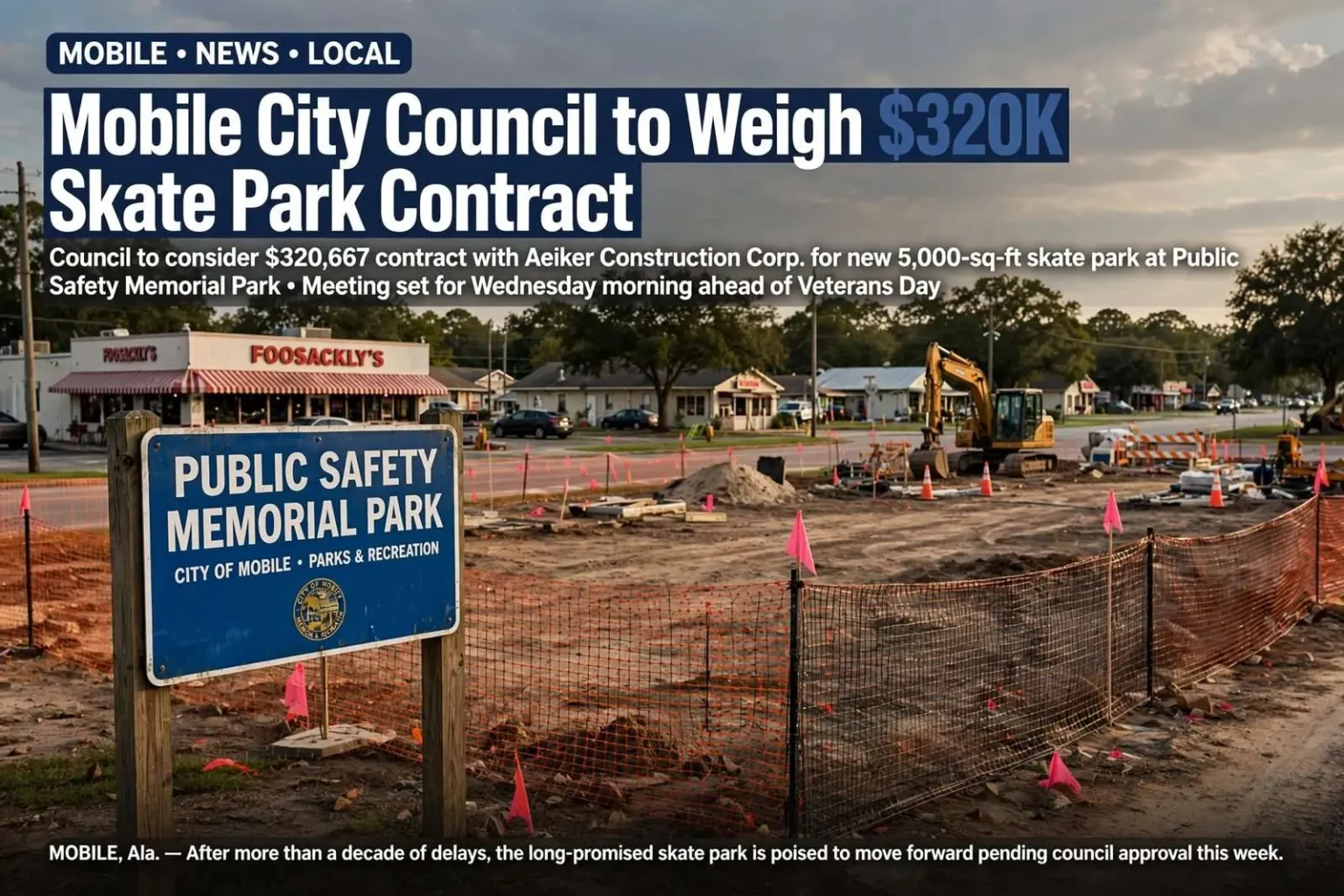
Concrete skate park features similar to those planned for Mobile's Public Safety Memorial ParkMobile's long-delayed skate park could break ground after a new construction contract is approved.

MOBILE, Ala. — A skateboard park that has been promised to Mobile skaters for more than two years could finally break ground after the City Council considers a construction contract at its next meeting.

Council members are expected to take up a resolution authorizing a $320,667 contract with Aeiker Construction Corp. to build the long-anticipated skate park at Public Safety Memorial Park, located on Airport Boulevard across from Foosackly’s. Because the meeting falls near the Veterans Day holiday, the council’s regular session has been shifted to a Wednesday morning start time.

The project traces back to at least 2012, when city officials first began floating plans for a skate park at the site. Former Mayor Sam Jones once pledged that construction would begin before the end of 2013, but the project stalled for years before finally winning council approval to proceed this past summer.

Under the current plan, crews would complete site work and grading, build a required retention pond, pour foundations and concrete flatwork, and install pre-cast concrete skateboard features. If the contract is approved, the project is expected to wrap up by late spring.

City engineering officials say the contract includes a contingency allowance not built into earlier cost estimates, intended to cover unexpected complications — such as poor soil conditions — without forcing the contractor to halt work and come back to the city for additional funding mid-project. Officials with the city’s architectural engineering department noted that construction costs tend to creep upward the longer a project sits on the shelf, which helps explain why the current bid outpaces the original $280,000 estimate.

Even with the increase, the current proposal remains substantially cheaper than the park city leaders originally envisioned. Early plans called for a $450,000, 8,000-square-foot facility that included a six-foot-deep bowl feature. That version has since been scrapped in favor of a smaller, roughly 5,000-square-foot design, a scaled-back approach city officials say better matches available funding while still giving Mobile’s skateboarding community a dedicated space to call its own.

For skaters and families who have been waiting since the project was first announced, Wednesday’s council vote represents the clearest sign yet that the park may finally move from rendering to reality after years of delay.

Mobile is the county seat of Mobile County in southwest Alabama and the state’s only saltwater port. Situated where the Mobile River meets Mobile Bay near the northern Gulf of Mexico, the city has long served as a commercial and cultural gateway between Alabama and the wider Gulf Coast. Founded in 1702 as Fort Louis de la Louisiane and ruled in turn by France, Britain, and Spain before joining the United States in 1813, Mobile carries a layered heritage distinct from the rest of the state.

See also  Battle of Mobile Bay Stamp to Be Dedicated at the History Museum of Mobile

Today Mobile anchors a metropolitan area spanning Mobile County and neighboring Baldwin County, and it remains a center for shipping, aerospace, healthcare, and higher education in the region. Its downtown and waterfront have seen sustained revitalization, while historic neighborhoods preserve architecture from its colonial and antebellum past. The city’s identity is shaped as much by its working port and industrial base as by its festivals and food culture, making it a frequent focal point for news about growth and change in southern Alabama.

Local government in the Mobile area operates through a combination of mayor-council or commission structures at the municipal level and a county commission in Mobile County, with elected officials handling budgets, public safety, infrastructure, and zoning. Baldwin County has its own commission and a collection of incorporated municipalities.

Decisions made in council chambers and commission meetings affect roads, school funding, economic development, and quality of life, which is why coverage of local government is a staple of regional journalism. The interplay between city, county, and state authorities often determines how effectively the area can address shared challenges.

Because many services residents rely on are delivered at the local level, the choices of elected officials have direct, everyday consequences. Budget priorities, in particular, reveal a community’s values and shape the trajectory of growth and public welfare for years to come.

The economy of the Mobile region is diversified across shipping and logistics, aerospace and shipbuilding, healthcare, tourism, and manufacturing. The Port of Mobile is one of the nation’s busiest seaports and a cornerstone of the local and state economy.

Major employers in aviation and defense contribute to a skilled workforce, while economic-development organizations aim to attract investment and jobs through incentives and infrastructure improvements. Small businesses, from restaurants to professional services, form the backbone of neighborhood commerce.

The health of the regional economy is a frequent subject of public discussion and reporting. Workforce development, recruitment of industry, and the fortunes of local retailers all feed into a broader picture of how the Gulf Coast competes and adapts in a changing national economy.

See also  Mobile Police Identify Man Found Dead at Brill Road Apartment Complex as Rommie Odoms

Baldwin County sits directly east of Mobile County across Mobile Bay and is the largest county in Alabama by land area. It encompasses the Eastern Shore communities of Daphne, Fairhope, Spanish Fort, and Foley and stretches south to the beaches of Gulf Shores and Orange Beach along the Gulf of Mexico.

Long among the fastest-growing counties in the state, Baldwin blends suburban development near the bay with tourism-driven coastal economies. Its proximity to Mobile and its position on the Eastern Shore make it a recurring subject of regional news covering growth, infrastructure, schools, and the balance between development and coastal preservation.

Mobile Bay is a shallow estuary in southern Alabama where freshwater from the Mobile, Tensaw, and other rivers mixes with saltwater from the Gulf of Mexico. It is among the largest estuarine systems in the United States and supports commercial and recreational fishing, shipping through the Port of Mobile, and wetlands that buffer the coastline from storms.

The bay’s Eastern Shore, in Baldwin County, includes Daphne, Fairhope, and Spanish Fort, while the Western Shore lies in Mobile County. Its ecology and economy have guided settlement for centuries, and the bay figures in regional debates over development, navigation, and conservation. Events on either shore are routinely covered as part of the interconnected life of the Mobile metro area.

The Gulf of Mexico borders Alabama’s southern edge and defines much of the state’s coastal identity. Alabama’s Gulf coastline, centered on Dauphin Island, Gulf Shores, and Orange Beach, supports a tourism industry built around beaches, charter fishing, and marine recreation, while offshore waters host shipping lanes and energy interests.

The Gulf’s warm, shallow shelf and exposure to hurricanes make weather and disaster preparedness recurring concerns for communities from Mobile to Baldwin County. The marine environment also underpins commercial seafood harvests that have sustained Gulf Coast families for generations, tying the region’s economy and culture closely to the water.

Alabama is a state in the southeastern United States bordered by Tennessee, Georgia, Florida, the Gulf of Mexico, and Mississippi. Often called the Heart of Dixie, it spans Appalachian foothills in the north and flat coastal plains in the south. Its largest cities include Birmingham, Montgomery, Huntsville, and Mobile.

Alabama’s history encompasses Indigenous roots, Spanish and French colonial settlement, a cotton-plantation economy, the Civil War and Reconstruction, and the Civil Rights Movement of the 1950s and 1960s, followed by a shift toward manufacturing, aerospace, and technology. Local news across the state frequently reflects this mix of tradition and change.

See also  Who Is the King of Mobile Bay? A Reader Debate Over the City's Real Power Brokers

The Federal Bureau of Investigation is the principal investigative arm of the United States Department of Justice, tasked with protecting the country against terrorist threats, foreign intelligence operations, cyber attacks, and major criminal activity. Established in 1908, the bureau operates a network of field offices across the country, each responsible for federal law-enforcement matters within its region.

Field offices such as the one serving Mobile work closely with state and local agencies, reflecting the bureau’s reliance on partnerships rather than unilateral action. The director, appointed by the president and confirmed by the Senate, sets national priorities that cascade down to individual offices handling everything from counterterrorism to public-corruption and civil-rights investigations.

Because federal agents are seldom the first to notice a threat in a community, much of the bureau’s effectiveness depends on tips and vigilance from local residents and police. That reality has made community outreach, including visits by senior leaders to field offices, a deliberate part of how the FBI maintains trust and communication with the public it serves.

Local law enforcement across South Alabama is carried out by municipal police departments, county sheriff’s offices, and state agencies that together cover a mix of urban, suburban, and rural territory. City departments handle policing within municipal limits, while sheriff’s offices provide courthouse security, jail operations, and patrol in unincorporated areas.

Cooperation among these agencies, and with federal partners, is central to tackling problems that cross jurisdictional lines, from drug trafficking to violent crime. Joint task forces that pair federal agents with local officers have become a standard mechanism for sharing information and concentrating resources on threats that no single agency could address alone.

Public-safety agencies in the region also contend with staffing, training, and community-relations challenges common to departments nationwide. How they allocate patrols, respond to calls, and engage neighborhoods is a regular subject of local oversight and news coverage, particularly where residents expect both accountability and visible protection.