
Mobile City Council Weighs Charging Developers for Public Right-of-Way
Mobile officials are reconsidering decades of giving away city right-of-way land, prompted by two Airport Boulevard development requests.
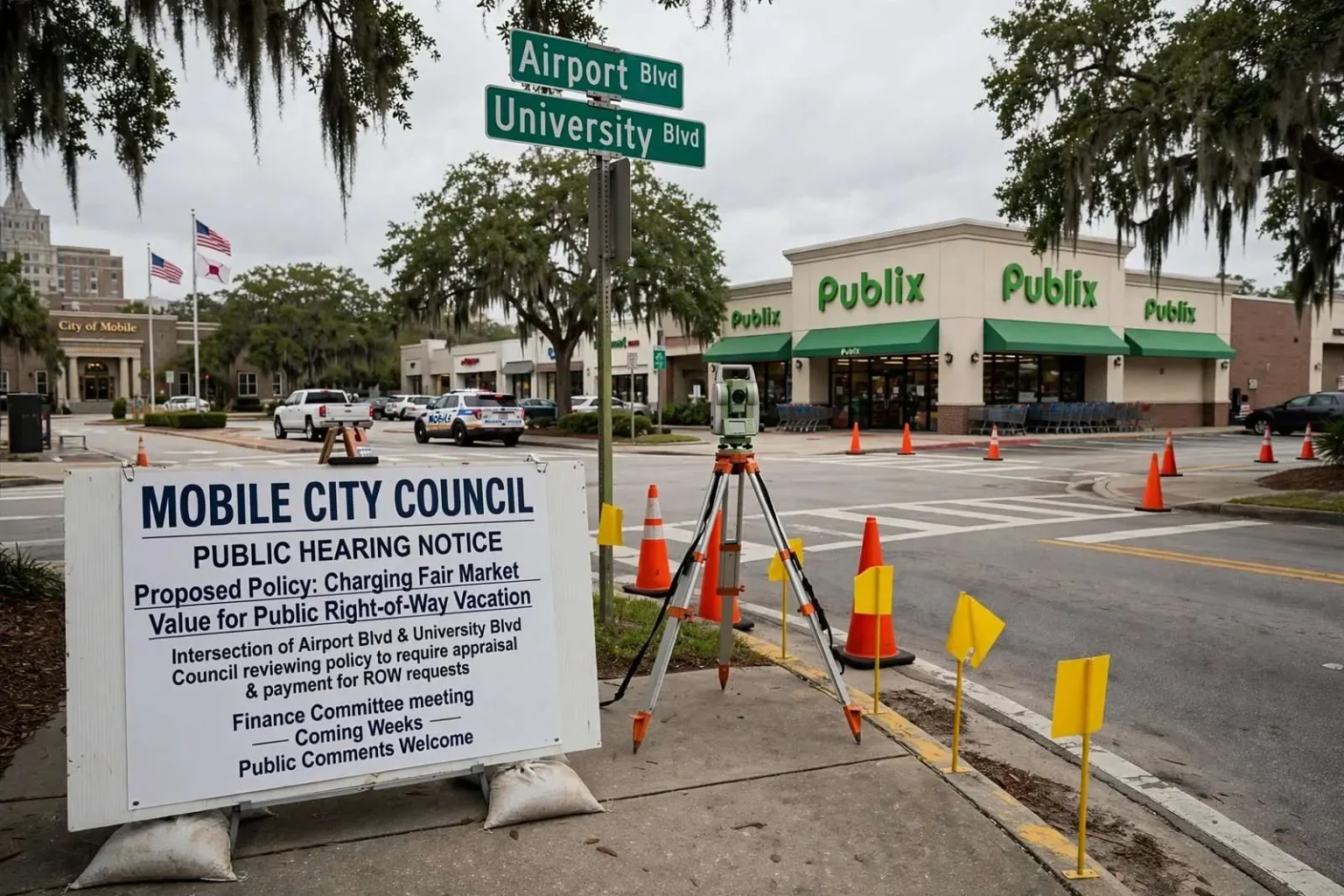
Mobile’s City Council is reconsidering a longstanding practice of giving away small strips of city-owned right-of-way to developers and residents for free, with several council members now pushing to require fair market value payments instead.
For years, the city routinely approved requests to vacate small pieces of public right-of-way along commercial and residential streets through simple council votes, with no charge to the person or company requesting the land. That practice is now under scrutiny after two separate requests involving property along Airport Boulevard forced council members to confront the question directly.
One request, from an attorney representing a lube shop operator, sought roughly 40 feet of public right-of-way in front of an existing business on Airport Boulevard. The council tabled that request rather than approving it outright. A separate, higher-profile case involved a strip of land near a Publix grocery store at the intersection of Airport and University boulevards, where the council voted 6-1 to vacate the right-of-way to a private developer after months of debate over whether the land should be appraised and sold at fair market value. That developer ultimately agreed to pay an amount expected to be near $41,000 for the property, with a final vote on the transaction to follow.
City Weighs Fair Market Value for Public Land
City officials say Alabama law gives municipalities the authority to charge fair market value for this kind of public right-of-way, but Mobile’s real estate manager said that in his more than two decades with the city, there had never before been serious interest in actually charging for it until now. He said the city has concluded it should no longer give away valuable commercial property without compensation.
The Airport and University property drew particular attention because city planners have floated the idea of a major redesign of that intersection in the past, one that could reshape how valuable the adjoining land becomes in the future. A study conducted several years ago proposed a significant overhaul of the Airport and University intersection, including elevated center lanes bypassing the cross streets, at an estimated cost north of $15 million, though the city has not moved forward with those plans.
A New Policy With Exceptions for Small Parcels
Council members appear to be leaning toward a policy that would charge for commercially valuable right-of-way while carving out exceptions for smaller residential parcels, such as alleyways, where the value is minimal and the administrative cost of requiring an appraisal could outweigh any money collected. Under the proposed process, developers seeking to acquire right-of-way would pay for an independent appraisal, selecting from a list of appraisers who already work with the city, before any sale would proceed.
The City Council’s Finance Committee is expected to take up the broader policy question in the coming weeks, a discussion that could reshape how Mobile handles future development requests involving public land across the city.