Mobile Councilman Calls for Meeting on Alabama Power’s Tree-Trimming Practices
A Mobile councilman scheduled a special committee meeting after complaints that Alabama Power cut back mature trees near power lines.
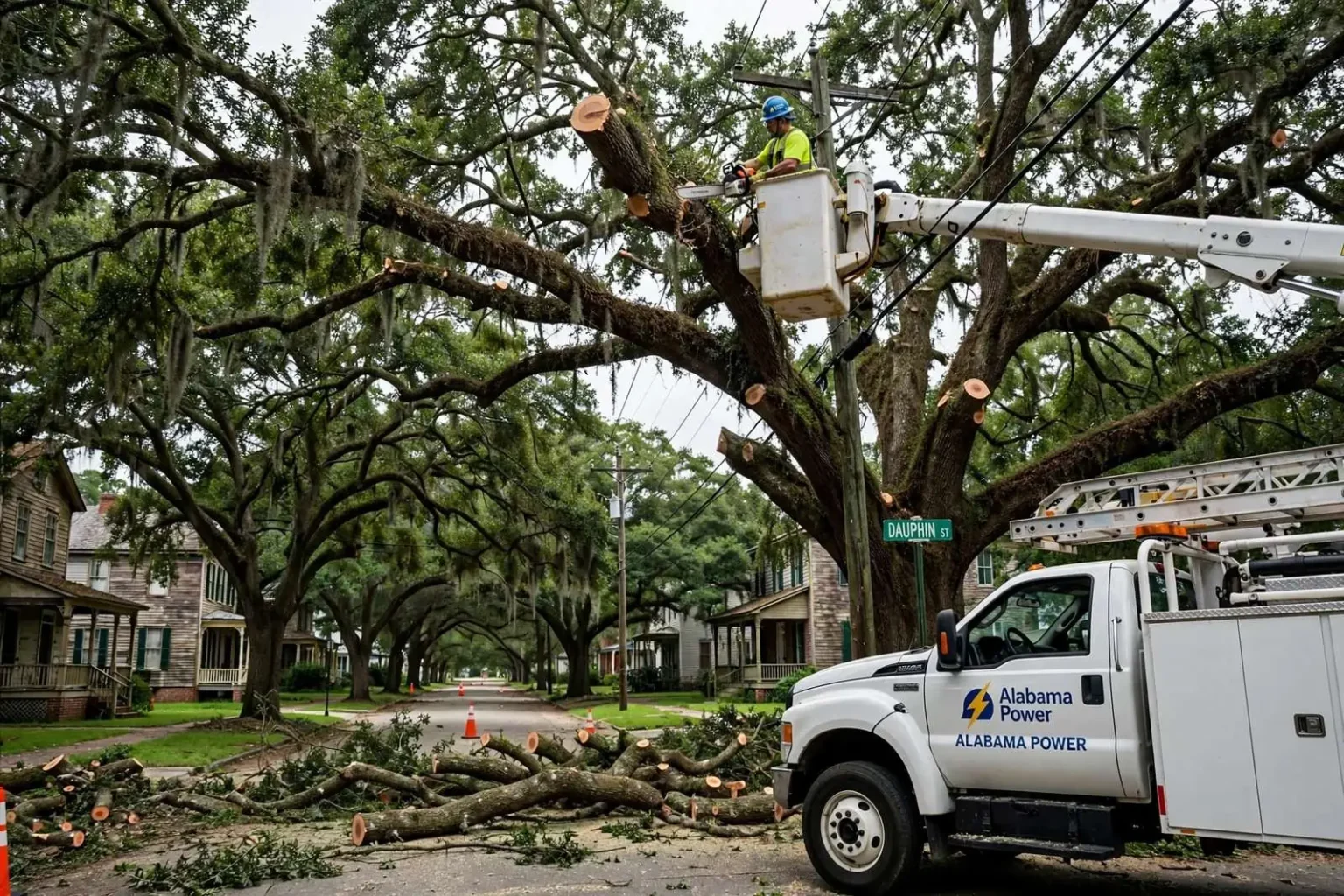
Complaints about the way Alabama Power trims trees near power lines in Mobile have prompted a city councilman to schedule a special meeting to examine the utility’s practices. The move sets up a public airing of a long-running tension in Mobile: the need to keep electricity flowing versus the desire to protect the mature oak canopy that defines many of the city’s oldest neighborhoods.
The issue surfaced after a Dauphin Street homeowner told the Mobile City Council that work crews had severely cut back large, mature oak trees on her property without adequate warning. She argued that ordinary residents face restrictions on trimming their own trees while the utility operates with far more latitude, leaving what she described as an unsightly tangle of poles and lines throughout residential streets.
Her appearance struck a chord with council members who said they have heard similar complaints from constituents across the city, particularly in older districts where towering oaks line the streets and power lines run overhead along the same corridors. In some cases, residents said, the trimming left trees visibly lopsided or thinned to a degree they considered excessive for routine line clearance.
Councilman Fred Richardson responded by calling for an August committee meeting, telling colleagues it was time to take a closer look at how the company handles vegetation management citywide after fielding numerous complaints from constituents. Richardson said the goal of the session would be to understand the utility’s methods, its notification practices and whether anything in the city’s relationship with the company can be improved.
The utility’s response
An external affairs manager for Alabama Power in the Mobile area said the company’s crews clear growth that encroaches on its right-of-way for safety and reliability reasons, and that the practice is applied consistently across the tens of thousands of square miles the utility serves. She said the company works with the city’s Urban Forestry Department to meet local expectations and believes the homeowner was notified in advance, as is standard practice before trimming begins in a neighborhood.
Utility officials describe vegetation management as an essential part of grid maintenance rather than an optional aesthetic choice. Limbs that contact or fall into power lines are among the most common causes of outages, and clearing them is a routine practice for electric utilities across the country. Trimming standards are generally tied to how quickly a given tree species grows and how close the branches come to energized conductors.
The company also notes that storm debris in a heavily wooded city creates hazards beyond outages, since energized lines that come down across tree limbs can endanger residents and delay restoration work. Those considerations shape how aggressively crews cut back growth near the lines, particularly along major distribution corridors that carry power to thousands of customers.
Split views on the council
Council members offered differing views on how to balance safety with the aesthetics of Mobile’s historic, tree-lined streets. The councilman representing the district where the homeowner lives said he wants the utility’s work done as sensitively as possible given the significance of century-old oak trees to the character of older neighborhoods. He noted that visitors and prospective residents often cite the canopy as one of the first things they notice about the city.
Another council member noted that many newer subdivisions on the west side of the city already have buried power lines, unlike some busier commercial corridors, and suggested residents might eventually push for more lines to be placed underground. Undergrounding eliminates the need for routine trimming along a corridor entirely, though it typically involves substantial construction costs and significant disruption while lines are being placed beneath streets and yards.
The debate reflects a broader reality in Mobile, where the city’s celebrated live oaks and other mature trees share limited above-ground space with the poles, wires and equipment of a growing electric system. Cities across the Gulf South face the same collision of priorities, and most rely on ongoing coordination between utilities and municipal forestry staff to manage it.
What the law allows
The city attorney told the council that state law gives the utility significant leeway when it comes to trimming near its lines, though the city may have some ability to weigh in on aesthetic standards. Utilities hold easements and rights-of-way that allow them to access and clear growth around their equipment, and those rights generally take precedence over property owners’ preferences when safety is at stake.
At the same time, the attorney’s comments left open the possibility that Mobile could negotiate or adopt clearer expectations about how trimming is performed — for example, the timing of notices, the species of trees involved, or the use of pruning methods that preserve a tree’s natural shape. Many municipalities have adopted such standards through franchise agreements or local ordinances, though their practical force varies.
Richardson said the council would rely on its attorney to research what authority, if any, the city holds over the matter before the committee meeting, where Alabama Power representatives are expected to explain their tree-trimming process in more detail. He said residents who have experienced what they consider damaging trimming would be welcome to share their accounts so the council can gauge how widespread the concerns are.
Why the canopy matters so much here
Mobile’s tree canopy is more than a point of civic pride. Mature oaks shade streets and reduce summer cooling costs, buffer neighborhoods from wind and noise, and contribute to property values in historic districts where the oldest trees have stood for generations. The city’s Urban Forestry Department, which Alabama Power says it coordinates with, exists largely because the canopy requires active management — planting, pruning and protection — to survive alongside urban infrastructure.
Homeowners, for their part, generally need permits or approval to remove or heavily prune protected trees on their own property, a framework designed to prevent canopy loss. That imbalance, as the Dauphin Street homeowner described it, is at the heart of the frustration residents have voiced: rules that bind individuals appear far looser when applied to a utility with statutory authority to clear its lines.
The August committee meeting will be the first formal opportunity for both sides to lay out their positions in public. Whether it produces new standards, a sharper notification process or simply a clearer explanation of the utility’s obligations, residents in Mobile’s older neighborhoods are expected to watch closely — because the outcome will shape what their streets look like for decades to come.
Storms shape the trimming debate
Anyone who has lived through a Gulf Coast hurricane season understands why utilities defend their trimming programs. High winds routinely send branches into power lines, and restoration crews working after major storms spend a large share of their time clearing vegetation before damaged equipment can even be reached. Utility planners argue that disciplined right-of-way maintenance between storms shortens outages when the next one arrives.
That experience is baked into industry practice. Utilities across the Southeast follow vegetation clearance cycles measured in years, trimming back growth well beyond the point of immediate contact so that lines remain clear until crews return. For fast-growing species in a humid climate like south Alabama’s, that can mean aggressive cuts that residents may not anticipate when they see crews arrive on their street.
The undergrounding question
The council member who raised buried lines pointed to a genuine long-term option, but one with real trade-offs. Placing distribution lines underground removes the exposure to falling limbs and eliminates routine trimming, yet the conversion costs are typically borne through rates or special assessments, and the work requires trenching through established neighborhoods. Older districts with dense tree roots, historic pavements and mature landscaping present some of the most expensive conditions for such projects.
Communities that have pursued partial undergrounding generally target the most outage-prone segments rather than converting entire neighborhoods at once. Utility regulators and ratepayer advocates often debate who should pay for conversions, since all customers share the costs while the visual and reliability benefits are concentrated in specific areas. For Mobile, any large-scale move in that direction would almost certainly begin with the kind of public discussion the council is now scheduling.
Oversight and accountability
Alabama Power operates as a regulated utility, and its service territory spans a broad swath of the state. While trimming practices on private property are not typically a matter for regulators, the balance between reliability spending and customer concerns is a recurring theme in utility oversight. City officials, meanwhile, have limited but real tools: franchise agreements, coordination with the utility’s community affairs staff, and the public visibility of meetings like the one Richardson has called.
For residents who believe their trees were trimmed improperly or without notice, utility customer service channels and the city’s Urban Forestry Department remain the first points of contact. Documenting conditions before and after trimming, and requesting advance notice for future work, are steps homeowners in other cities have used to reduce disputes over line clearance.
Richardson’s committee meeting is expected to draw homeowners from several historic districts, and the councilman has indicated he wants the utility to walk through its process step by step, from notification to cleanup. With Mobile’s oaks among the most visible symbols of the city, the question of who decides how far a chainsaw can reach is unlikely to stay quiet for long.