Grand Bay Wilmer Road Closure Set for Bridge Repair Over Jackson Creek
Mobile County will close part of Grand Bay Wilmer Road South starting in July to repair and lengthen the bridge over Jackson Creek.
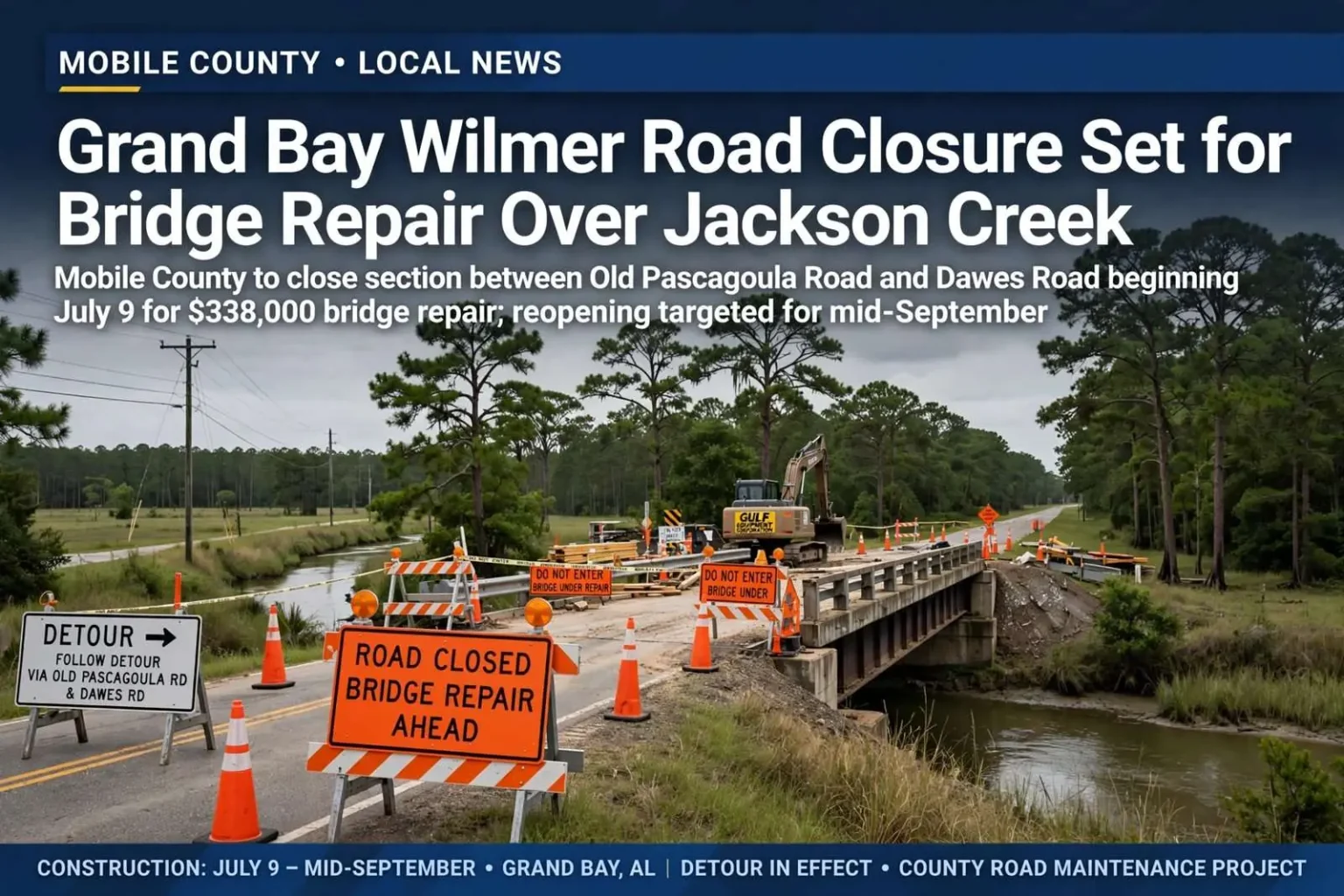
Drivers in the Grand Bay area should prepare for a lengthy detour later this month as Mobile County moves ahead with plans to close a stretch of Grand Bay Wilmer Road South for bridge work. The closure will affect the section of roadway between Old Pascagoula Road and Dawes Road while crews lengthen and repair the bridge crossing Jackson Creek.
County officials say construction is expected to begin around July 9, with detour signage going up two days ahead of the project’s start to give commuters advance notice of the closure. The advance signage is intended to help drivers plan alternate routes before the work actually begins and traffic is rerouted. Residents who travel the corridor daily will have a short window to test alternate paths before the closure takes full effect.
The bridge upgrade carries an estimated price tag of $338,000, according to county officials. Gulf Equipment Corporation has been awarded the contract to carry out the repair and lengthening work on the span. Officials say the project is expected to wrap up by mid-September, giving the area roughly two months of construction before the road returns to its normal configuration.
The timeline suggests the county is aiming to complete the work well ahead of the fall school year settling in and before conditions that could complicate outdoor construction work during the hottest part of summer subside. A mid-September finish keeps the disruption inside a single summer, avoiding the complications that come with running a road closure through a school year.
A key link in southwest Mobile County
Grand Bay Wilmer Road South serves as a key route for residents in the unincorporated Grand Bay community in southwest Mobile County, connecting neighborhoods to Old Pascagoula Road and other nearby corridors. The community sits along the corridor between Mobile and the Mississippi state line, an area where county — not city — government maintains the roads, bridges and drainage that residents depend on every day.
Bridge and culvert work on rural roads like this one is a routine but necessary part of maintaining the county’s aging infrastructure, particularly along waterways like Jackson Creek that see periodic flooding and wear on crossing structures. Creek crossings built decades ago were sized for the traffic and storm events of their era, and lengthening a span improves both the structure’s capacity and the water flow beneath it, reducing the chance that debris and high water damage the road during heavy rain.
Mobile County covers one of the largest land areas of any county in Alabama, and its road network outside the incorporated cities includes hundreds of bridges and culverts that the county engineering department inspects and maintains. Projects like this one are selected based on condition assessments, flood history and traffic patterns, then scheduled as funding allows. The $338,000 cost is typical of the scale of rural bridge repair work, which ranges from modest culvert replacements to full span reconstructions.
The closed section lies between two of the area’s main east-west connectors, which means drivers will have practical alternates. Old Pascagoula Road and Dawes Road both bracket the work zone, and through traffic can route around the closure using the surrounding grid of county roads. Local drivers know, however, that those alternates add distance — and that unpaved and lightly paved connectors through the area can be slow going, especially during summer afternoon storms.
What the work involves
Lengthening a bridge over a creek is more than a cosmetic repair. Crews typically extend the structure to widen the channel beneath it, giving floodwater more room to pass and reducing scour — the erosion around bridge supports that is a leading cause of rural bridge failures. Repair work on the existing span addresses wear on the deck, railings and approaches that accumulates over years of traffic and weather exposure.
For a project of this size, work generally proceeds in stages: site preparation and traffic control first, then the structural work on the span, then approach paving and final striping before the road reopens. Weather is the biggest variable in a summer schedule along the Gulf Coast, where afternoon thunderstorms can idle earthwork for days at a time. The county’s mid-September target builds in room for those delays, but residents should treat the reopening date as an estimate rather than a guarantee.
The detour signage going up two days before the closure is part of the county’s standard practice for planned road work. Signs at key intersections flag the closure ahead of time so commuters can adjust their routes before the first morning they are forced to. Emergency services are also notified of planned closures so that fire, EMS and sheriff’s units serving the Grand Bay area can adjust response routes during the construction window.
Living with the closure
Residents who rely on this stretch of road for their daily commute or for accessing nearby businesses and schools are encouraged to plan for alternate routes once the detour signage goes up and construction gets underway. The affected segment connects neighborhoods to shopping, schools and churches along the surrounding corridors, and the two-month duration means families should build the extra drive time into their routines until the work is complete.
Businesses along the detour routes often see an increase in pass-through traffic during closures like this one, while those on the closed section can experience a drop-off in customers who simply avoid the area. County officials encourage drivers to remember that the closure is of the bridge segment only — the community around it remains open, and local destinations stay reachable via the marked detours.
County officials have not indicated whether additional phases of work will follow on nearby crossings, but the project fits a pattern of steady investment in the county’s rural bridges. Structures that carry school buses, farm equipment and commuter traffic across the small creeks of south Mobile County are periodically evaluated, and work like the Jackson Creek span repair is how the county keeps those crossings safe without waiting for failures to force emergency closures.
For updates as the project progresses, residents can watch for posted notices along the route and follow Mobile County’s public announcements about road work in the Grand Bay area. The surest guide during construction will be the signage in the field: when the detour signs come down and the barricades clear the roadway, the bridge over Jackson Creek will be back in service, lengthened and repaired for the decades of traffic still to come.
Why rural bridges get the spotlight
Across Alabama, thousands of bridges carry local traffic on county and municipal roads, and a significant share of them are older than the traffic loads they now handle. State and federal inspection programs grade each structure on condition, and when a crossing shows its age, counties face a choice between closing it, posting weight limits, or investing in repair. Mobile County has generally chosen repair where feasible, because a closed rural bridge can double or triple a resident’s drive to work, school or the grocery store.
Jackson Creek is one of many small waterways that thread through the flat coastal terrain of south Mobile County, draining toward the Gulf. Creeks like it can rise quickly after heavy rain, and their banks shift over time, which is why spans and culverts along them need periodic attention. Lengthening a bridge widens the opening and keeps floodwater from pushing against the roadway embankment — a failure mode that has washed out rural roads across the Gulf Coast in past storm seasons.
The work also has a safety dimension beyond the structure itself. Bridge approaches on older rural roads can narrow sharply, and extending a span often allows for safer geometry where the road meets the bridge. Motorists crossing the repaired bridge should find smoother approaches and modern guardrails when the road reopens, improvements that matter for the school buses and farm vehicles that share these roads with commuter traffic.
The bigger maintenance picture
Grand Bay sits in one of the fastest-developing edges of Mobile County, where growth spreading south from the city brings more traffic to roads that were rural byways a generation ago. Increasing counts on formerly quiet routes accelerate wear on bridges and culverts designed for lighter use, and the county’s maintenance schedule has to keep pace. Each repair project like this one is a piece of a longer program of keeping the unincorporated county’s network serviceable.
County government funds this work through a mix of local revenue and state-shared road funds, and larger projects can draw federal bridge money through programs administered with the Alabama Department of Transportation. Whatever the funding source, the practical sequence is the same: inspection, design, bidding, award to a contractor such as Gulf Equipment Corporation, and then construction — with the public’s patience as the unavoidable cost.
For the next two months, the detour around the Jackson Creek bridge will be part of daily life in Grand Bay. Drivers should expect the signage first, then the closure around July 9, and should plan their mornings accordingly. The county’s target of a mid-September reopening means the inconvenience is real but bounded — a summer of slower drives in exchange for a crossing that will carry the community’s traffic safely for years.