Retired Police Lieutenant Opens Republican Challenge for District 3 County Commission Seat
John E. Graham, a retired Mobile police lieutenant who has run a west Mobile fitness and martial arts gym for two decades, said he would seek the Republican nomination for the District 3 seat on the Mobile County Commission.
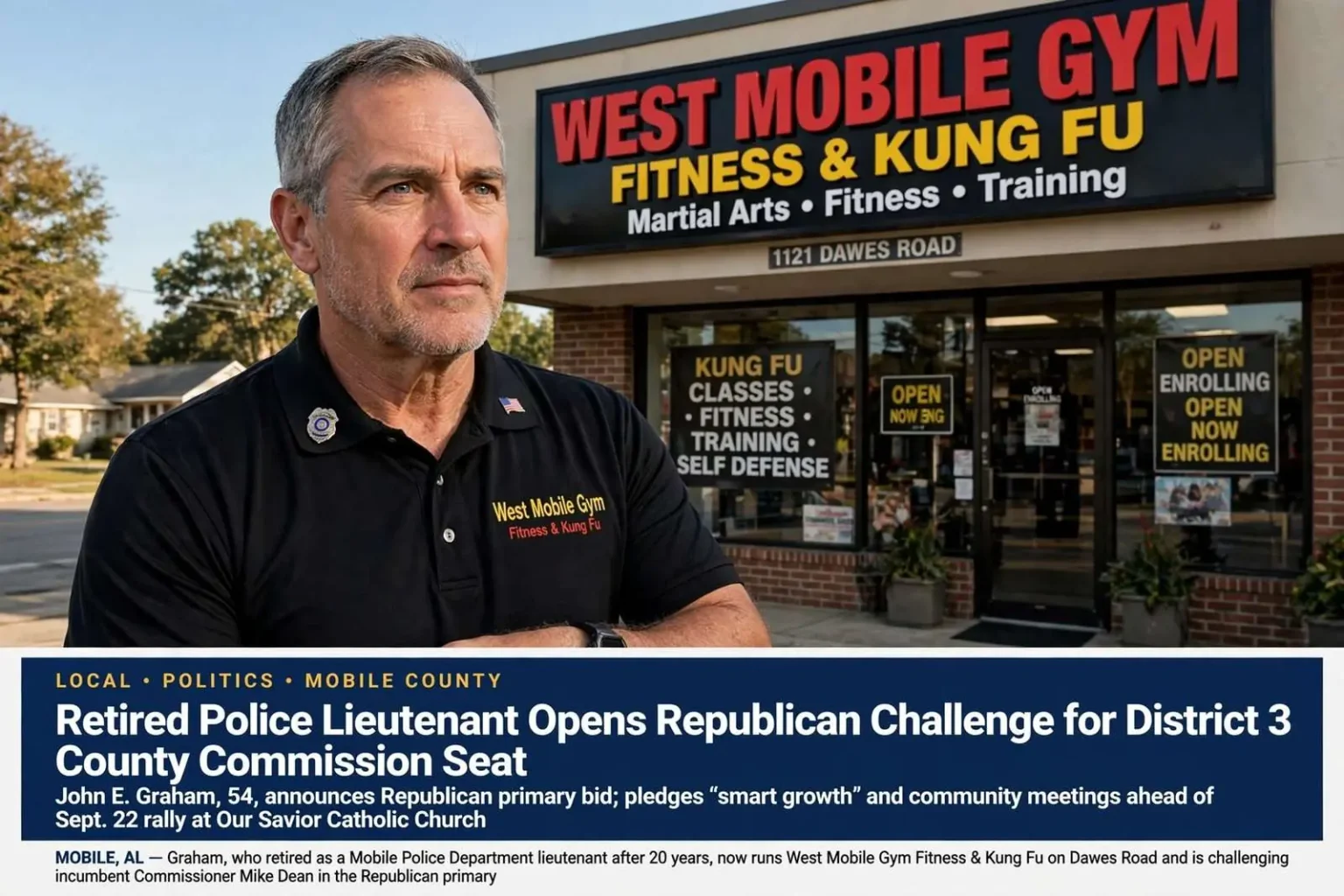
A retired Mobile police lieutenant who has spent the past two decades running a fitness and martial arts gym on Dawes Road announced plans to seek the Republican nomination for the District 3 seat on the Mobile County Commission, setting up a primary challenge to an incumbent from his own party. John E. Graham, 54, owner of West Mobile Gym Fitness & Kung Fu at 1121 Dawes Road, said he would open his campaign with a kickoff rally from 6:30 to 8:30 p.m. Saturday, Sept. 22, at Our Savior Catholic Church, 1801 Cody Road S.
The seat he is pursuing covers south and west Mobile County and is held by Commissioner Mike Dean, also a Republican. The district is one of the county’s fastest-changing — a stretch that runs from the sprawling subdivisions of west Mobile out to the bayfront communities and working waterfronts of the south, where growth pressures and hurricane recovery exist side by side.
A Campaign Built on Credentials
Graham, who retired from the Mobile Police Department at the rank of lieutenant, said his pitch to voters would rest on experience and education rather than criticism of the incumbent. “I want to bring energy, experience and education to the county commission,” Graham said. “I would be the first county commissioner with a masters degree in public administration. I have the experience because I retired as a police lieutenant. I want to use that experience and education to ensure that taxpayers’ money is spent in a fashion that they want.”
The framing is deliberate: rather than positioning himself as an anti-establishment challenger, Graham is presenting his résumé — a career in a major municipal police department followed by two decades as a small business owner — as the qualification itself. His argument is that the commission’s work is fundamentally about administration and public money, and that a background in managing people, budgets and public safety translates directly. A police career, he suggested, teaches exactly the skills a county commission uses daily: reading a budget, supervising personnel, dealing with emergencies, and answering to the public when something goes wrong. Running a gym on Dawes Road for two decades adds the other half of the pitch — he is a West Mobile businessman whose customers and employees are the same growth-corridor residents the commission’s road and infrastructure decisions affect every morning.
He was explicit about the tone he intended to set. “I’m going to run a positive campaign on my qualifications and my history,” he said. “I’m not gonna run around and talk bad about Dean.” In a primary where both candidates belong to the same party and many voters know both men, avoiding a slash-and-burn contest was presented as both a strategy and a statement about how he would conduct himself in office.
Graham spent seven years in the U.S. Marine Corps and holds an undergraduate degree in criminal justice along with a master’s in public administration. He ran unsuccessfully for Mobile County sheriff in 2002, an earlier bid that gave him a first look at countywide campaigning and the contacts that come with it.
Growth, Roads and a Call for ‘Smart Growth’
The candidate framed west Mobile’s rapid expansion as the district’s central challenge. In the mid-2000s, the corridor along Schillinger, Cody and Dawes roads was among the fastest-developing parts of the county, with subdivisions and retail outpacing the two-lane roads that served them. Homes arrived faster than the infrastructure to serve them, and the morning and evening commutes along those corridors became a daily illustration of growth outrunning planning.
“We need to pursue ‘smart growth’ in west Mobile,” Graham said. “We need to fix the roads we have in west Mobile before building new roads. We have potholes and roads that need fixing. We have youth programs that need to be developed. We need to look at our infrastructure and plan for growth. We do not have a strategic plan for rapid, strong growth in south Mobile County and I can bring that to the table.”
Graham argued that the county had never asked residents what kind of development they wanted. “When you look at west Mobile, it could be the fastest growing part of the whole state,” he said. “Yet do you see any community meetings on what the citizens want as far as what type of growth, what type of industry?” The complaint gets at a familiar tension in fast-growing suburban counties: development decisions made parcel by parcel through zoning boards and rezoning votes, without a broader public conversation about the shape of the community being assembled.
He said he had met with Bayou La Batre Mayor Stanley Wright, who he said felt “left out of the loop,” and he described similar frustration in Grand Bay and on Dauphin Island, communities still working through recovery and insurance disputes two years after Hurricane Katrina. The south end of the district has a different set of problems from the subdivisions of west Mobile: Bayou La Batre’s seafood industry rebuilding after the storm, Grand Bay’s long-running questions about drainage and services, and Dauphin Island’s struggle to keep a barrier-island town insured, protected and affordable.
By centering those communities in his announcement, Graham signaled that his campaign would not be a west-Mobile-only effort. District 3 stretches across a varied geography — from suburban growth corridors to coastal towns whose economies run on shrimp boats and tourism — and county commissioners there have to balance competing definitions of what “growth” means. For Bayou La Batre, that means rebuilding a working waterfront and a seafood processing economy that Katrina damaged; for Grand Bay, it means pressing for roads, drainage and services that match the area’s population growth; for Dauphin Island, it means navigating the insurance and beach-nourishment disputes that follow any barrier island town. A commissioner who treats the district as one undifferentiated growth story, Graham’s argument implied, misses all three.
If elected, Graham said, he would hold regular community meetings in Grand Bay, Bayou La Batre, Dauphin Island and along Dauphin Island Parkway. His broader complaint was that county government had become invisible to the people it served. “I can ask 10 people down here who their county commissioner is and two will know,” Graham said. “I want them to say my commissioner is John Graham and he’s my advocate for what I want done in this part of the county.”
That promise of regular meetings is a direct answer to the isolation he described in the small communities at the district’s southern end. Mobile County’s commission districts are large — the county spans from the Mississippi line to the Gulf — and residents in towns like Grand Bay or Bayou La Batre can be an hour’s drive from the commission’s downtown chambers, making in-person advocacy a real burden. Regular meetings in those communities would, in effect, bring the commission to them.
The Incumbent’s Response
Dean did not immediately return a call seeking comment, but his spokesman, Jon Gray, said the commissioner welcomed the campaign as a chance to discuss the district’s record. “Commissioner Dean looks forward to the upcoming election as an opportunity to talk with the voters about the hurricane recovery efforts still going strong in south Mobile County, and the thousands of new jobs, new roads and the positive real estate and economic outlook for Mobile County as a result of the commission’s work over the last few years,” Gray said.
The statement set the likely shape of the contest: Graham running on engagement and planning for the district’s growth pressures, Dean running on recovery projects and economic results. Both men will be speaking to the same voters — many of whom have watched the district’s population swell while its road network and public services strain to keep pace.
A Rally With Comedy and College Football
Graham said Saturday’s kickoff would feature comedian Killer Beaz, whom he described as “a dear friend” performing “a cleaned up set,” along with a jazz ensemble and catering by Alec Naman. A.J. Krause and Joe Rodriguez were also scheduled to speak, and televisions would carry the Alabama-Georgia football game. The mix — church hall, comedy, live music, catered food and a big Saturday game on the screen — is a recognizably Gulf Coast kind of political event, built to feel more like a community gathering than a rally.
Graham and his wife, the former Yvette Grimm, live in the Dawes Lake community and have four children. The Republican primary was set for the following June, with the general election to follow in November. Between the kickoff and the primary, the contest will play out in the fast-growing neighborhoods of west Mobile and the coastal communities at the district’s southern end, where the questions Graham raised — who decides what kind of growth the district gets, and who shows up to hear what residents want — will be the ones voters weigh against the incumbent’s record.