Oakleigh Reception to Raise Funds for Sam Jones Mayoral Bid
A $500-per-couple reception at the Oakleigh Garden District home of former Ambassador Gary Cooper was scheduled to benefit Mobile County Commissioner Sam Jones' campaign for mayor of Mobile.
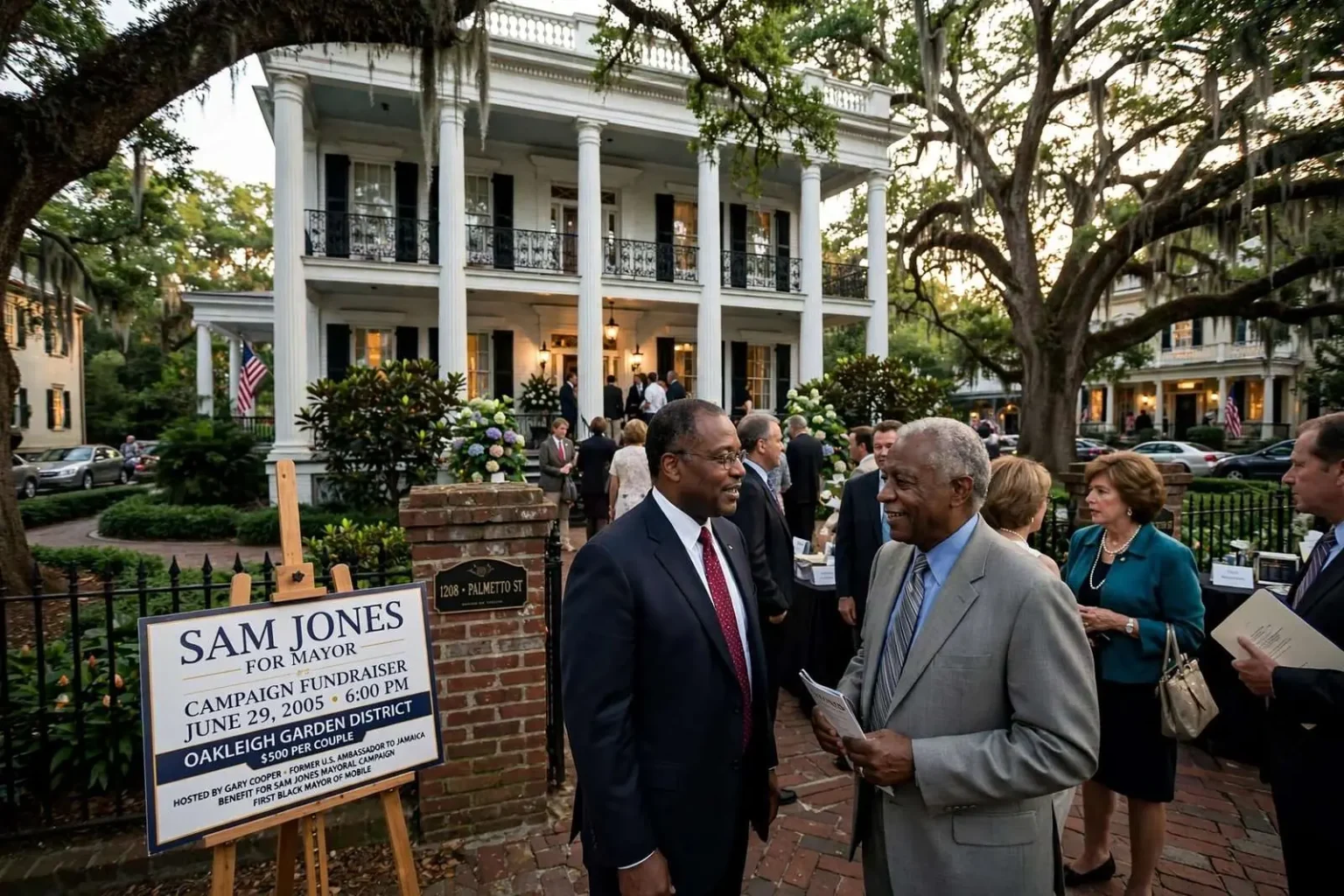
A cross-section of Mobile’s business, legal and civic establishment prepared to gather in the Oakleigh Garden District to raise money for Mobile County Commissioner Sam Jones, whose campaign sought to make him the first Black mayor in the city’s three-hundred-year history.
The reception, billed at $500 per couple, was scheduled for Wednesday, June 29, at 1208 Palmetto St., the home of Mr. and Mrs. Gary Cooper. The two-hour event was set to begin at 6 p.m.
In a municipal race that would decide the successor to a term-limited mayor, the summer fundraiser circuit was where candidacies were tested. A reception in one of the city’s most prestigious neighborhoods, hosted by a former ambassador, was intended to make a statement about exactly how far Jones’ candidacy reached beyond the constituencies that had supported him in county government.
The 2005 race came at a hinge point in Mobile politics. The city’s Black population made up roughly two-fifths of the city, and Black candidates had won countywide and district offices for years — but the mayor’s office, the single most powerful job in city government, had remained out of reach. Every element of the summer campaign was being read through that history.
An establishment host
The choice of host said as much about the state of the race as the guest list did. Gary Cooper, of Commonwealth National Bank in Mobile, had served as United States ambassador to Jamaica in the administration of President Jimmy Carter.
Commonwealth National was among the oldest Black-owned banks in the region, and the Cooper family had long occupied a place at the intersection of Mobile business and public service.
Organizers framed the evening in warm terms, describing it as an opportunity to “thank (Jones) for all his years of hard work for Mobile and to celebrate his candidacy with friends and neighbors.”
The venue itself carried weight. The Oakleigh Garden District takes its name from the Oakleigh mansion, the antebellum house that serves as one of the city’s signature historic properties, and its streets — Government, Government-place, Ann, and the garden streets around them — have long been where Mobile’s old-line civic leadership lived and entertained. A campaign event on Palmetto Street was, by local standards, a signal of arrival.
Commonwealth National Bank, founded in the early 1970s, stood as a monument to Black enterprise in a city where access to credit had once defined racial boundaries. Cooper’s biography — banker, diplomat, civic leader — made him one of the few figures whose presence could vouch for a candidate across every line in the city.
A long host committee
The list of hosts ran to several dozen names and stretched across the professional and civic life of the city — attorneys, physicians, developers, bankers and longtime political figures among them. Among those listed as hosting the reception were Lynda Burkett; Mr. and Mrs. Steve Davies; Larry Hallett; Mr. and Mrs. Keith Jones; Mr. and Mrs. Council Powell; Mr. and Mrs. Henry Seawell III; Mr. and Mrs. Clarence Ball; Mr. and Mrs. Larry Wettermark; Mr. and Mrs. Thomas M. Galloway Jr.; Dr. and Mrs. Thomas Kessler; Donald J. Stewart; Richard Sullivan; Mr. and Mrs. Riley Boykin Smith; Mr. and Mrs. Caesar F. Rivers; Richard Davis; Dr. Jewell R. Felder; Henry W. Flowers; Mr. and Mrs. Terry Harbin; Marshall McLeod; Mr. and Mrs. Jerry Thompson; Mr. and Mrs. Don Langham; Mr. and Mrs. Cooper C. Thurber; Mr. and Mrs. Thomas O. Galliard III; Mr. and Mrs. Andrew J. Rutens; Phil Tyus; Dr. Herb Stone; Mr. and Mrs. Tony Moore; Donald Ponquinette; Mr. and Mrs. Sidney King; Cecily Kaffer; Dr. and Mrs. James O. Gordon; and John C.H. Miller Jr.
Host committees of that length are, in local politics, a form of public argument. Each name is a signal to a network of friends, clients and colleagues; taken together, a list that broad was meant to demonstrate that a candidate who began his career in community action agencies and county government had assembled support well beyond any single constituency.
The committee also mapped the city’s interracial establishment politics at a moment when the race itself was testing them. Lawyers and bankers whose names appear on the letterheads of the city’s civic institutions were lending a candidacy their social standing, which in a Mayoral contest often matters as much as money.
Several of the hosts had themselves run for office or served in appointive posts; others sat on the boards of the museums, hospitals and universities that anchor the city’s civic infrastructure. Their backing of Jones signaled a judgment about electability as much as ideology.
And the money was real. A $500-per-couple ticket placed the event among the higher-priced solicitations of the Mobile municipal season, aimed at contributors for whom the evening was as much a commitment as a gesture.
The candidate
Jones had served on the Mobile County Commission since 1987 — eighteen years by the summer of the campaign — making him one of the most experienced elected officials in the county. Before that he had led Mobile Community Action, a public service agency, after nine years of service in the U.S. Navy.
His career traced the arc of Black political leadership in modern Mobile: military service, community-action administration, then county office, where his commission district took in much of the city’s core and where he built a record on infrastructure, parks and neighborhood investment that his mayoral campaign would spend the summer talking about.
County government had also given him a working relationship with the city’s delegation and its legislative leaders — useful currency for a mayor, in a state where municipal wishes often must pass through Montgomery to become real.
His opponents in the Aug. 23 municipal election were City Councilman John Peavy, former state Sen. Ann Bedsole and former City Councilwoman Bess Rich. All four were competing to succeed Mayor Mike Dow, who had declined to seek a fifth term.
Mobile’s city elections are nonpartisan, though Jones had held county office as a Democrat while his three rivals had all sought office as Republicans.
The shape of the field gave the race its texture. Peavy, a longtime councilman with deep ties in the city’s Black neighborhoods, and Jones, the county commissioner, would draw on overlapping but distinct bases; Bedsole, a pioneer in Alabama Republican politics and a former legislator and councilwoman, and Rich, known for her scrutiny of city spending, anchored the field’s conservative end. With no incumbent running, the campaign was a wide-open contest among four well-known names in a city of roughly 200,000.
Each of the four entered with a distinct coalition. Jones and Peavy were expected to compete for the city’s Black wards, with Peavy’s council record against Jones’ county experience; Bedsole and Rich would compete for the city’s white, Republican-leaning precincts while reaching for crossover voters. The mathematics of the first round — and of a likely runoff — shaped every fundraising decision of the summer.
Dow’s departure after four terms marked the end of a long era of downtown renewal — the convention center, the ballpark, the waterfront investments that changed the face of the central city — and every candidate in the field promised a different relationship between City Hall and the neighborhoods.
That record was popular downtown and contested elsewhere: critics argued the renewal had been concentrated in the core while outlying neighborhoods waited, and the mayoral field’s differences were sharpest on that question — who had benefited from two decades of investment, and who should benefit next.
The money race
Fundraising was shaping up as one of the defining features of the contest. A four-way race for a citywide office required television, radio and direct mail across the whole of Mobile, and each of the leading campaigns would ultimately report raising and spending sums in the hundreds of thousands of dollars — figures that were, at the time, extraordinary for a municipal race in Alabama.
The June reception was part of that arithmetic. Summer fundraising feeds the August advertising push, and in a nonpartisan race with no runoff-free guarantee, campaigns had to plan for both the first round and a possible second — Mobile’s system sends the top two finishers to a runoff when no candidate wins a majority.
That possibility made coalitions — and the goodwill built at events like the Oakleigh reception — more than decorative. In a four-way field, a candidate who could not win outright needed second-place support to survive the runoff, and every host and attendee in June was a potential ambassador come October.
The campaign told those unable to attend the Oakleigh reception that contributions could be mailed to the Sam Jones Campaign, P.O. Box 40621, Mobile, AL 36640. Further information was available at (251) 433-6016.
Oakleigh
The setting carried its own weight. The Oakleigh Garden District, just west of downtown, is among Mobile’s oldest and most recognizable neighborhoods, its antebellum and Victorian houses shaded by live oaks.
A campaign reception held on Palmetto Street placed Jones’ candidacy squarely inside the city’s historic core — a piece of political staging that no one involved was likely to have overlooked.
Three centuries into Mobile’s history, the question of who would lead the city had never been answered by a Black candidate. Jones’ campaign — and an evening in one of the most storied neighborhoods in the city, hosted by an ambassador and a list of the city’s civic establishment — was an argument that the answer could come that August, and that the coalition required to produce it already existed, one name on a host list at a time.