Clarke County Judge Asks Mobile Court to Void $1.2 Million Judgment Against Him
Clarke County Circuit Judge Stuart DuBose asked a Mobile court to vacate an order holding him personally liable for $1.2 million in an estate dispute, arguing the order would force him to act illegally.
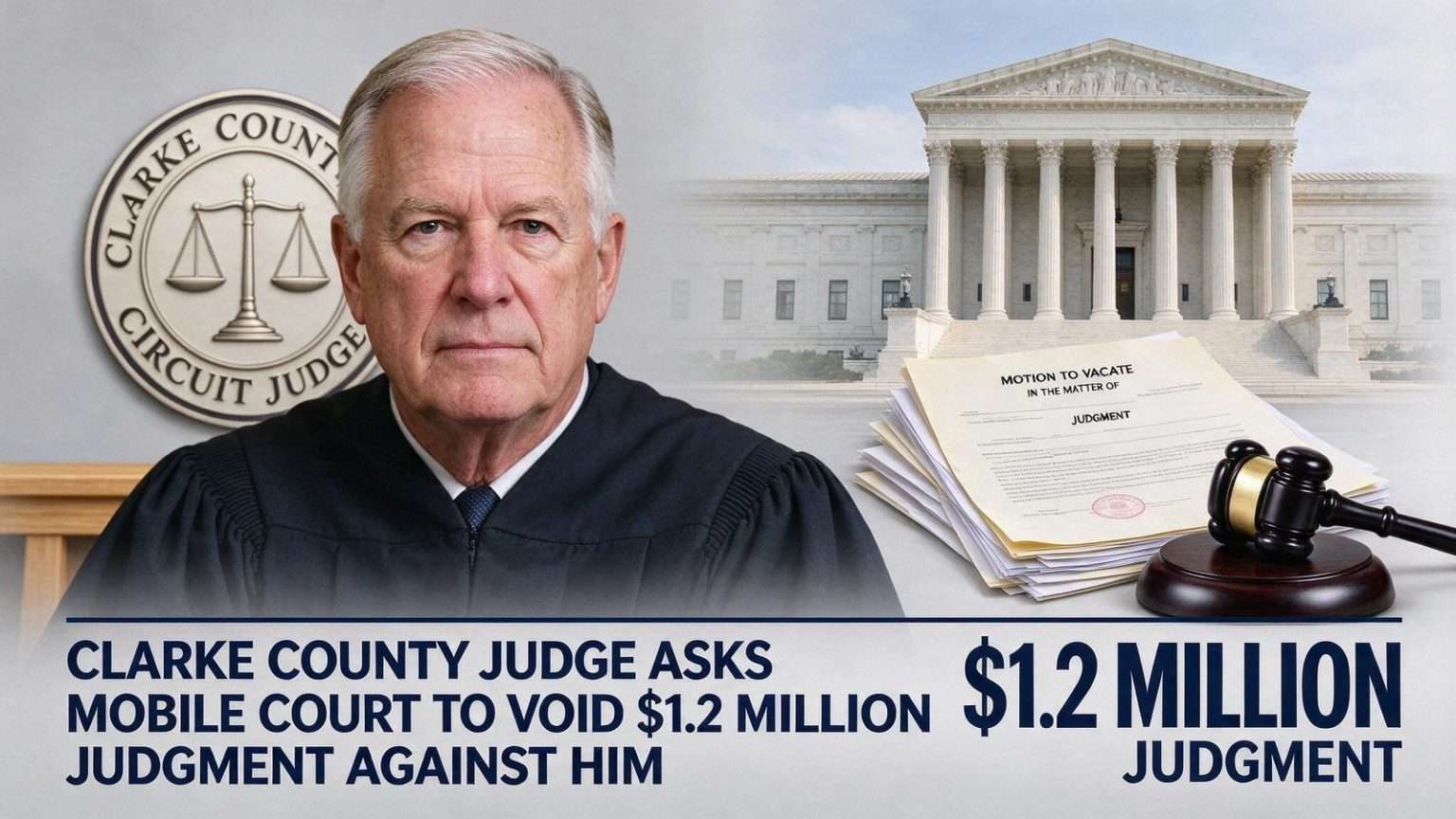
A south Alabama circuit judge asked a Mobile court to vacate a ruling that held him personally liable for $1.2 million in a long-running estate dispute, arguing that the order was legally improper and would require him to take part in a fraud on any future buyer of the land in question. Clarke County Circuit Judge Stuart DuBose contended that Mobile County Circuit Judge John Lockett erred in finding him individually responsible for the judgment, because every claim in the case had been brought against the estate and never against DuBose himself.
Complying with the order, DuBose’s motion said, would compel him to “commit an illegal act and become involved in the perpetration of a fraud” on any subsequent purchaser of land or timber still held by the estate. “Judge DuBose respectfully declines to do so,” wrote his attorney, Jim Rossler.
How the dispute began
The case grew out of DuBose’s work as a private attorney in Jackson before he took the bench. Cheryl Weaver, the longtime friend and caretaker of an ailing, elderly Joseph J. Sullivan, approached DuBose about drafting a will. He wrote it without ever meeting Sullivan to discuss it.
Weaver took the document to Sullivan, who signed it and died a short time later. Weaver later agreed that DuBose would receive a percentage fee based on the value of the estate — roughly $2.5 million — if the will were contested.
Sullivan’s relatives did object, and their claims were settled out of court. DuBose and Weaver, by then co-executors, subsequently fell out with each other.
The case was moved from Washington County to Mobile County. Shortly before trial the previous October, it was settled confidentially, but not before Lockett determined that a $1.2 million legal fee — about 40 percent of the estate’s value — was “reasonable and necessary” and allowed DuBose to remain as executor.
The IRS complication
Distribution of the assets stalled when the Internal Revenue Service disallowed a deduction the estate had taken for attorney’s fees. Without a corresponding payment matching the deduction, the agency balked.
“The Estate is presently engaged in battle with the IRS in Tax Court over what even Weaver’s expert tax consultant has characterized as a legitimate dispute,” DuBose’s motion stated. All parties agreed, the filing said, that if the deduction were allowed there would be no additional estate tax; if it were denied, there would be “a very substantial estate tax bill” — potentially large enough, tax attorneys involved warned, to consume the estate itself.
DuBose argued that the entire matter would have been resolved two years earlier had Weaver’s side allowed him to make a payment to the IRS. “The IRS has previously agreed to accept the sum of $7,000 as final payment on all tax liabilities,” the motion said.
“Judge DuBose requested permission to make this payment, but that permission was denied and never given.”
Lockett’s order
In August, Lockett ordered a judgment against the Sullivan estate and “Stuart DuBose, individually, jointly and severally” for $1.19 million, imposed liens on property that was to go to Weaver — including roughly 240 acres surrounding her home, 309 acres in two sections and a 56-acre parcel known as the Pringle property — and gave DuBose 30 days to convey the land free of any IRS encumbrance. “The court will not recite the troubled history that gets us to this point,” Lockett wrote.
“Suffice it to say that on Oct. 2, 2006, on the date this matter was set for trial, the parties announced they had reached a settlement of their disputes and read into the record a settlement agreement. Now, 10 months later, the matter is not resolved.” DuBose’s filing argued that Lockett misread the settlement, which said DuBose was responsible “to” the IRS, not “for” it — a distinction his lawyer said meant only that he would handle the administrative work, not personally pay estate taxes. The motion also argued that Lockett no longer had jurisdiction and that the matter belonged back in probate court.
Weaver was represented by Pete Burns of Burns, Cunningham and Mackey in Mobile and Topie Cassady of Cassady & Cassady, with offices in Fairhope and Evergreen.
A judgeship under a cloud
DuBose won the Democratic nomination for the First Judicial Circuit — Clarke, Choctaw and Washington counties — in a bitter race, defeating fellow Jackson attorney Chris Bailey by fewer than 100 votes out of about 19,000 cast.
With no Republican on the November ballot, the only obstacle to the judgeship was an anonymous bar complaint over his handling of the Sullivan estate. That appeared resolved when the Alabama State Bar accepted a “conditional guilty plea” suspending his law license for 45 days beginning the day after the general election — a timeline that preserved his eligibility on Election Day and at his swearing-in.
But the Alabama Supreme Court, which reviews all bar discipline, rejected the arrangement, with eight of nine justices finding the penalty too lenient. The matter remained pending before the bar’s disciplinary committee, said Tony McLain, general counsel for the state bar, raising unsettled questions about whether the bar may discipline a sitting judge for conduct as a private attorney.
DuBose, meanwhile, had taken the oath of office in January and was hearing cases.
In Alabama, complaints about the conduct of sitting judges generally go to the Judicial Inquiry Commission. The commission can bring formal charges before the Court of the Judiciary, which has the power to discipline or remove judges. The State Bar handles discipline of practicing lawyers.