County Commission Hopefuls Line Up Against Onshore LNG Terminal in South Mobile County
A 2004 survey of Mobile County Commission candidates found nearly unanimous opposition to a proposed onshore liquefied natural gas terminal at Hollingers Island in south Mobile County.
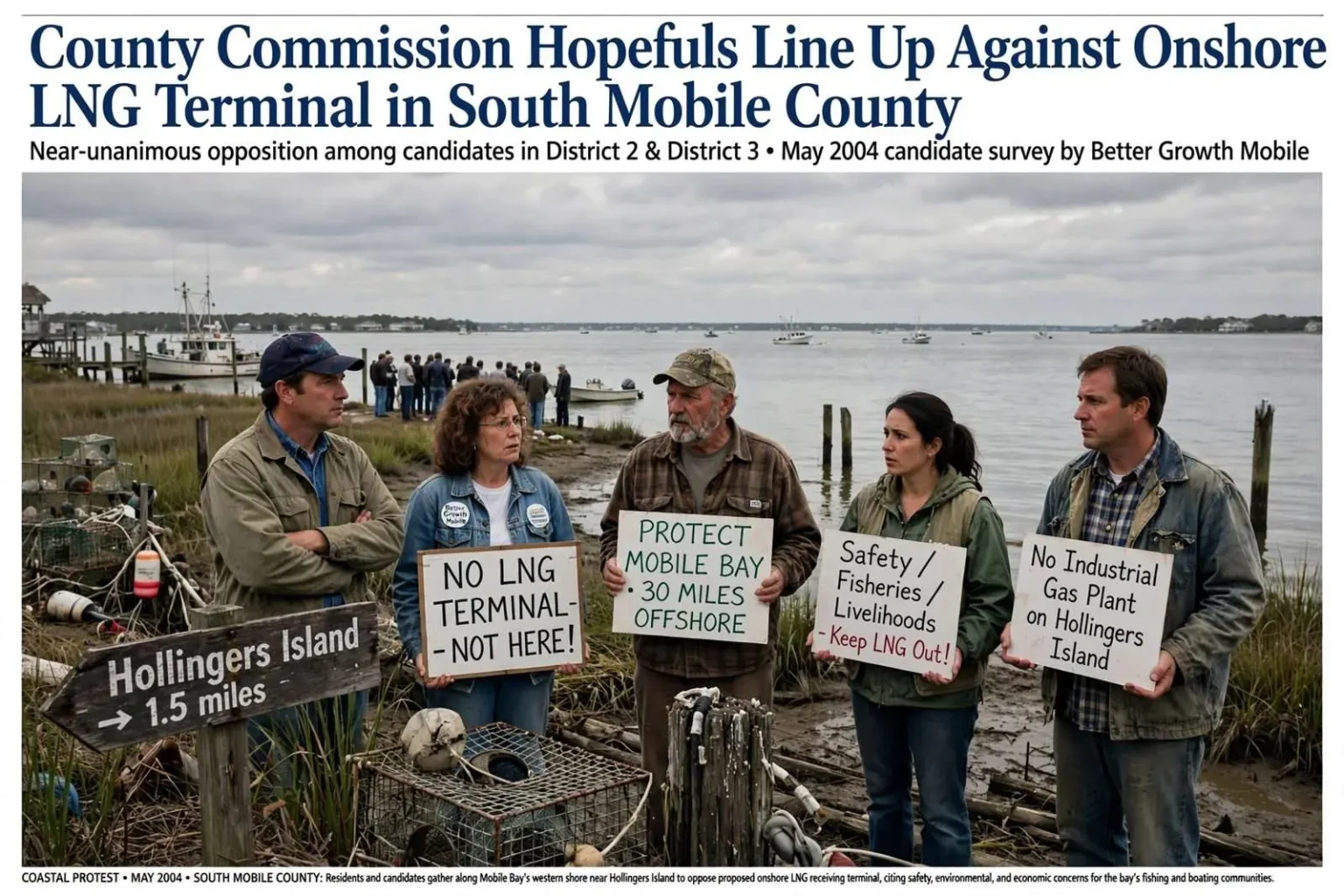
Opposition to an onshore liquefied natural gas terminal in south Mobile County ran nearly unanimous among the candidates seeking seats on the Mobile County Commission, according to a candidate survey released in mid-May 2004 by the grassroots group Better Growth Mobile. Five candidates told the organization flatly and without qualification that they opposed the proposed plant at Hollingers Island. The survey gave voters a clear map of where the field stood on the issue that had animated civic meetings from Theodore to Fairhope for months.
At the time, two energy companies — ExxonMobil and Cheniere Energy — had each floated plans for onshore LNG receiving terminals in Mobile County, and the prospect of a cryogenic gas facility sitting on the western shore of Mobile Bay had become one of the defining local issues of the 2004 campaign season. LNG is natural gas that has been chilled to roughly 260 degrees below zero so it condenses into a liquid that can be shipped across oceans in specialized tankers; a receiving terminal regasifies the cargo and pipes it into the domestic network. The siting questions that came with such a facility — zone sizes, evacuation planning, tanker traffic in a working bay — put energy policy directly into county politics.
Mobile Bay is a shallow, heavily used estuary that sustains one of the region’s most important seafood economies, a port district that ranks among the busiest on the Gulf Coast, and a recreational boating culture that spans both counties. Hollingers Island sits at the southern end of the bay’s western shore, and opponents argued that an industrial gas complex there would sit too close to neighborhoods, marinas and the shipping channel for comfort. The debate drew in Baldwin County as well, because a terminal on the western shore would put bulk tanker traffic across water that Daphne, Fairhope and Point Clear residents use daily.
What the candidates said
In District 2, Mobile City Councilman Stephen Nodine, then seeking the Republican nomination, and Milton Morrow, the lone Democrat in the race, both said they opposed an onshore terminal outright. Asked whether they would use the power of the office to block such a plant, each answered yes. Their answers left no daylight between them on the central question, even as the two men competed for the same seat in a district that includes much of west Mobile and stretches toward the bay’s western shore.
Austin Rainwaters, the third Republican in the District 2 field, left himself the narrowest of openings while landing in essentially the same place. Safety questions had to be settled before any facility went into Mobile Bay, he wrote, and he did not expect them to be resolved to his satisfaction. He raised the effect a terminal would have on other users of the bay, and he noted that while he did not believe terrorism was a present risk, security adjustments would be difficult to make after a plant was already built.
“Much more study needs to be done,” he wrote, “but I don’t expect anything can be done to change my mind from the position I have now.”
Rainwaters, Nodine and Morrow each said they would prefer an offshore facility if the safety questions could be answered adequately. The preference for an offshore site became a recurring theme across both commission districts, reflecting the coalition’s argument that the Gulf already offered locations far from population centers where import infrastructure could operate without sitting over a residential shoreline.
In District 3, incumbent Commissioner Mike Dean and his two challengers, Mike Burdine and Howard Waters, all opposed an onshore terminal, citing safety and environmental concerns. Each said he would prefer an offshore site after appropriate study. District 3 spans south Mobile County — the part of the county that would have lived most directly with a Hollingers Island plant — and the unanimity there reflected the issue’s local weight in Theodore, Bayou La Batre and the communities around it.
James George, the Republican preparing to challenge Commissioner Sam Jones for the District 3 seat in November, echoed his rivals in opposing an onshore terminal while reserving judgment on an offshore one. George offered one idea no other candidate raised: if an onshore LNG proposal ever gained traction while he held office, he would push for a public referendum on the question, and he would ask that Baldwin County residents be allowed to vote in it as well — an acknowledgment that a terminal in Mobile Bay would be a two-county matter. The suggestion treated the bay as a shared asset whose future should not be decided by one side of the water alone.
The candidates who did not answer
Commissioner Sam Jones, the Democratic incumbent, and District 2 Republican contender Ralph Buffkin did not respond to the survey, an organizer with the group said. Their silence left the ticket’s Democratic standard-bearer and one GOP challenger without a documented position on the issue as absentee voting approached.
Commissioner Freeman Jockisch, the Republican incumbent from District 2, did respond, saying he would defer to the District 3 commissioner and to constituents, supporting or opposing the project according to their wishes. If the commissioner and the residents appeared to be at odds, Jockisch said, he would side with the residents. The answer was the most conditional in the survey — a pledge to follow rather than to lead — and it turned out to be overtaken by events almost immediately.
Jockisch was convicted in federal court that same week in connection with the fraudulent handling of his campaign money. He suspended his re-election campaign and asked to be removed from the ballot — a request complicated by the fact that some absentee ballots bearing his name had already gone out. The timing collided with the June 1 primary in the worst possible way, forcing election officials to improvise rules for ballots that were already in voters’ hands.
Election officials moved to honor the request and sought an attorney general’s opinion on how to handle the outstanding absentee ballots. Voters who had received a ballot with Jockisch’s name on it, local election officials said, might be sent an amended ballot mirroring the one that would appear at the polls on June 1. The episode became a small case study in how Alabama election law handles a candidate’s mid-flight withdrawal, and it meant many District 2 voters cast their LNG views in a race that had changed shape under them.
The group behind the survey
Better Growth Mobile, Inc. described itself as a grassroots coalition of more than 800 residents and businesses from Mobile and Baldwin counties, organized around a single primary mission: to drive any proposed liquefied natural gas terminal out of Mobile Bay and at least 30 miles offshore. The 30-mile standard was deliberately blunt — far enough that a facility and its tanker traffic would be out of the bay and the eyes of shoreline communities, close enough to the coast to remain connected to the regional gas network.
The coalition’s framing — that the fight was not over whether the Gulf Coast should import natural gas, but over where the receiving terminal should sit — proved to be the frame the candidates adopted almost to a man. Nearly every respondent said the same thing in slightly different words: not here, not on the shoreline, and not without far more study than had been done. That consensus made LNG one of the rare issues in the 2004 cycle on which candidates from both parties in both contested districts converged.
The political geography mattered. Hollingers Island and south Mobile County are working water communities where seafood processing, shipbuilding and charter fishing share the shoreline with residential growth pushing down from Theodore, and residents there had watched industrial siting decisions reshape the coast before. The survey captured a constituency that wanted economic development, but not on its waterfront.
How the story ended
For readers looking back, the survey captures a moment when a national energy build-out collided with local politics on the Alabama coast. The early 2000s were an era of anticipated gas shortages, when planners assumed the United States would need to import increasing volumes of LNG from producers in the Caribbean, West Africa and the Middle East, and more than a dozen receiving terminals were proposed around the Gulf and Atlantic coasts.
Onshore LNG never took root at Hollingers Island. The company proposals for Mobile County eventually faded, and no cryogenic import plant was ever built on the bay’s western shore. Offshore gasification projects in the Gulf drew their own scrutiny in the years that followed, as regulators and fishermen weighed floating regasification buoys that would have chilled and discharged water into areas used by commercial and recreational fleets, and several of those projects were shelved amid opposition and low gas prices.
The domestic shale boom later upended the economics that had made import terminals attractive in the first place. Hydraulic fracturing in Texas, Louisiana, Pennsylvania and beyond produced so much cheap domestic gas that the country swung from expecting imports to planning exports — a reversal so complete that Cheniere Energy, the company that once floated an onshore receiving terminal for Mobile County, went on to build the nation’s first large-scale LNG export complex at Sabine Pass on the Louisiana-Texas line. The 2004 survey stands as a snapshot of the moment before that reversal, when Mobile County’s officeholders-in-waiting were asked where, if anywhere, the world’s gas ships should dock, and answered: not here.