Mobile Lawyers Weigh In: Bar Association Poll Picks Favorites in Judicial Races
A May 2004 Mobile Bar Association poll of members produced landslide preferences in several judicial contests, including a lopsided vote for Mobile attorney Robert H. Smith for the Alabama Supreme Court.
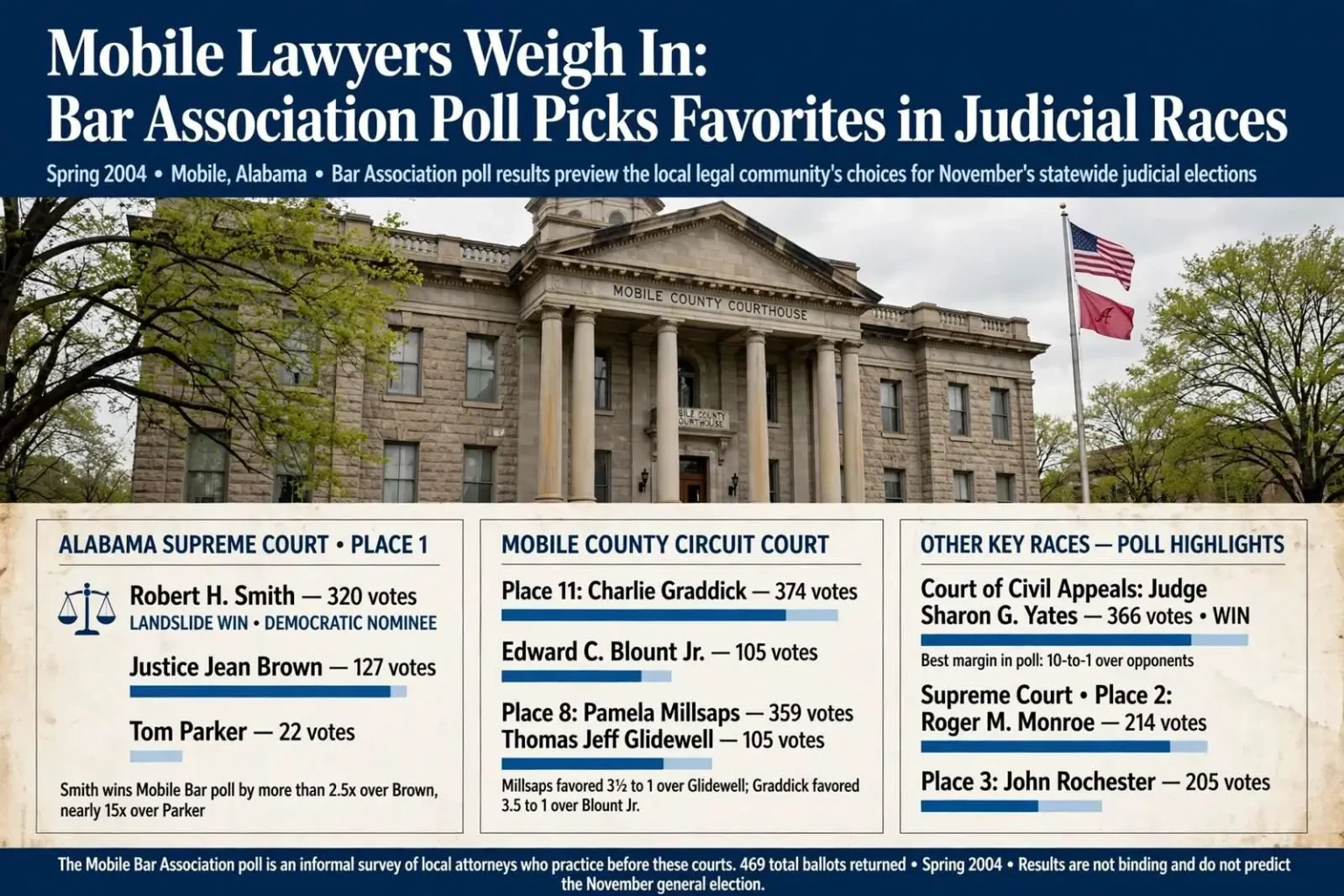
Mobile’s legal community delivered its verdict in the spring of 2004, and in at least one race it was not close. Mobile attorney Robert H. Smith was a landslide winner in the Mobile Bar Association’s “best qualified to serve” poll for Place 1 on the Alabama Supreme Court, drawing 320 votes from local members. Whether that hometown support would translate into statewide backing was a question for November.
Smith, the Democratic nominee, was set to face either incumbent Justice Jean Brown or her Republican challenger, Tom Parker. In the bar poll, Brown drew 127 votes and Parker 22. The margin — more than two and a half times Brown’s total and nearly fifteen times Parker’s — made Smith the clear favorite of the lawyers who practiced before the appellate courts and followed their work most closely.
For a Mobile lawyer, the result carried a particular weight. Smith was one of the bar’s own, an attorney whose reputation had been built in the same courthouses where the poll’s respondents practiced. Judges and justices are, in a practical sense, the most consequential colleagues a litigator has: their temperament, preparation and command of the record shape outcomes in ways that no campaign advertisement can capture. A poll of people who have stood before a candidate’s bench, or filed briefs in that candidate’s court, measures something different from name recognition.
The Place 1 contest was one of several statewide judicial seats on the 2004 ballot. The Alabama Supreme Court sits in Montgomery and consists of nine justices elected in partisan races, meaning that a Democratic nominee in that era started every campaign against the structural reality of an electorate that had trended steadily Republican in statewide contests for more than a decade. Smith’s strength inside the Mobile Bar Association told him how his profession rated him; it told him little about how voters from Huntsville to Brewton would mark their ballots in November.
That gap — between the judgment of the bar and the judgment of the general electorate — is the permanent tension of every bar preference poll in Alabama. Lawyers vote on familiarity and professional experience. The public votes largely on party label, name identification and, in the expensive judicial campaigns Alabama had become known for, television advertising. The spring poll was the first unofficial tally of the season, not the last word.
In the contests closest to home, the attorneys who practice before these judges every day made their preferences plain. The Mobile County Circuit Court handles the heaviest docket in South Alabama, and its judges touch the daily working lives of nearly every lawyer in the poll — civil trials, criminal cases, family matters and the sprawling juvenile docket. Familiarity here runs deep, and the margins reflected it.
Circuit Court, Place 11: Republican Charlie Graddick was favored over Democratic hopeful Edward C. Blount Jr., 374 to 105. Graddick was already a familiar name in Mobile legal and political circles, with a career in public office and prosecution that predated the race, and the poll’s respondents gave him better than a three-to-one edge over his Democratic opponent. In a race for a bench both candidates sought for the first time in this configuration, the lawyers’ preference leaned decisively toward the better-known name.
Circuit Court, Place 8: Incumbent Republican Judge Pamela Millsaps outpolled her Democratic opponent, Thomas Jeff Glidewell, 359 to 105. Millsaps had recently been tapped by Gov. Bob Riley to take on the judgeship overseeing juvenile court, a vacancy created by the retirement of longtime juvenile court Judge John Butler, who had presided at Strickland Youth Center for more than two decades. Riley’s appointment had put Millsaps on the bench only weeks before the poll, yet the bar’s response suggested that local attorneys were prepared to give the new incumbent the benefit of their confidence.
The seat Millsaps inherited was one of the more distinctive assignments on the Mobile County bench. Strickland Youth Center, the county’s juvenile detention and court facility, is where delinquency cases, dependency matters and child-welfare proceedings are heard, and the judge who presides there handles children and families at the most difficult moments of their lives. Butler’s tenure of more than twenty years had given the docket an unusual continuity, and his retirement closed an era in Mobile’s juvenile justice system.
Whoever won in November would take over a docket with high stakes and little glory: truancy, foster care placements, youthful offenders and the questions of rehabilitation and public safety that come with them. The bar poll’s lopsided totals in both circuit races — three and a half to one in each — showed that the local legal community had sorted these contests early and with little hesitation.
In the Alabama Supreme Court Place 2 election, the Mobile bar supported incumbent Justice Roger M. Monroe with 214 votes, ahead of Baldwin County’s Pam Baschab (125) and Patti M. Smith (98). Monroe’s edge was real but hardly commanding — a plurality rather than a majority — and the results suggested that even an incumbent’s standing inside a hometown bar could be contested. Baschab, a Baldwin County judge, drew respectable support across the bay, where her local base gave her a natural constituency among Mobile-area lawyers.
The Place 3 race — the most crowded and hotly contested of the group — drew a scattered field. Mobile’s lawyers backed Democratic contender John Rochester, a longtime Clay County circuit jurist, with 205 votes. Behind him came Peggy Givhan of Montgomery (72), Birmingham Probate Judge Michael F. Bolin (62), Jerry E. Stokes (19) and Denny Holloway (10).
Rochester was seeking the seat opened by the retirement of Justice Douglas Johnstone of Mobile, who at the time was the high court’s lone Democrat — a fact that gave the race unusual weight for the local bar and made Johnstone’s departure a milestone in the long realignment of Alabama’s appellate judiciary. For a generation, Johnstone had been the Mobile area’s voice on the Supreme Court and the last Democrat holding a seat on a bench that had otherwise shifted decisively to the Republicans through the 1990s. Five candidates competing to replace him meant that the bar’s preferences fractured across the field, and Rochester’s 205 votes represented a strong showing in a race where no candidate could unite the profession behind a single choice.
The widest margin of preference recorded anywhere in the poll belonged to Judge Sharon G. Yates, whose 366 votes dwarfed the totals of her two competitors, Tommy Bryan (32) and Win Johnson (20). Yates, who served on the state Court of Civil Appeals and was the incumbent in the Mobile area’s appellate orbit, drew more raw support than any other candidate named on the poll — more, in fact, than Robert H. Smith drew in his landslide. Her margin of better than ten to one was the most one-sided result the survey produced, evidence of how strongly the local bar coalesced around an incumbent it knew well.
Taken together, the appellate results sketched a clear pattern. Where the Mobile bar knew the candidate — as an incumbent with a local record, or as one of the city’s own — the votes piled up. Where the field was crowded or the candidates were strangers from elsewhere in the state, the tally scattered. Bar polls reward familiarity, and in 2004 familiarity ran through Mobile’s own courthouse corridors.
Bar association preference polls have long occupied an unusual place in Alabama judicial politics. They are not binding, they do not appear on any ballot, and they measure the opinion of a self-selected slice of the electorate — the lawyers who appear in these courtrooms and who arguably know the candidates’ work best. Participation is voluntary, the results carry no legal force, and no candidate is obliged to acknowledge them.
Supporters of such polls argue that in judicial races, where campaign advertising is thin and name recognition often decides outcomes, the considered judgment of practicing attorneys is one of the few substantive signals available to voters. Judicial candidates are bound by rules of conduct that limit what they can say about issues likely to come before them, which makes their campaigns among the least informative in American politics. A poll of the lawyers who have actually appeared before a judge, or negotiated with a prosecutor, or watched a candidate manage a courtroom, offers the closest thing to a performance review the system allows.
Critics counter that lawyers have professional interests of their own and that a bar poll can look like an insiders’ endorsement dressed up as expertise. Attorneys may favor judges who rule their way, run efficient dockets, or come from their own social and professional circles. The self-selection of respondents — only members who choose to return the ballot are counted — adds a further layer of uncertainty about how representative the results really are.
Either way, the results carried real information in 2004. The margins were wide enough — Yates by more than ten to one, Graddick by better than three to one, Smith by roughly two and a half to one over a sitting justice — that they were hard to dismiss as narrow preference. When hundreds of lawyers who deal with a candidate’s work every week converge on one name, the judgment says something about how the profession views the field, whatever its limitations as a predictor of the general election.
Looking back
The 2004 cycle came at a moment when Alabama’s appellate courts were completing a transformation. Judicial elections in the state had grown into some of the most expensive in the country, funded heavily by business and trial-lawyer interests, and the partisan composition of the Supreme Court had shifted decisively. Races for seats on the court had attracted national attention for their campaign spending, and the contests of 2004 were expected to continue the pattern of hard-fought, well-funded campaigns.
The retirement of Mobile’s Justice Johnstone removed the last Democrat from that bench. Whatever happened in November, the court that would be seated in Montgomery in 2005 would look very different from the one that had begun the decade, and the Place 3 field — five candidates drawn from Clay County, Montgomery, Birmingham and beyond — showed how widely the opportunity was being chased.
For readers of local politics, the poll offered a snapshot of how Mobile’s bar saw the field before a single vote was cast at the polls — and a reminder that in judicial contests, the people who know the candidates best often vote first, and unofficially.