Attorney General Declares Freeman Jockisch’s Commission Seat Vacant After Fraud Conviction
An opinion from the Alabama Attorney General held that Mobile County Commissioner Freeman Jockisch vacated his seat upon his federal fraud conviction, leaving the governor to fill the vacancy.
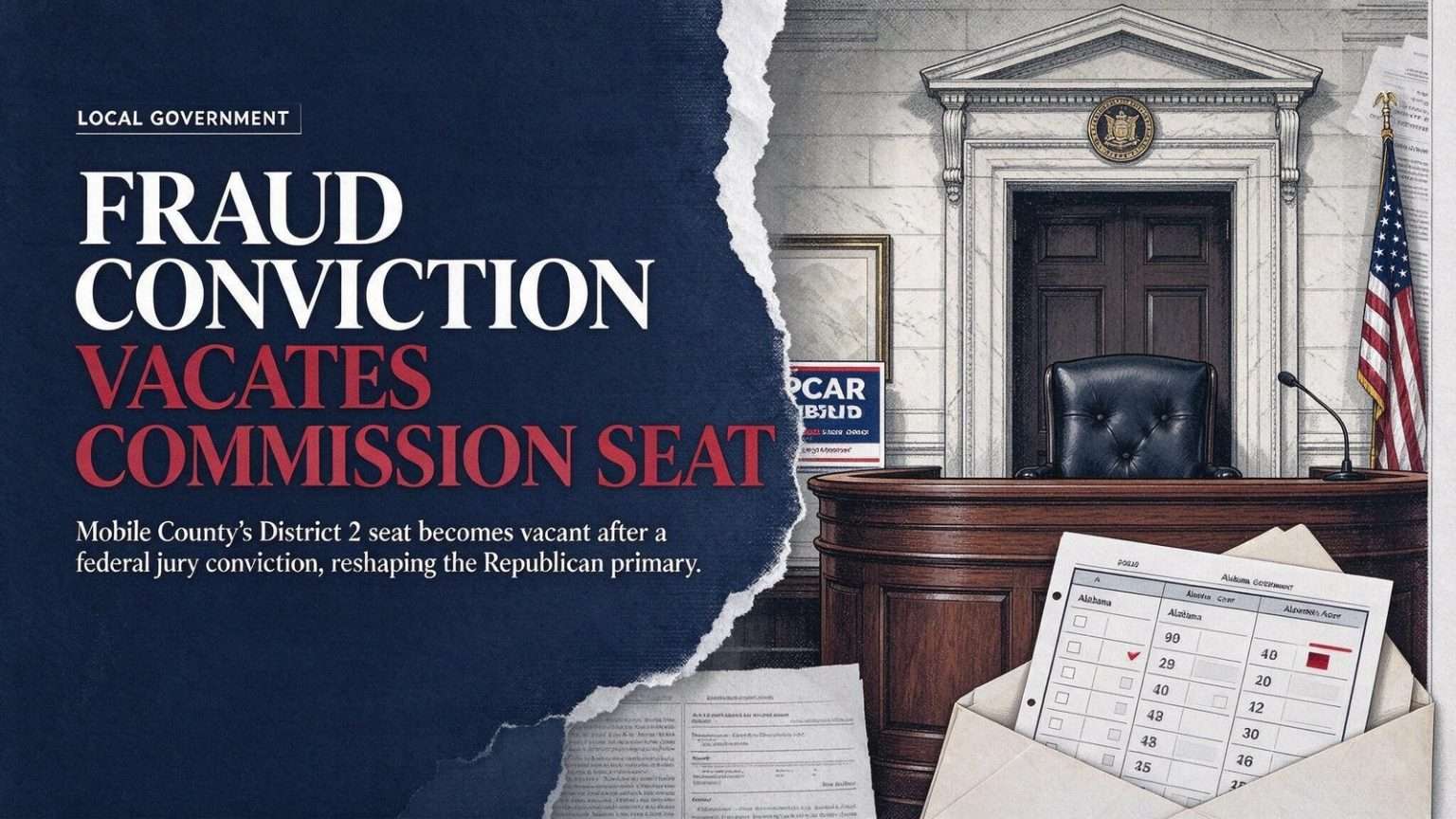
Mobile County Commissioner Freeman Jockisch no longer holds his office, according to a letter from the Alabama Attorney General to the governor, a development that reversed an earlier opinion and left a vacancy on the commission weeks before the Republican primary. The ruling stripped a three-term incumbent of his seat not by the verdict of voters but by that of a federal jury, and it forced the county’s governing body to plan for a future that did not include the man its constituents had twice re-elected.
The office of Attorney General Troy King advised Gov. Bob Riley that Jockisch — the three-term Republican incumbent convicted in federal court of fraud tied to his campaign finances — vacated his seat upon his conviction. An earlier view had held that the commissioner would remain in office until sentencing, leaving him in place to vote on county business while awaiting a judge’s determination of his punishment. The Attorney General’s letter closed off that interpretation, establishing that the conviction itself, not the sentence that followed it, was the moment the office emptied.
For the commission, the timing could hardly have been more disruptive. The five-member Mobile County Commission administers county government for more than 400,000 residents, controlling a road and bridge program, zoning in unincorporated areas, and a budget that runs into the hundreds of millions of dollars. District 2’s seat represents a swath of the county stretching toward its southern and western reaches, and its absence — even temporarily — removed one voice from a body whose members are used to negotiating road projects, drainage complaints and industrial incentives district by district.
Conviction and its consequences
A federal jury found Jockisch guilty on 15 counts of mail fraud and four tax counts. The charges grew out of his campaign finances, an area of election law that prosecutors in the Southern District of Alabama had grown increasingly willing to police with the full weight of federal fraud statutes. Mail fraud, the workhorse charge of federal prosecutors, carries potentially long sentences when stacked count upon count, and juries in the district had shown little patience for officials who treated campaign money as personal property.
Sentencing was set for August before U.S. District Judge Randy Butler, and the former commissioner faced the possibility of nearly three years in prison. Under the federal sentencing guidelines, the number of counts mattered less than the calculated loss amounts and the enhancement that applies to offenses involving public office, but prosecutors’ calculations put the likely range near the three-year mark — a fall that would take a man who had spent decades in county politics from the commission chamber to a federal facility.
The attorney general’s letter, dated May 12, was copied to Jockisch, Probate Judge Don Davis, fellow Commissioners Sam Jones and Mike Dean, and the county Republican chairman. It advised the governor that he now had the authority to fill the vacancy. The distribution list ensured that every official with a role in the transition — the judge who administers elections, the commissioners who would work with a successor, and the party chairman whose organization would sort out the primary — had the ruling in hand and in writing.
Upon his conviction, Jockisch suspended his re-election bid. In a letter to the probate judge, he asked that his name be stricken from the June 1 primary ballot, and the court indicated it would comply. The request spared the county party the awkwardness of a convicted felon nominally heading its ticket in a countywide race, but it came late enough in the election calendar that the mechanics of printing and mailing had already outrun it.
Because absentee ballots had reportedly already been mailed, however, his name was expected to appear on some of them. Absentee voting in Alabama runs on a schedule fixed by state law, and ballots printed and dispatched before a candidate’s withdrawal cannot be recalled. Voters who had requested ballots in the weeks before the primary would receive a sheet listing a man who, by the time they marked it, no longer held the office he was seeking — one of the small, unfixable ironies of election administration that probate judges across the state know well.
The withdrawal reshaped a primary that had already been contested on unusual terms. Jockisch had qualified for re-election before the criminal case resolved, betting that voters would weigh his record against the charges, and the county’s Republican electorate had been left to sort out its feelings about an incumbent under federal indictment. His departure mid-campaign transferred the contest entirely to the challengers who had spent months raising money and building organizations on the assumption that the incumbent might yet survive.
A crowded field left behind
Jockisch had faced three Republican challengers — Ralph Buffkin, Stephen Nodine and Austin Rainwaters — for the District 2 seat. Buffkin and Nodine brought the deepest political resumes of the three, both having served in county government and both carrying relationships with the state’s Republican establishment. Rainwaters rounded out a field that gave primary voters a genuine range of backgrounds in a race that, without the incumbent, became an open seat in everything but the fine print of the ballot.
Milton Morrow was the sole Democrat to qualify for the November general election, guaranteeing that a party which had once dominated Mobile County politics would field a candidate but face steep odds in a district drawn and settled in the Republican era. Morrow’s unopposed path through the primary meant that while Republicans fought their own contest, the Democratic side of the ballot was decided before the first vote was cast.
Both Buffkin and Nodine had been allies of the governor, who held the appointment power over the seat. That convergence of relationships gave the appointment an added layer of consequence: whoever Riley selected would step into an office with the power of incumbency, the commission’s platform, and the implied endorsement of a popular governor, entering the fall campaign as something very like a front-runner despite never having run in the June primary.
The Republican Party of Mobile County said it was “very pleased that Mr. Jockisch is ceasing to campaign,” praising the “respect and pride he has shown the Republican party and for the other primary candidates by ceasing his campaign.” The statement, issued as the conviction’s implications sank in, reflected the party’s effort to close the chapter cleanly: thanking a man whose troubles had become a liability while redirecting attention to the contest that remained. Local party organizations walk a fine line in such moments, honoring a long-serving member of their own while making clear that the campaign, and the county, moves on without him.
For the county’s voters, the episode raised questions larger than one commissioner’s fate. Campaign finance fraud prosecutions are rare enough in Alabama county politics that each one becomes a reference point, cited in the next decade’s debates about ethics laws, disclosure requirements and the enforcement of campaign rules. The Jockisch case would be remembered alongside the state’s periodic corruption scandals as evidence that federal prosecutors stood ready to reach down to the courthouse level, and that a county commissioner’s campaign account was not beyond a grand jury’s interest.
The legal debate over when a convicted official’s seat empties was not unique to Mobile County, and the Attorney General’s opinion added to a body of interpretations that counties consult whenever an officeholder is convicted mid-term. Alabama law is unforgiving toward officials convicted of certain offenses, but the practical questions — when the seat is deemed vacant, who administers the oath to a successor, and what happens to votes cast for the ousted candidate before his withdrawal — rarely have obvious answers, and each case tends to set the expectation for the next.
What comes next for the commission
In the near term, the commission’s business continued with four members, a configuration that mobile county government had experienced before and could function under, though not without adjusting its committee routines and its informal habits of district-by-district negotiation. The governor’s appointment would restore the full complement, and the appointee would inherit a district’s worth of constituent files, road requests and appointments to regional boards within days of taking the oath.
The longer-term consequence fell to the voters. A June primary now centered on three candidates, a November general election in which the appointee or a primary winner would face the lone Democrat, and a district whose representation had been thrown into motion by events entirely outside the ordinary campaign calendar. County commissioner races rarely draw intense attention; this one, by conviction and cancellation, had become the most closely watched local contest on Mobile County’s ballot.
Jockisch’s departure also marked a generational turn in county politics. He had served through the period when Mobile County’s government professionalized its road program, expanded its industrial recruiting and absorbed the growth of its western suburbs, and his seniority made him a fixture of commission deliberations. The county’s Republican Party, now firmly in control of its courthouse, would replace that experience with one of the men who had challenged him — a reminder that in Alabama’s counties, the fastest way offices change hands is not always an election, and that the federal courthouse in Mobile can remake a ballot as thoroughly as any primary.