Ono Island Man Avoids Prison in Orange Beach Road Rage Shooting Case
A Baldwin County judge handed down a suspended sentence and probation to a man convicted in a 2012 road rage shooting near Orange Beach.
A Baldwin County judge has spared a retired state conservation officer from prison time following his conviction earlier this year in a road rage shooting near Orange Beach. Steven Pinson, 56, of Ono Island was found guilty in April of second-degree assault for shooting another driver during a confrontation that began on the Perdido Pass Bridge in August 2012.
Circuit Judge Jody Bishop sentenced Pinson this week to a 10-year suspended sentence along with three years of supervised probation. As part of the sentence, Pinson must complete 250 hours of community service, pay a $1,000 fine and contribute $200 toward the state’s crime victim compensation fund. A separate restitution amount, to compensate the man he shot, will be determined later.
The sentence closed a case that had lingered for more than two years after the August 2012 confrontation, and it split the difference between what prosecutors wanted and what the defense sought. Prosecutors had pushed for a harsher outcome, with the assistant district attorney handling the case asking the court to impose five years of incarceration.
Why the judge stayed a prison term
According to the prosecutor, the judge explained that he didn’t believe sending Pinson to prison would serve any real purpose, citing letters submitted on Pinson’s behalf and testimony from character witnesses presented at trial. The judge indicated he didn’t expect to see Pinson back in court for any future violations — a prediction that matters, because the terms of a suspended sentence put Pinson’s freedom on a conditional footing for years to come.
A suspended sentence works by imposing a prison term and then withholding its execution as long as the defendant complies with probation conditions. If Pinson violates the terms of his three years of supervised probation — by committing a new offense, failing to complete the community service hours, or missing payments and reporting requirements — the state can move to revoke the suspension, and the 10-year term could then be ordered served. It is a structure that leaves the courtroom door open behind a defendant while keeping him under court supervision in the meantime.
The man who was shot, identified as a 46-year-old McCalla resident, had hoped for a prison sentence and was disappointed by the outcome, the prosecutor said, though he ultimately accepted the judge’s ruling. Victims in assault cases frequently experience sentencing decisions differently than the courts do, weighing the harm they suffered against what they see as proportionate punishment — and in this case the victim’s view, as relayed by the prosecutor, was that the shooting deserved incarceration.
How the confrontation unfolded
According to police accounts presented during the case, the confrontation began when the victim was driving below the speed limit on the bridge, prompting an exchange of rude gestures between the two men. At one point, Pinson pulled in front of the other driver’s vehicle and hit the brakes — the kind of brake-checking maneuver that transforms a passing irritation into a genuine traffic hazard.
The situation escalated after both men stopped near the intersection of Alabama 182 and Alabama 161, where the victim got out of his car and approached Pinson’s truck. Following a heated exchange of words, Pinson shot the man in the chest with a hollow-point round fired from a .380-caliber pistol. The wound was serious enough to constitute second-degree assault under Alabama law, which covers intentionally causing serious physical injury to another person.
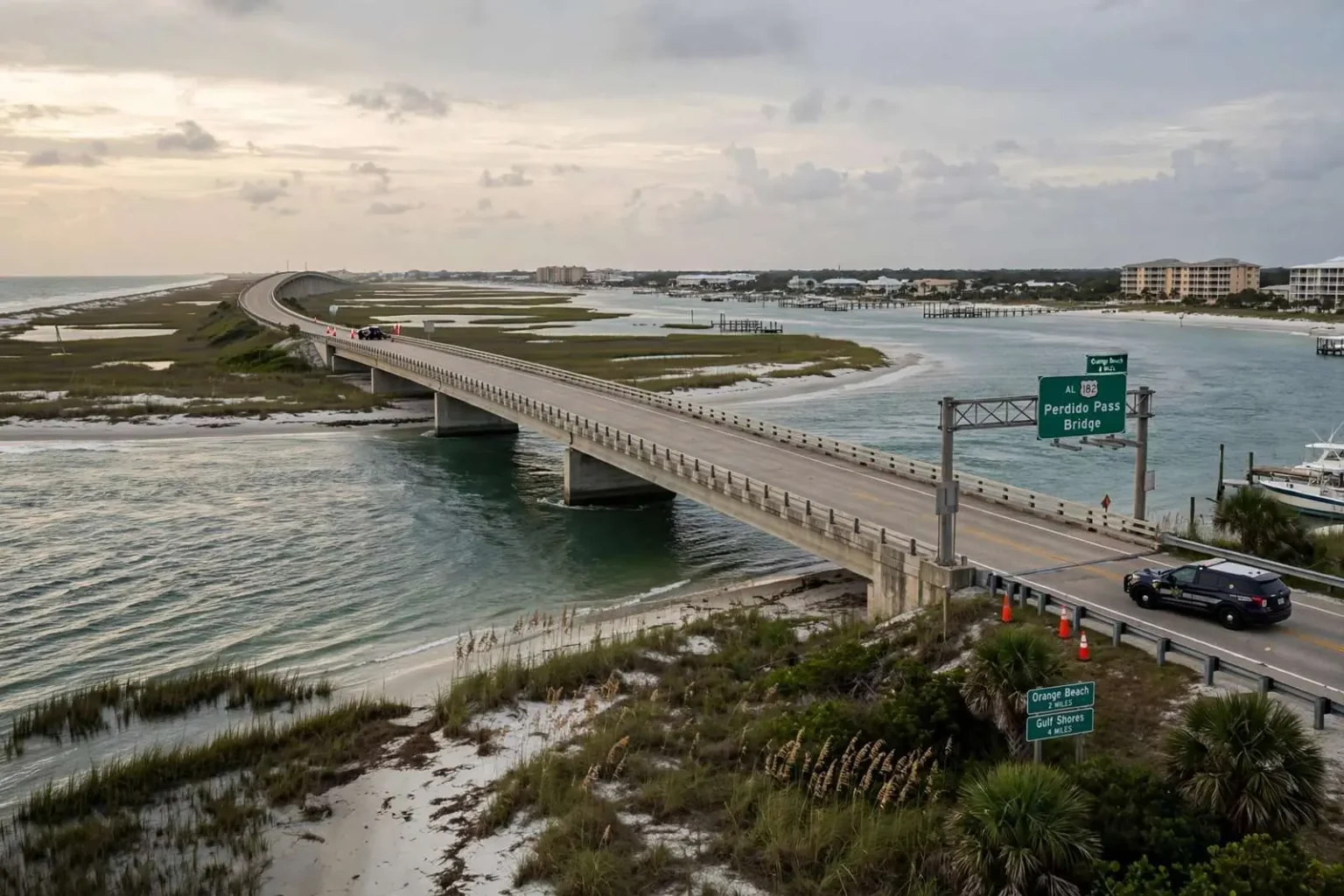
The location matters to anyone who knows Orange Beach. The Perdido Pass Bridge carries Alabama 182 over the pass that connects the Gulf of Mexico to Wolf Bay, and it is the principal link between the beachside development on the barrier peninsula and the residential enclaves along the water — including Ono Island, the gated community where Pinson lives, reachable by boat or by way of the pass’s connecting roads. Alabama 182 is the beach highway itself, and Alabama 161 is the north-south artery through Orange Beach, so the intersection where the two men stopped sits at the heart of some of the busiest summer traffic on the Alabama coast.
Second-degree assault and what it carries
Under Alabama law, second-degree assault is a Class C felony, punishable by up to 10 years in prison — which is why the 10-year suspended sentence represents the outer edge of the statutory range even as its execution was withheld. Prosecutors consider several factors in these cases: the seriousness of the injury, whether a weapon was used, and the circumstances that led to the encounter. Here, the use of a firearm — and a hollow-point round, designed to expand on impact — weighed heavily in the state’s request for prison time.
The counterweights were the defendant’s age, his record as a retired state conservation officer, and the volume of community support that came forward after his conviction. Character letters and witness testimony are common features of Alabama sentencing hearings, and while they rarely spare a defendant from conviction, they often influence whether the sentence is suspended. Judge Bishop’s reasoning, as the prosecutor recounted it, went precisely to that point: that imprisonment would serve no real purpose given the person Pinson had shown himself to be over a lifetime, whatever happened on the afternoon of the shooting.
Restitution remains to be determined. Alabama courts routinely order convicted defendants to compensate victims for medical expenses and related losses, and the separate restitution hearing will set the amount Pinson owes the man he shot — a figure that could substantially exceed the fines and fees fixed at sentencing, depending on the cost of treating a chest wound.
Road rage and the law
The case is a stark illustration of how quickly traffic disputes can turn criminal. What began with a slow driver on a bridge and some gestures ended with a man shot through the chest, and the legal system spent more than two years sorting out responsibility. Alabama law treats the intentional infliction of serious injury as a felony regardless of provocation, and the man who exits his car to confront another driver — as the victim did here — takes a real risk of escalation that safety campaigns have long warned against.
Safety guidance from law enforcement agencies is consistent on road rage: do not brake-check or otherwise retaliate against a driver who upsets you, avoid eye contact and gestures, and if a confrontation begins to form, drive to a well-lit, populated place such as a busy service station rather than stopping on the roadside. Traffic stops between private citizens, like the one that ended in this shooting, are precisely the scenario those warnings exist to prevent.
For Baldwin County specifically, the case resonated because the geography made it familiar. The Perdido Pass bridge corridor sees heavy seasonal traffic, and summer congestion on the barrier roads has long been a source of friction among drivers. Most such friction dissipates at the next light; this one did not, and the difference was a loaded .380 in a truck’s reach.
What happens now
Pinson’s obligations under the sentence are concrete: 250 hours of community service, a $1,000 fine, a $200 payment to the crime victim compensation fund, and three years of supervised probation during which any misstep could activate the suspended term. Restitution will follow once the court fixes the amount.
For the victim, the outcome was not what he wanted, but the process has now run its course — conviction, sentencing and his decision, relayed through the prosecutor, to accept the judge’s ruling. For the community along the Orange Beach corridor, the case stands as a reminder that a moment of roadway anger can follow a person for years, through trial and sentencing, and that the consequences of a few seconds of escalation are measured in a courtroom long after the traffic has cleared.
Life on Ono Island and the roads around it
Ono Island, the private residential community at Alabama’s southern tip along the Perdido Pass, is home to some of the most expensive waterfront property on the Gulf Coast, and its residents depend on the bridge and beach highway corridor for nearly every trip east or west. The August confrontation occurred at the height of the summer season, when traffic between the pass and the Orange Beach entertainment district thickens with visitors and the roads that residents use daily become slow-moving lines of tourist traffic.
That mix — locals in a hurry and visitors unfamiliar with the roads — is a standing recipe for the kind of minor friction that preceded this shooting. Baldwin County’s coastal communities have grown rapidly over recent decades, and the road network on the barrier peninsula has not expanded much with them, so the same handful of routes carries an ever-larger share of the region’s traffic each summer.
The case also drew attention because of the defendant’s background. A retired state conservation officer is a familiar figure in coastal Alabama, where the Department of Conservation and Natural Resources’ enforcement arm patrols the bays, passes and waterways that define life along the Gulf. Pinson’s career in that world informed the character picture presented at sentencing, and it was part of what Judge Bishop weighed when he concluded that prison would serve no real purpose.
For the court system, the case is also an example of how long even straightforward assault prosecutions can take. The shooting occurred in August 2012, the conviction came the following April at trial, and sentencing waited until this week — a timeline shaped by scheduling, preparation and the ordinary pace of felony cases in Baldwin County Circuit Court, one of the busiest trial courts in the state.
As the dust settles, the practical lessons remain the ones repeated after every road rage case: slow drivers are not worth confronting, brake-checking is dangerous and provocative, and no dispute over lane changes or speed is worth exiting a vehicle for. The two men in this case will live with the consequences of an August afternoon on the Perdido Pass Bridge for years — one with a chest wound and an unsatisfying sentence, the other with a decade-long suspended term hanging over three years of probation.