Foley Launches Public Art Program With Bronze Statue Honoring Longtime Parks Worker
A new bronze statue at Mel Roberts Park kicks off a citywide public art push in Foley, honoring a man who spent 30 years tending its parks.
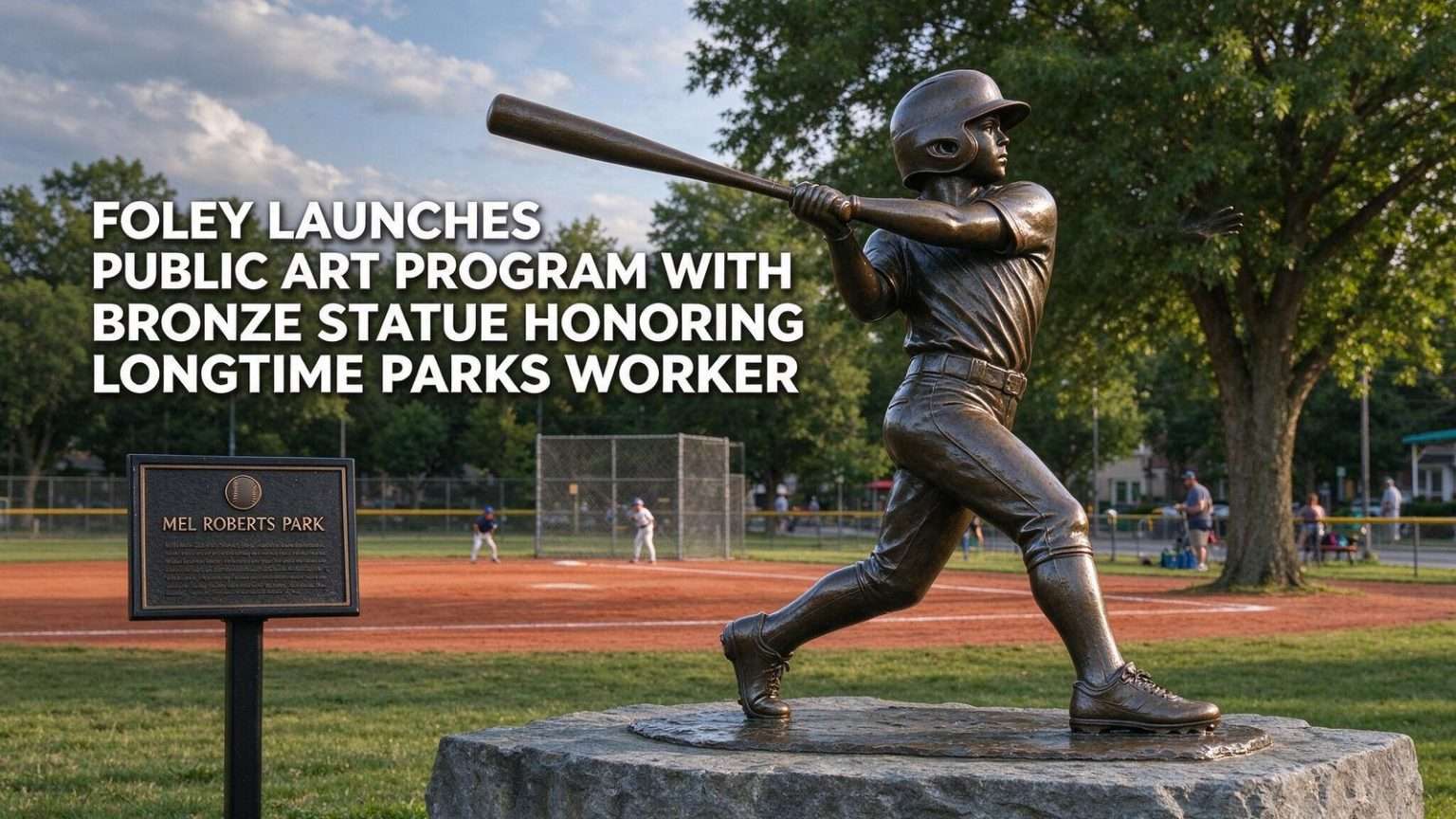
Foley has kicked off a new public art program with the installation of a bronze statue at Mel Roberts Park on Cedar Street, the first piece in what city officials hope will become a growing collection of sculptures around town. The statue, nicknamed Slugger, was donated by the family of the late Melvin Roberts, the park’s namesake, and marks the start of an effort led by the city’s Revitalization and Beautification Advisory Board.
The program gives Foley something many cities its size lack: a deliberate, organized approach to public art, with a board shepherding acquisitions, choosing sites and raising the money to make each piece possible. Rather than waiting for donations to arrive at random, the city has set up a framework meant to grow the collection piece by piece over the years — beginning with a tribute to a man whose life was woven into the city’s parks.
Roberts spent roughly three decades working for the city’s parks department and lived across the street from the Cedar Street park for much of his life, staying there until his death in 2009 at the age of 97. His deep, lifelong connection to that stretch of Foley made the park a natural home for the memorial piece his family chose to give the city — a figure of a ballplayer, frozen mid-swing, standing in the park where children still play the game he spent his career making possible for others.
A Legacy in Bronze
Pat Davis, Roberts’ daughter and chairwoman of the advisory board overseeing the new initiative, was a driving force behind getting the program off the ground. Her family purchased the Slugger statue and donated it outright, while the city handled the practical side of the installation, building a stone foundation for the piece and adding signage to explain its story to visitors.
The division of labor is a template for how the program is expected to work going forward: private donors supply the art, and the city supplies the siting, the foundation and the interpretive signage that tells visitors what they are looking at and why it matters. Signage in particular matters for a statue like Slugger — a generation from now, visitors who never knew Melvin Roberts will learn his story from the plaque rather than from memory.
The choice of a baseball figure honors the substance of Roberts’ work. Parks employees are the people who mow the fields, line the diamonds, open the gates and repair the equipment that makes youth sports run — invisible labor that thousands of families benefit from without ever thinking about who does it. A statue of a batter at the park’s edge makes that service visible, and gives the kids swinging bats on the Cedar Street fields a permanent reminder that the place they play was built by people who cared about it.
At 97 years old, Roberts had lived through nearly the whole modern history of Foley, a city that transformed in his lifetime from a small railroad and farming community into one of the fastest-growing municipalities in south Baldwin County. That growth has brought new subdivisions, new schools and new commercial development — and with it, a growing awareness that the city needs to preserve and celebrate the people and stories that predate the boom.
A Growing Collection
City officials say the Cedar Street statue is only the beginning. Plans are already in motion for additional bronze pieces elsewhere in Foley, including one planned for the grounds of the public library and another slated for a new dog park that has yet to be built. The pipeline reflects a deliberate strategy: rather than a single showpiece, Foley wants art distributed across the places residents already go — parks, libraries, trails — so that encountering a sculpture becomes part of ordinary life in the city.
Placing art at a library and a dog park also illustrates the range of subjects a civic collection can hold. A library piece can honor literature, learning or the readers of the future; a dog park statue can be pure whimsy, the kind of playful bronze that becomes a city’s unofficial mascot and a favorite of photographers. Collections that mix reverence with humor tend to be the ones residents embrace most fully.
The program is being funded through a mix of public money and private donations, a model city leaders hope will let the collection keep growing over time without falling solely on taxpayers. The arrangement shares the cost — the city commits to sites and installation while donors underwrite the art itself — and it gives families and organizations a structured way to commemorate people, events and history they consider worth remembering.
That model has worked well in cities across the country. Public art funded jointly by public and private money tends to produce pieces chosen with community input rather than imposed from above, and the shared ownership builds a constituency for maintaining the collection over decades. Foley’s advisory board gives the effort exactly that kind of stewardship: a standing body responsible for the collection’s quality, placement and care.
Art in a Growing City
For a city that has invested heavily in recent years in parks and beautification projects, the new art initiative is being framed as a way to add character and storytelling to public spaces that residents already use every day, while also honoring the people whose long service helped build those spaces in the first place. Beautification and public art are natural companions: landscaping, walkways and lighting shape how a park looks, while sculpture shapes what it means.
Foley’s rapid growth gives the effort a particular urgency. Newcomers arriving with the city’s expansion experience Foley largely through its roads, shops and subdivisions; public art is one of the few tools a city has for telling newcomers who it is and where it came from. A bronze batter on Cedar Street says something no subdivision entrance sign can: that this city remembers its own.
The economics of the region reinforce the value of the investment. South Baldwin County’s economy runs substantially on visitors — travelers bound for the Gulf beaches pass through Foley year-round, and the city’s outlet shopping and historic downtown give them reasons to stop. Public art adds to that appeal: sculptures become landmarks, photo stops and small anchors of identity that distinguish one Gulf Coast town from another in a traveler’s memory.
Public art programs also carry practical benefits for the spaces they occupy. Cities that install sculpture in parks report that the pieces become focal points for programming — dedications, school visits, walking tours — and that well-tended art discourages the neglect that invites vandalism. A park with a story is a park people watch over.
Remembering Melvin Roberts
The first piece in the collection could hardly have been better chosen for what it says about Foley’s values. Roberts’ three decades with the parks department spanned the era when the city’s park system grew from modest ball fields into the network of recreational facilities that today serves one of Alabama’s fastest-growing populations. Honoring him at the park that bears his name ties the city’s past to its present in bronze and stone.
The family’s decision to donate the statue outright — purchasing the piece and giving it to the city without expectation of return — reflects the kind of civic devotion that no purchase order can replicate. Davis’s dual role as daughter and board chairwoman makes the initiative personal as well as administrative: the program she leads began with her own family’s gift, and the standard it set is the one future donations will be measured against.
Residents who want to see the program’s beginning can visit Mel Roberts Park on Cedar Street, where Slugger stands on his stone foundation, signage nearby telling the story of the man who lived across the street and worked three decades to keep the city’s parks ready for the children who play there. The statue is at once a memorial, a first exhibit and an invitation — the opening line of a collection Foley intends to keep writing, one sculpture at a time.
As additional pieces arrive at the library and the future dog park, the city’s collection will grow into something more than decoration: a distributed portrait of Foley itself, assembled from the people, stories and values the community chooses to remember. The Slugger statue has thrown the first pitch. What the city builds from here will determine how the story ends.
The advisory board’s role extends past acquisition into stewardship. Bronze survives outdoors far better than most media, but every public sculpture needs periodic cleaning, waxing and inspection — maintenance that a funded program plans for and an improvised one forgets. Cities whose art collections endure are the ones that budget for care from the first installation, and Foley’s decision to build the program around a standing board suggests the Slugger statue will be looked after long after its dedication crowd has gone home.
There is also a generational dimension to what Cedar Street now holds. Children playing ball at the park today will grow up beside the figure of a batter and the story of the man it honors; some will serve on city boards decades from now with the memory of that statue shaping what they think public service looks like. Monuments work slowly, but they do work — and Foley has given its first one a home where the effects will compound with every season of youth baseball played in its shadow.