Sixty Thousand Books, Three Weeks, and One Very Emotional Goodbye: Foley’s Library Is Moving
Foley's new 40,000-square-foot library on East Orange Avenue will welcome patrons in weeks. Staff are packing more than 60,000 titles, and the current building closes for three weeks during the move.
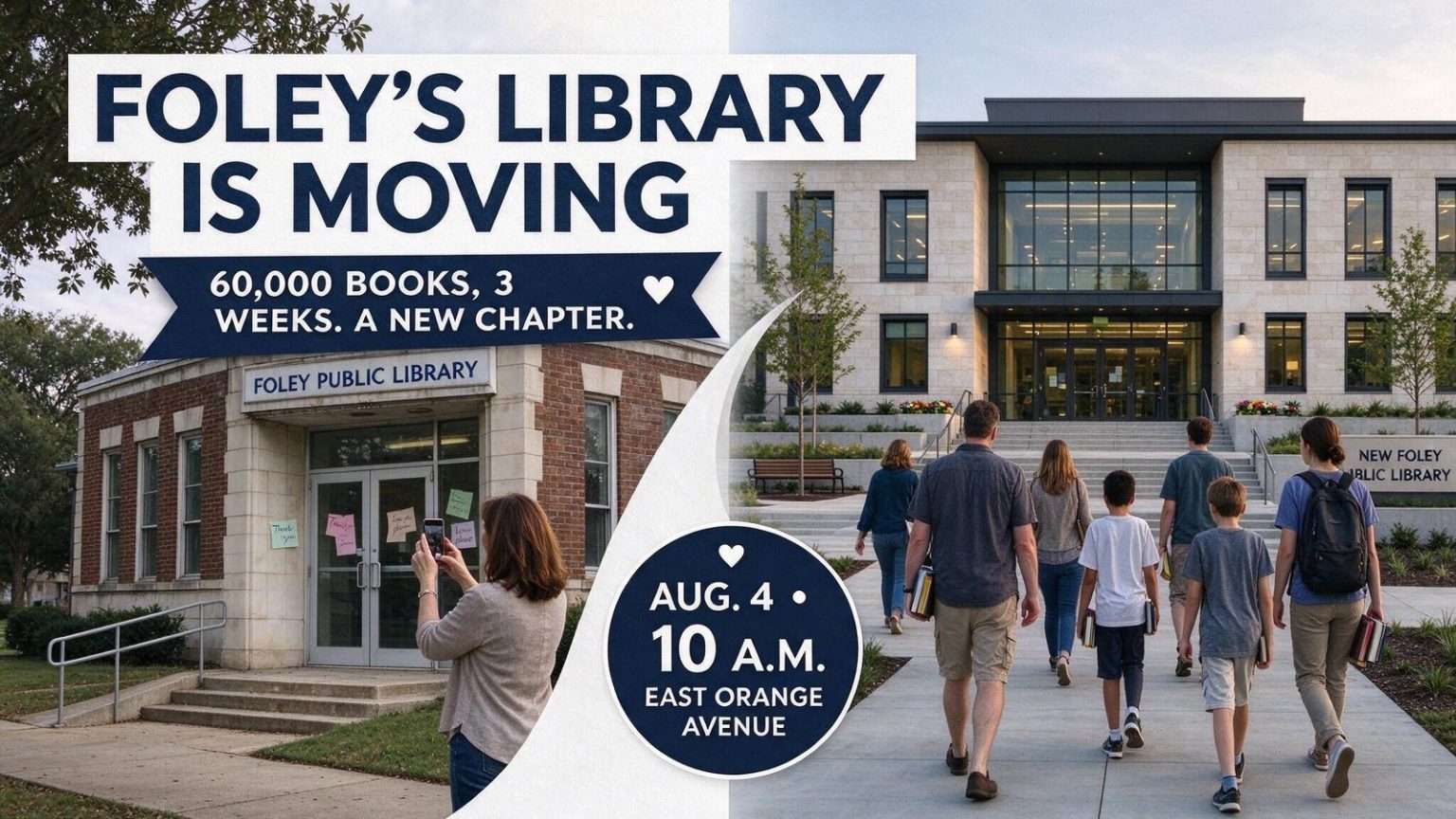
Last week, people kept stopping in the doorway of the Foley Public Library to take pictures. Not of anything in particular — just the building. There was no event, no program, no announcement drawing them in. They simply wanted one more look at a place that has served as the city’s living room for decades, before the doors closed and the long-awaited move to a new home finally began.
The New Building
In just a few weeks, Foley’s new 40,000-square-foot library on East Orange Avenue will welcome its first patrons. Librarian Kate Norris has been walking through it and still cannot quite believe it. “Every time I walk in there, I just cannot believe how pretty it is. The building is beautiful. I cannot wait for our patrons to step foot in it.”
The leap in size is the headline, but the day-to-day difference will show up in a hundred smaller ways. The current East Laurel Avenue building has served Foley well, yet it was designed for a city considerably smaller than the one Foley has become. Shelves compete for floor space with programming areas; meetings spill into rooms that are needed for something else the same afternoon. Forty thousand square feet changes that arithmetic, giving staff room to spread collections out, add seating, and host activities without tripling over one another.
Three Weeks and 60,000 Titles
Over the next three weeks, the library will be closed so staff have time to pack and move more than 60,000 book titles — an undertaking that is less romantic than it sounds and considerably heavier. Norris said the upgrade is overdue for a city that has outgrown its current space. “Every time we have a program, we’re just busting at the seams. We don’t have enough room.”
Moving a public library is one of the more demanding jobs in municipal logistics. Unlike a private office, a library cannot simply box everything and sort it out later — every one of those 60,000 titles has to arrive at the new building in an order that lets staff reshelve quickly, or the collection becomes effectively unusable for weeks. That is why systematic moves rely on careful labeling, staged packing by call number range, and a shelving plan finalized long before the first box is loaded. The three-week closure is not padding; it is the realistic time required to move a working collection without chaos.
What Patrons Should Know During the Move
Library officials have laid out a simple set of arrangements to keep the closure from inconveniencing readers more than necessary:
Returns: Patrons can continue returning books at the current location. The old building may be closed for browsing, but the drop-off point stays available, so borrowers do not need to hold materials until the reopening.
New holds and pickups: These must be handled at a nearby library branch during the closure. Readers who have placed items on hold should plan to collect them at the alternate location until the Foley building reopens, and should check with the branch for its own hours and pickup procedures.
Grand opening: Aug. 4 at 10 a.m. at the new East Orange Avenue building. After the ribbon is cut, patrons will finally get to see the space that staff have been describing with such enthusiasm.
The closure window also means due dates and programming schedules are affected. Regular visitors should expect story times, club meetings and computer access to pause during the three weeks, and should watch the library’s announcements for the reopening calendar. Staff have generally found that a clear, short closure with firm dates generates far less frustration than a staggered or uncertain move, and the Aug. 4 opening gives everyone a concrete day to look forward to.
For Foley, the move is the visible payoff of years of planning, budgeting and construction. Libraries of this scale do not appear overnight: the city had to secure and prepare the East Orange Avenue site, design a building around both current needs and decades of projected growth, and see the project through the disruptions that accompany any major public construction. Reaching the point where boxes are being loaded marks the transition from a building project to a community one.
Inside the New Library
Beyond its larger footprint, the new building will include a sensory room and separate activity areas for children and teens. A multipurpose room seating 277 people gives the city room for larger community gatherings, and planners have also included space for a STEAM/STEM lab and programs such as special-needs activities. A second-story porch will overlook the Perry Wilbourne Antique Rose Trail and the city’s dog park.
Each of those features answers a specific pressure the old building could not relieve. The sensory room reflects how much the science of childhood development has shaped modern library design — quiet, controlled spaces where children with sensory processing differences can regulate and participate, which mainstream libraries a generation ago simply did not provide. Separate child and teen zones acknowledge that a nine-year-old in the picture books and a fifteen-year-old doing homework have entirely different needs, and that neither group benefits from sharing one undifferentiated space.
The multipurpose room is perhaps the feature with the broadest reach. A 277-person assembly space gives civic clubs, school groups, homeowners associations and cultural organizations a venue that Foley previously lacked in a public setting, and it lets the library host author talks, performances and large-format programs that were physically impossible before. Public meeting space is scarce in fast-growing towns, and a room of that capacity will find itself booked constantly.
The STEAM/STEM lab signals the library’s evolution into hands-on learning territory — robotics, coding, building projects and maker-style activities that turn the building from a place that stores knowledge into a place that produces it. And the second-story porch, overlooking the Perry Wilbourne Antique Rose Trail and the city’s dog park, is a small design flourish with an outsized effect: it connects the library to Foley’s outdoor network and gives readers a place to sit outside with a book, which may end up being the building’s most photographed feature after all.
Once the new library opens its doors, the current East Laurel Avenue building will be renovated and repurposed for other municipal uses. The old structure’s working life is not ending; it is changing. Cities that repurpose civic buildings this way avoid the cost of abandonment and keep established facilities in public service, and East Laurel Avenue’s next chapter will be determined as the city’s needs continue to grow.
A Community Saying Goodbye to a Building
Norris said the final week in the old building turned into something staff had not entirely expected — a steady stream of people coming by to look around one more time. “Last week was such a reminder that we are loved by the community and that we just mean a lot to everybody. A lot of people would just stop and just take pictures and just, you know, just take in the memories.”
Buildings accumulate meaning the way rivers carve channels — slowly, invisibly, until the shape is simply there. The East Laurel Avenue library holds decades of first library cards, summer reading certificates, rainy afternoons, research projects and quiet hours. The impulse to photograph the doorway before leaving it is not sentimentality for sentimentality’s sake; it is recognition that a specific room, with a specific light and a specific arrangement of shelves, will never exist in quite the same form again. The new building will make its own memories quickly, but the old one earned its farewell.
Public libraries in fast-growing Baldwin County have quietly become something broader than book repositories — they serve as summer programming for kids, air conditioning during a heat wave, free internet for job seekers, and meeting space for groups that have nowhere else to go. A building that is “busting at the seams” during programs is a building that a community is actually using.
That point deserves emphasis in a county growing as quickly as Baldwin. Newcomers arriving by the thousands discover that before they know the neighbors, before they join a church or a civic club, the library is often the first public institution that treats them as regulars. It is the rare government service that asks nothing first — no fee, no appointment, no paperwork beyond a card — and offers internet, shelter, story time and help finding work. When usage outgrows the walls, the walls have to change.
Grand Opening Plans Take Shape
Update: The city has released a full schedule for the Aug. 4 grand opening at the new library, located at 230 E. Orange Ave. Festivities begin at 10 a.m. with a ribbon-cutting ceremony, followed by open house hours from 10:30 a.m. to 5 p.m. that let visitors explore the building, enter a scavenger hunt raffle and take part in activities in each meeting space.
A Children’s Grand Opening in the new Children’s Story Grove will feature pop-up story time and crafts at 11 a.m., 1 p.m. and 3 p.m., and kids can also visit the Maker Meadow for additional craft activities. The library is also running a bookmark design contest for children throughout the day, with winners to be announced the following week.
The schedule reflects a deliberate choice: rather than a single ribbon-cutting moment, Aug. 4 is built as a full-day introduction meant to pull in every part of the community. The scavenger hunt raffle and the activity stations spread through each meeting space serve a practical purpose beyond celebration — they walk visitors physically through the building, ensuring that a family exploring for the morning will discover the teen area, the multipurpose room and the STEAM/STEM lab rather than lingering only in the parts that look familiar. The Children’s Story Grove and Maker Meadow give the youngest patrons their own program to anchor the day, and the bookmark contest adds a creative outlet that continues the library’s long tradition of involving children in its identity.
For staff, opening day will be the culmination of the busiest stretch the library has ever had: packing 60,000 titles, resettling them on new shelves, testing systems and training in a new building, all while fielding questions from an eager public. The mood among the team, by Norris’s account, has made the strain worth it. The excitement she feels walking through the finished building is the same feeling the city will get to share on Aug. 4.
What the Move Means for Foley Readers
In practical terms, patrons should think of the coming weeks in three phases: the closure itself, when the current location accepts returns and nearby branches handle new holds; the transition after Aug. 4, when normal borrowing resumes at East Orange Avenue; and the renovation period for the old East Laurel Avenue building, which does not affect readers directly but rounds out the city’s longer plan for its civic properties.
The bigger story, though, is what a building of this kind does for a city’s trajectory. Towns competing for families and businesses on the Gulf Coast list their schools, parks and civic amenities when they make the case for themselves, and a modern 40,000-square-foot library with a sensory room, a 277-seat assembly hall and a hands-on learning lab is exactly the kind of amenity that signals a community investing in itself. Foley has effectively told current and prospective residents that public education and public life matter here — and backed it with square footage.
The three weeks of packing between now and the ribbon-cutting will be quiet on East Orange Avenue, but only in the way a stage is quiet before the curtain rises. When the doors open Aug. 4 at 10 a.m., the photographs people took in the old doorway last week will become the before pictures — the images Foley residents will look back on when they tell the story of the summer their library grew up. The memories made at East Laurel Avenue go with them; the memories to come will be made at 230 E. Orange Ave.