What Mobile and Baldwin County Voters Need to Know for the 2014 Republican Runoff
Low expected turnout means every vote counts more in Tuesday's Republican runoff races across Baldwin and Mobile counties.
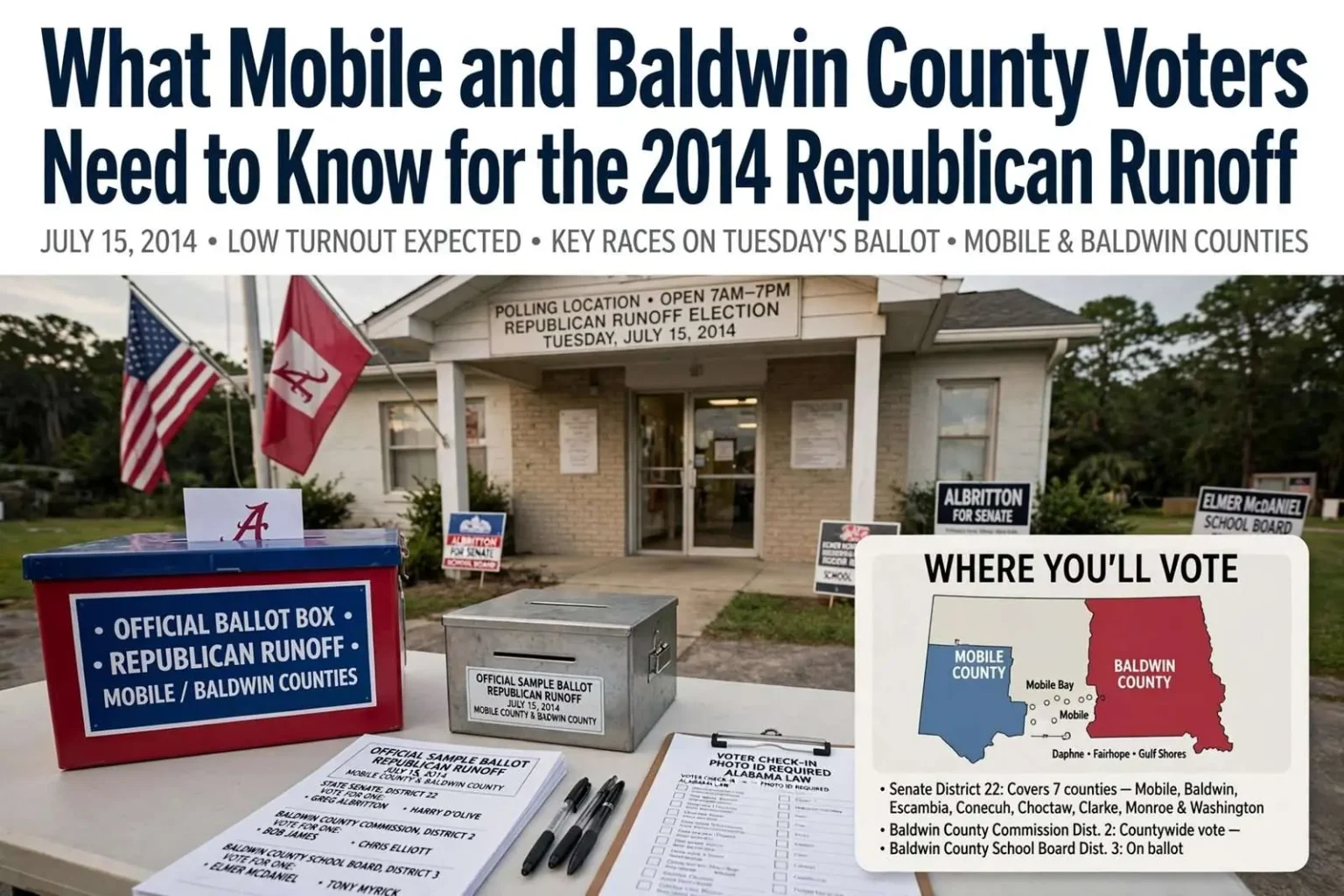
Voters heading to the polls Tuesday for Alabama’s Republican Party runoff will find only a handful of contested local races in the Mobile area, but each individual ballot is expected to carry unusually heavy weight given anemic anticipated turnout. Runoffs are the quietest elections on Alabama’s calendar, and this one shapes up quieter than most: no statewide marquee race, no countywide draws for Mobile’s Democrats, and a ballot built from the bottom up rather than the top down. For the candidates who survived June, however, every vote cast Tuesday counts double — the same number of ballots must be won with fewer of them in play.
Low turnout expected statewide
In the first round of the Republican primary on June 3, roughly 433,000 people voted statewide. Political consultant Brent Buchanan, managing partner of a Montgomery-based consulting firm, said polling had been weighted around a runoff turnout closer to 314,000, though he suspected the real number could fall below 300,000. The drop-off between a primary and its runoff is a familiar arithmetic in Southern politics: the second round draws a fraction of the first, and the voters who return tend to be older, more engaged and more reliably partisan.
Turnout is expected to run even lower in the Mobile area specifically, since Democrats in both Mobile and Baldwin counties have no runoff races on their ballots this cycle. Voters who show up without a contest on their party’s ballot face a choice between requesting the Republican ballot or skipping the election entirely, and history suggests many will stay home. That dynamic shrinks the electorate further and concentrates the outcome in the hands of the most committed Republican primary voters.
Most Mobile County precincts will see only three low-interest statewide contests, with a handful of precincts in the northern part of the county also weighing in on a state Senate race. Baldwin County has more at stake, with a county commission runoff, a school board runoff, and a large share of the county included in a contested state Senate district. The geography means Tuesday’s results will read very differently depending on which side of Mobile Bay a precinct sits.
Senate District 22: Albritton vs. D’Olive
The most far-reaching local race is the runoff for Senate District 22, a sprawling district covering Escambia County along with portions of Mobile, Baldwin, Conecuh, Choctaw, Clarke, Monroe and Washington counties. Districts that size are rare in Alabama politics — a single Senate seat stretching across seven counties and two metro areas, from the pineywoods of Conecuh County to the fast-growing subdivisions of Baldwin. Representing it means reconciling rural timber counties’ priorities with the suburban growth agenda of the Eastern Shore.
Former state Representative Greg Albritton of Conecuh County faces former Baldwin County Probate Judge Harry D’Olive after the two topped a five-candidate field in June, with Albritton finishing first and D’Olive second. Both men bring long public résumés to the runoff: Albritton’s years in the House gave him command of the state budget fights, while D’Olive’s judicial tenure made him a familiar face at the center of Baldwin County government.
D’Olive has centered his campaign on economic development, while Albritton has emphasized streamlining state government and easing the path for starting businesses and entering licensed professions. The contrast gives district voters a genuine philosophical choice: one candidate pitching an active-government approach to attracting jobs, the other pitching a leaner state that gets out of the way of entrepreneurs. In a district where agriculture, timber, manufacturing and coastal growth all compete for attention, both messages have their constituencies.
Whoever wins will face Democrat Susan Smith in November, who stepped in after incumbent Democratic Senator Marc Keahey withdrew following the qualifying period. The late shuffle left the general election as a formality in all but name — the district’s registration trends and the strength of the Republican field point to the runoff as the real election. That is precisely why turnout on Tuesday, however thin, will decide representation for the next four years for hundreds of thousands of residents across south Alabama.
Baldwin County Commission District 2
Incumbent Commissioner Bob James, a road builder, is defending his seat against challenger Chris Elliott after edging him by just 142 votes in a three-candidate June primary that fell short of the 50 percent threshold needed to avoid a runoff. A margin that thin guarantees a hard-fought second round, with both campaigns hunting for the small pool of voters who backed the third-place finisher — and for any of June’s stay-homes who can be persuaded to return.
James has campaigned on spending cuts, scrapping a long-range planning effort he argued infringed on private property rights, and improving government transparency. His first term made him one of the county commission’s most assertive members, particularly on budget questions, and his challenge to the county’s planning documents turned him into a lightning rod on growth policy — praised by property-rights advocates, criticized by planners and municipal leaders who favored a coordinated approach to Baldwin’s boom.
Elliott has pushed back on suggestions he would reverse those changes, arguing instead that his main advantage would be an ability to work more collaboratively with fellow elected officials. The framing sets up the classic incumbent-versus-temperament choice: James as the independent voice willing to stand alone, Elliott as the consensus-builder who promises a quieter commission dais. Elliott’s service on the Daphne City Council gave him his own record of Eastern Shore government to run on.
Although the commission district covers the Eastern Shore, all county voters may cast ballots in the race, and the winner will face no opposition in November. Baldwin’s countywide ballot rule means a Daphne-area seat will be decided by electorates from Bay Minette to Gulf Shores, a quirk of the county’s at-large voting setup that has long shaped how commission campaigns are run. The absence of a November opponent makes Tuesday the final word on the seat for the next term.
Baldwin County School Board District 3
In the school board race, incumbent Elmer McDaniel won 47 percent of the vote in June, just short of an outright win, and now faces retired teacher and coach Tony Myrick. The race has become the clearest referendum on the district’s direction at a moment when Baldwin County schools are growing faster than nearly any system in the state, adding classrooms, staff and technology at a pace that keeps the budget under permanent strain.
McDaniel has campaigned on continuing the district’s Digital Renaissance initiative, which provides every student from kindergarten through 12th grade with a laptop or iPad. The program, one of the first of its scale in Alabama, has been the system’s signature bet: that ubiquitous devices, paired with teacher training, will modernize instruction across a county of widely varying schools. McDaniel points to the initiative as the reason to return him to the board.
Myrick has argued the program is too costly and pulls resources away from more urgent needs. His challenge channels a persistent strain of voter concern about technology spending — that devices age out faster than textbooks, that maintenance contracts compound, and that teachers and basic programs deserve the dollars first. As a retired educator, Myrick carries a resume tailored to the argument that the district should spend closer to the classroom.
The winner will run unopposed into a six-year term. That stakes the election not just on the next budget cycle but on the long arc of a district that must keep building for growth while deciding how much of its future to route through screens. Between the county commission race and the school board contest, Baldwin County’s Tuesday ballot carries more consequence than any runoff in recent memory — a reminder that in runoffs, the lowest-turnout elections often matter most.
How to cast a runoff ballot
Practical details matter in an election this thin, where a few hundred votes can settle a Senate district. Polls open across the two counties on the standard schedule, and voters should confirm their precinct before heading out — runoff elections frequently use consolidated polling places, and a voter who shows up at June’s location may find the tables moved. Election officials recommend bringing photo identification, as Alabama law requires, and checking sample ballots posted by the probate offices in both counties.
Because Democrats face no contested runoff in either county, the practical choice at the check-in table is simple: voters can request the Republican ballot to participate in the contests described here, or cast a ballot limited to whatever nonpartisan items appear. Party rules in Alabama allow voters to choose either ballot in a primary runoff regardless of past voting history, which is how independents and Democrats have long influenced close Republican runoffs — a dynamic both campaigns factor into their turnout math.
Why the small numbers matter
The arithmetic of a low-turnout runoff rewards organization over mass appeal. A campaign that can identify 3,000 loyal supporters and actually get them to the polls can win a district of hundreds of thousands of residents. That is why the closing days of races like these are dominated by phone banks, church visits and yard-sign geography rather than television — the audiences are too small to reach efficiently through a broadcast, and too committed to need persuading over the airwaves.
It is also why the candidates themselves spend runoff season at the retail end of politics: fish fries, civic clubs, Rotary lunches and the doors of the voters who already voted for them once. Senate District 22’s seven-county sprawl makes that ground game a logistics exercise — a candidate can spend the whole day driving between Courthouse squares in Monroe, Clarke and Washington counties. By Tuesday night, whichever campaign did the tedious work will hold a Senate seat, a county commission district or a school board post for years to come.