Acquitted of Assaulting a Councilman, a Former Attorney Is Now Suing Orange Beach and Its Mayor for Defamation
Harry Still, acquitted in May of assaulting a Bay Minette councilman, has filed a defamation lawsuit against Orange Beach, Mayor Tony Kennon and four other city officials. He filed without an attorney and has requested a jury trial.
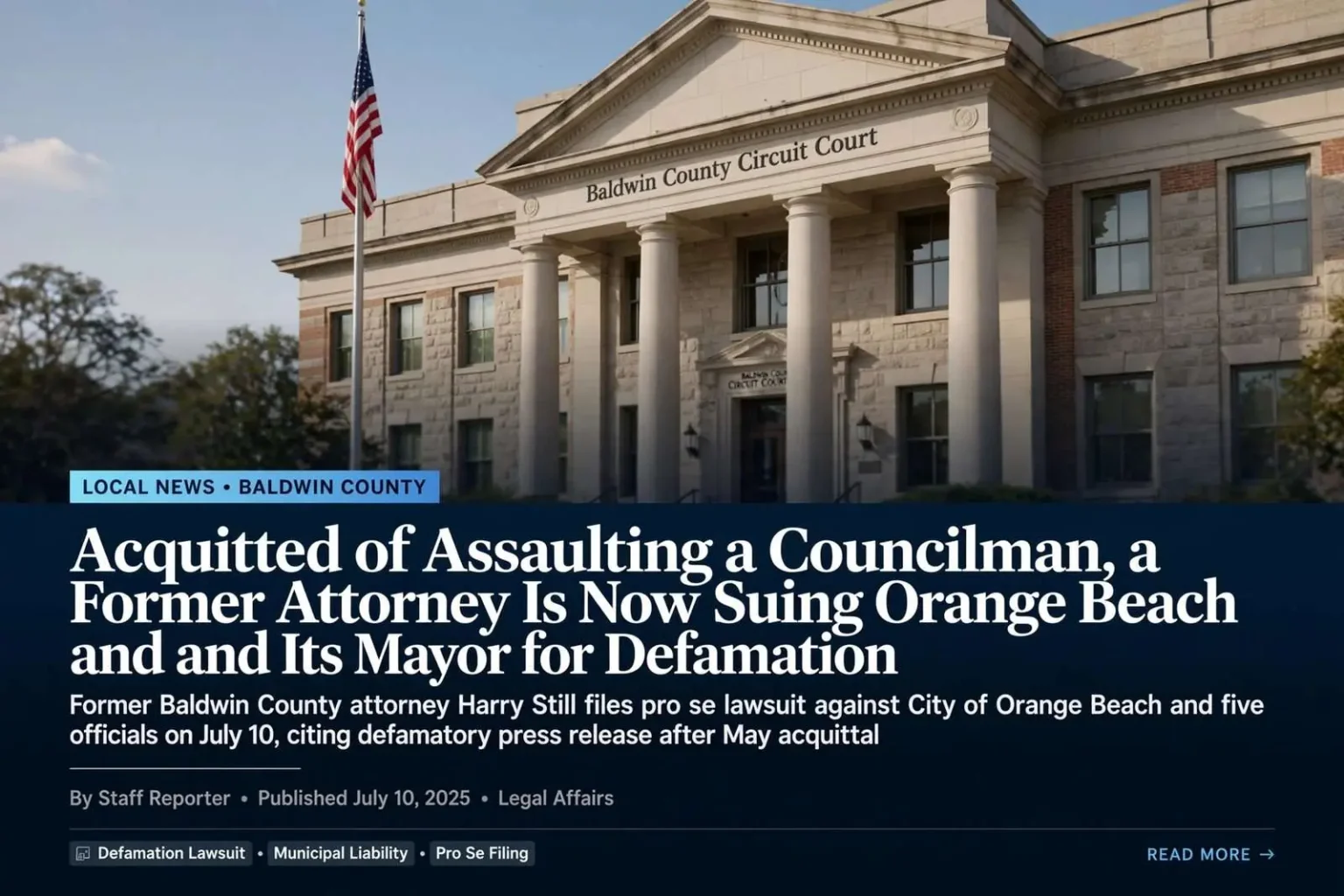
A former Baldwin County attorney who was found not guilty in May of assaulting an elected official has turned around and sued the city that he says helped destroy his reputation in the first place. Harry Still filed the lawsuit on Friday, July 10, in Baldwin County Circuit Court — and he filed it without an attorney, representing himself. The pro se filing is an unusual move in a defamation case against a municipality and five of its officials, and it signals how personally Still views the dispute: after months of criminal proceedings and public statements, he chose to take the fight to the city’s doorstep himself.
Defamation cases against municipal officials are notoriously difficult — public officials and matters of public concern trigger heightened standards, and plaintiffs must prove actual malice for statements about public officials. Still’s decision to file alone raises the stakes of the technical requirements, but his underlying theory is straightforward: he was acquitted, and statements made before the acquittal portrayed him as guilty of something a court found he did not do.
Who Is Named
The complaint names the City of Orange Beach along with five individual officials: Mayor Tony Kennon; Steve Brown, former Police Chief; Jamie Logan, City Attorney; Ford Handley, City Administrator; and Renee Eberly, City Clerk. Additional unnamed defendants are referenced in the complaint but have not yet been identified, leaving room for the lawsuit to expand through amendments as discovery identifies others Still alleges participated in the statements he challenges.
Naming both the city and its top officials individually means the litigation can reach both municipal resources and the personal liability of the officials involved. Municipalities enjoy certain immunities in state tort claims, but defamation claims against individual officials for statements made in their official capacity follow a separate legal track, and Alabama law has specific procedures for claims against cities and their officers. The structure of the complaint suggests Still is pursuing every available path at once.
The Core Allegation: A Press Release
The suit alleges harassment, slander and libel. Specifically, it claims city officials conspired to defame Still in statements made in a news article about his September 2025 arrest for assaulting a Bay Minette city councilman. Still was later found not guilty in that case, in May, by Baldwin County Circuit Judge Clark Stankoski. That acquittal is the foundation of the current claim — the argument being that the statements made about him were not merely damaging but false.
“In making this willful, false, malicious, defamatory and slanderous Press Release, the Defendants intended to injure the Plaintiff’s reputation and character. Further, the Defendants’ conduct was intended to bring the Plaintiff into scandal, public ridicule, disgrace, odium, contempt, and professional repute to future clients and employers.” The language of the complaint frames the release as a deliberate act, not an error — an allegation that, if proven, would satisfy the malice standard that defamation claims against officials require.
The Complaint Reaches Back Further
The filing does not confine itself to the 2025 arrest. It also raises several other Baldwin County matters, including the case of Thomas Daniel Williams, who died in 2022 and is the subject of a wrongful death lawsuit, and a 2012 murder case in Orange Beach. In connection with that older case, Still claims that he and his client were harassed by Orange Beach Police Department officers on two occasions in 2025. When the complaint’s allegations reach back years, they change the character of the suit: from a single-defamation claim about one press release to a broader pattern allegation about how the city and its police department treated Still and his clients over time.
The Williams matter and the 2012 murder case appear in the complaint as context for a claimed pattern of hostility — incidents in which Still says the city’s institutions acted against him or his clients before and after the assault case. Including them broadens the factual record Still intends to develop, and it also raises the litigation’s exposure: a pattern case, if supported by discovery, supports larger damages theories than a single statement would.
The Legal Terrain He Faces
Still’s road ahead runs through some of the hardest terrain in Alabama civil law. Statements in a press release about an arrest are generally protected if they accurately report what was publicly alleged — truth and accurate reporting of official proceedings are classic defenses. The acquittal helps him on falsity: a court has found the underlying accusation untrue. But he will still have to prove the defendants knew the statements were false or recklessly disregarded that question, and that the statements identified him, injured him, and were published by the defendants themselves.
His pro se status adds difficulty. Defamation litigation against five municipal officials involves motions to dismiss, immunities defenses, discovery disputes and the finer points of Alabama’s defamation statute — technical requirements including a pre-suit demand process and specificity requirements that end pro se plaintiffs’ cases on procedure before they ever reach the merits. Representing himself, Still will face all of it without counsel.
Why the Case Matters in Baldwin County
The lawsuit lands in a county where municipal governments and their police departments have faced increasing scrutiny over how they communicate about arrests and ongoing cases. A press release issued after an arrest is a public statement by a government about a citizen who has not yet been tried — and when that citizen is acquitted, the gap between the release and the verdict becomes the raw material for exactly this kind of lawsuit. Still’s complaint is a test of where Alabama law draws the line between a government’s right to announce an arrest and a citizen’s protection from being publicly branded a criminal.
The case also tests the city’s institutional posture. Orange Beach officials named in the suit — its mayor, its former police chief, its city attorney, its administrator and its clerk — will have to respond collectively and individually, and the city’s insurance and legal strategy will shape whether the case settles or runs to trial. With Still as his own attorney, the proceedings are likely to draw unusual public attention in Baldwin County legal circles.
The Acquittal That Started It
The May acquittal by Judge Clark Stankoski in Baldwin County Circuit Court was the turning point in Still’s story. An assault charge against an elected official — a Bay Minette city councilman — is the kind of case that generates immediate public attention, and the September 2025 arrest put Still’s name in headlines across the county for months before the verdict. When the judge found him not guilty, the criminal matter ended, but the public record of the accusation and the publicity around it remained.
That sequence — public accusation, months of publicity, then acquittal — is the pattern that gives rise to defamation claims by acquitted defendants. The criminal court restored his legal standing; the civil suit attempts to restore his professional one, seeking damages for the harm to his reputation, his practice and his standing with future clients and employers that he attributes to the city’s statements.
What Discovery Will Examine
If the complaint survives the early procedural stages, discovery will focus on a handful of concrete questions. Who drafted and approved the press release, and what did its authors know about the evidence at the time? What communications passed between the named officials about Still before the release? And what role, if any, each of the five named defendants played in crafting or distributing the statements? The unnamed defendants referenced in the complaint suggest Still expects the answers to implicate others.
Discovery will also test the other allegations — the 2025 harassment claims tied to the 2012 murder case and the Williams wrongful death matter — where documentary evidence, if it exists, would shift the case from one disputed press release to a documented pattern. Those are high bars for a self-represented plaintiff, but they are the questions that would determine whether the case is worth its requested remedies.
The Road Ahead
The immediate next steps are procedural: the defendants’ responses, likely including motions to dismiss on immunities and procedural grounds, and the court’s rulings on whether the claims proceed. Baldwin County Circuit Court dockets move at their own pace, and defamation cases of this profile can run for years between filing and resolution. Still, having bet the case on himself, will have to navigate each stage without counsel.
Whatever its outcome, the suit has already done what its author intended in one respect: it puts Orange Beach’s official statements about a citizen it once called a criminal under formal legal scrutiny, with the city’s five top officials named as defendants. The verdict in the criminal case acquitted Harry Still of the assault; the verdict in this one, whenever it comes, will be about what the city said while the case was pending — and whether the truth it eventually obtained licenses it to have said it.