Hobby Lobby, Costco and Dick’s Sporting Goods Headline New McGowin Park Shopping Center in Mobile
Groundbreaking is set for the 650,000-square-foot McGowin Park Shopping Center near Hank Aaron Stadium, with Costco, Hobby Lobby and Dick's Sporting Goods among the retailers signed on.
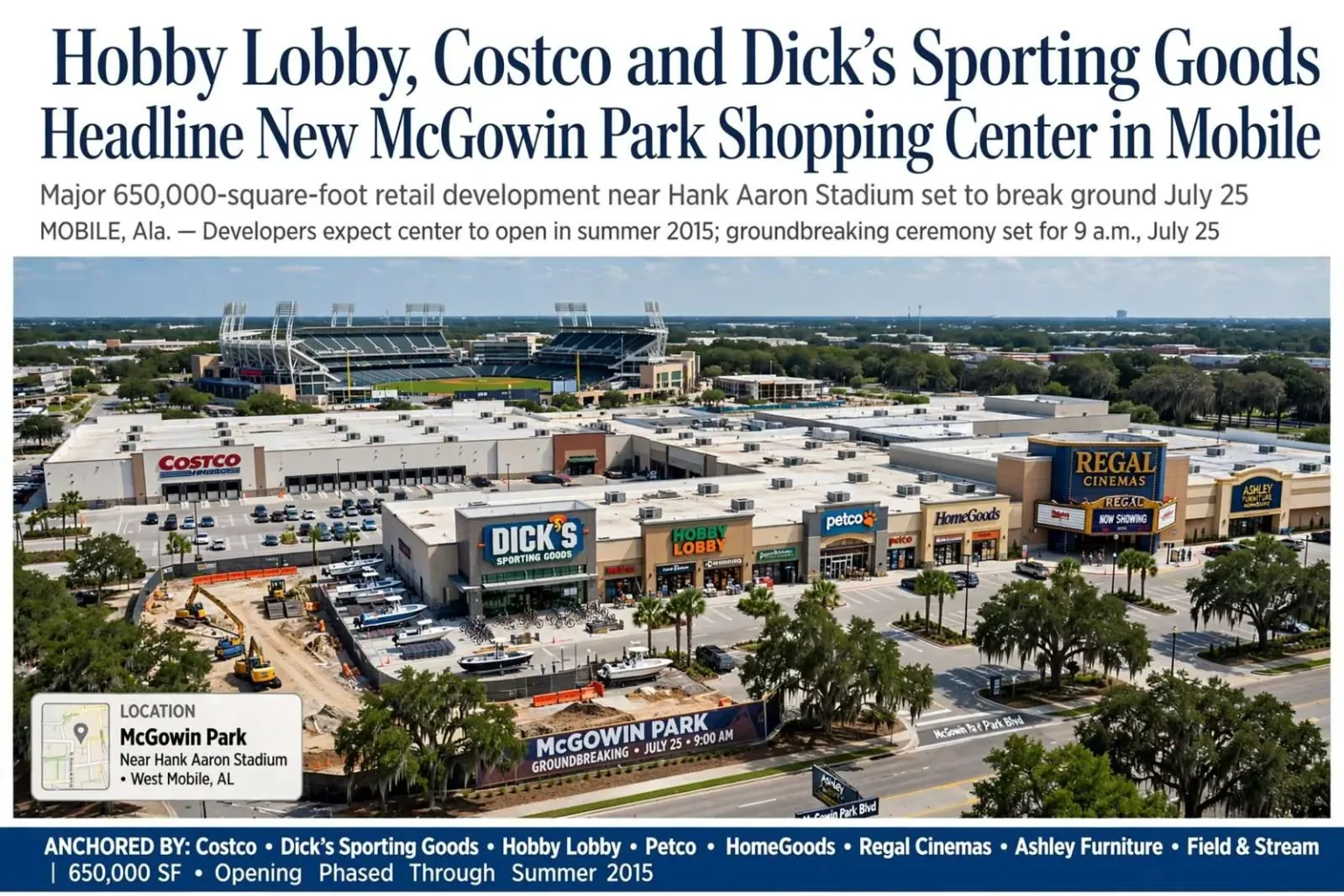
A major new retail development near Hank Aaron Stadium in Mobile is set to break ground later this month, bringing a lineup of national retailers to a 650,000-square-foot shopping center.
The groundbreaking ceremony for McGowin Park is scheduled for 9 a.m. on July 25, after previously being pushed back from an earlier date in late June.
George Alexandris, vice president of development with The Hutton Company, the Chattanooga-based firm behind the project, said he expects the center to be fully complete by the summer of 2015. The Hutton Company is developing the property alongside JLL, a Chicago-based commercial real estate firm handling leasing for the site.
The pairing brings together a developer known for large-format shopping centers across the Southeast and one of the biggest names in commercial real estate services. Hutton’s role covers the physical transformation of the land into retail space, while JLL’s leasing team works to fill that space with tenants capable of anchoring the center’s long-term success.
Groundbreaking ceremonies of this kind serve as both celebration and signal. For the developers, the July 25 event marks the moment a shopping center stops being a set of plans and drawings and becomes a construction site. For the city, it puts a public timeline on a project that residents have been tracking since the land near the ballpark was first identified for retail development.
A National Retail Lineup
According to information released this week by the two firms, the retailer lineup for McGowin Park includes Dick’s Sporting Goods, Field & Stream, Hobby Lobby, Petco, Costco, Regal Cinemas, Ashley Furniture and HomeGoods.
The mix reflects a blend of big-box retail, home goods, sporting goods and entertainment options aimed at drawing shoppers from across the Mobile area. Each of the announced tenants occupies a distinct retail niche, and together they cover the categories shoppers most often leave the city or cross town to find.
Dick’s Sporting Goods and Field & Stream together give the center a strong outdoors and athletics presence, an approach tailored to a Gulf Coast market where fishing, hunting, boating and youth sports command devoted followings. Field & Stream, a sporting goods concept built around hunting and fishing heritage, paired with Dick’s broader athletic offering, positions the center as a destination for gear of nearly every kind.
Hobby Lobby and HomeGoods strengthen the center’s home and craft categories, a segment that has proven resilient because home improvement and decorating purchases continue regardless of economic cycles. Ashley Furniture adds one of the nation’s largest furniture brands, bringing a high-volume showroom format that generates steady cross-shopping with the home goods stores around it. Furniture and home décor stores are also destinations in the truest sense: shoppers travel specifically for them and budget entire trips around a showroom visit.
Petco extends the lineup into the pet category, which has grown into one of retail’s most reliable performers, while Costco brings the warehouse club model — membership-based bulk shopping that pulls repeat visits from households across a wide radius. Costco locations are known for drawing from entire metropolitan areas rather than immediate neighborhoods, and their arrival in a market tends to reshape regional shopping patterns.
Regal Cinemas rounds out the mix with an entertainment component, giving the center evening traffic that pure retail strips often lack. Movie theaters generate repeated visits, extend the hours shoppers spend at a center and feed surrounding restaurants and shops, which is why leasing teams treat them as anchors for the experience side of a development.
Alexandris said additional details about the development, including further specifics on store layouts and additional tenants, would be shared during the groundbreaking ceremony later this month.
The Location Near Hank Aaron Stadium
The project’s location near Hank Aaron Stadium places it in a highly visible corridor already frequented by shoppers and event-goers in the area. The ballpark, longtime home of Mobile’s minor league baseball club, sits in the western part of the city, where arterial roads connect residential neighborhoods with the commercial strips that serve them.
A shopping center next to a stadium benefits from a built-in rhythm of traffic. Baseball season brings regular crowds on game nights, and the surrounding roads already carry the commuters, students and families who move through west Mobile daily. Retailers at McGowin Park will be positioned to capture both the dedicated shopping trips and the incidental stops that high-visibility corridors generate.
The site’s name itself is a nod to Mobile’s history. McGowin Park takes its name from the McGowin family, whose roots in the city run deep through the timber and lumber businesses that helped build the region’s economy. Naming a major retail center after that legacy ties a modern development to one of the oldest commercial families on the Gulf Coast.
Scale and Market Impact
The scale of the development, at roughly 650,000 square feet, would make McGowin Park one of the larger retail additions to the Mobile market in recent years, joining a wave of commercial development activity in the region.
A center of that size represents hundreds of thousands of square feet of new retail space, requiring substantial site work, infrastructure and phased construction. Projects on this scale typically open in stages, with anchor stores and outparcels delivering on timelines that can stretch across multiple seasons while the remaining shops are fitted out.
The presence of Costco in particular marks a significant addition, as the warehouse retailer has drawn strong interest in markets where it has newly arrived. Membership clubs concentrate purchasing power, and shoppers routinely plan weekly or monthly trips around them, buying groceries, electronics, tires and household goods in the same visit. New Costco locations also tend to spark secondary development nearby, as other retailers seek the traffic the club generates.
For Mobile’s retail landscape, the development addresses a familiar complaint: shoppers who drive to Pensacola or the Eastern Shore for certain national retailers now have closer options. Keeping that spending inside the city limits matters not only for the stores themselves but for the sales tax revenue that funds city and county services.
Local officials have long tracked retail leakage — the spending residents do outside the community — as a measure of unmet demand. A lineup like McGowin Park’s, covering sporting goods, crafts, furniture, pets, bulk goods and entertainment, is designed to capture categories where local options were previously thin.
With construction slated to begin this month and a completion target of next summer, the project gives Mobile shoppers a timeline for when they can expect the new stores to open. In the meantime, the developers say more concrete details on individual store openings and site plans will follow as the groundbreaking approaches.
Entertainment as Part of the Plan
The addition of Regal Cinemas alongside the retail tenants suggests the center is also being positioned as an entertainment destination, rounding out the shopping options with a movie theater component.
Modern shopping centers increasingly depend on that combination. As more routine purchasing moves online, the stores that thrive at physical centers are those selling experiences, fresh goods, furniture and bulky items — the categories where shoppers want to see, try or transport the product in person. A cinema extends visits into the evening and gives families a reason to return weekly.
The theater also supports the other tenants in ways that show up in leasing math. Moviegoers arriving early or staying late browse nearby shops, pick up dinner and add errands to their trip. Retail analysts consistently find that centers anchored by entertainment capture more visits per household than those built on retail alone.
What Happens Between Now and Opening
Between the July 25 groundbreaking and the projected summer 2015 completion, the site will pass through the familiar stages of a big-box development: clearing and grading, utilities and roads, foundation work on the anchor buildings and then the steady assembly of storefronts. Construction of this scale employs hundreds of workers across trades, giving the local building industry a substantial boost even before the first store opens its doors.
Leasing work continues in parallel. JLL’s team will keep filling remaining spaces with smaller shops, restaurants and service tenants — the businesses that occupy the spaces between anchors and determine whether a center becomes a destination or merely a collection of stores. Additional tenant announcements are expected as the project advances.
Local officials and residents will get their first official look at the full scope of the project when the ceremonial groundbreaking takes place this month.
For west Mobile, the ceremony begins a countdown. Within two years of the shovels hitting the dirt, the land near Hank Aaron Stadium is slated to hold one of the largest shopping centers in the region, with a tenant roster that spans from bulk groceries to blockbuster films — and a claim on the shopping habits of the entire metropolitan area.