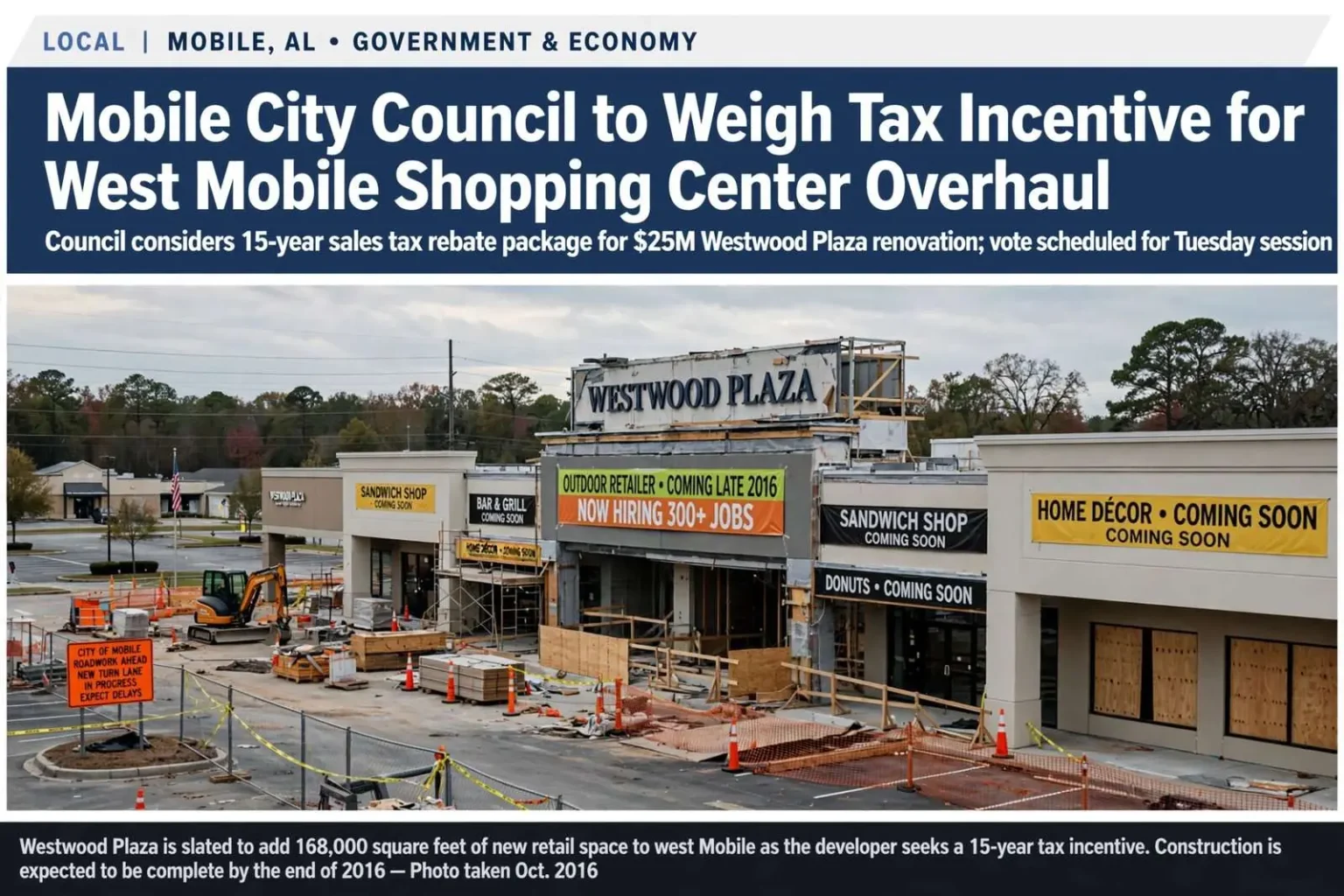
Shopping center storefronts under redevelopment in west Mobile, AlabamaA west Mobile shopping center is undergoing a major redevelopment backed by a proposed city tax incentive.

The Mobile City Council is weighing a long-term sales tax incentive package aimed at helping a developer finish rebuilding a west Mobile shopping center where an outdoor retailer is preparing to open later this year.

The proposed 15-year arrangement with the company overseeing Westwood Plaza would return a share of sales taxes collected at the site once revenue climbs above 140 percent of what the property generated back in 2013, a baseline of roughly 795,000 dollars. At that threshold, the annual rebate ceiling starts near 1.1 million dollars, assuming the local sales tax rate holds at 5 percent.

Under the terms being considered, the developer could collect rebates up to a combined 4.75 million dollars over the first seven years, or until that seven-year mark passes, whichever happens first. After that point, the yearly rebate cap drops to 450,000 dollars for the remainder of the 15-year term, capping total payments at 9.25 million dollars. If sales tax collections in any year fall short of roughly 1.1 million dollars, no rebate would be paid that year.

The agreement also requires that at least 80 percent of the shopping center tenant roster be made up of retailers new to Mobile. Falling short of that mark would pause the incentive until the requirement is met. In exchange for the tax break, the city would cover up to 250,000 dollars in road work, including a new turn lane near the property and relocation of a traffic signal at a nearby intersection.

The rebuilt center, long anchored by a large home and crafts retailer, is expanding by around 168,000 square feet. Additional tenants slated to join include a sandwich shop, a bar and grill, a home decor chain and a doughnut shop, alongside existing anchor stores. The developer says the project represents an investment of more than 25 million dollars and is expected to be finished by the end of 2016.

The project path to the council has not been entirely smooth. Earlier this year, a council member representing the west Mobile district where the center sits raised concerns about a proposed user fee that would have tacked an extra percentage point onto purchases made at the shopping center for its first several years, on top of existing sales tax. That fee has since been dropped from the proposal, though the council member has said she wanted to review the final terms closely before offering public support.

See also  Mobile-Born Writer Albert Murray Honored in New York Magazine's '9 Over 90' Feature

The developer has called the arrangement mutually beneficial, saying the project will bring more than 300 new jobs and over 100,000 square feet of additional retail space to the area, while attracting several retailers with no prior presence in Mobile.

The council was expected to take up the incentive agreement at its regular Tuesday session, following a morning pre-conference meeting.

Mobile is the county seat of Mobile County in southwest Alabama and the state’s only saltwater port. Situated where the Mobile River meets Mobile Bay near the northern Gulf of Mexico, the city has long served as a commercial and cultural gateway between Alabama and the wider Gulf Coast. Founded in 1702 as Fort Louis de la Louisiane and ruled in turn by France, Britain, and Spain before joining the United States in 1813, Mobile carries a layered heritage distinct from the rest of the state.

Today Mobile anchors a metropolitan area spanning Mobile County and neighboring Baldwin County, and it remains a center for shipping, aerospace, healthcare, and higher education in the region. Its downtown and waterfront have seen sustained revitalization, while historic neighborhoods preserve architecture from its colonial and antebellum past. The city’s identity is shaped as much by its working port and industrial base as by its festivals and food culture, making it a frequent focal point for news about growth and change in southern Alabama.

Local government in the Mobile area operates through a combination of mayor-council or commission structures at the municipal level and a county commission in Mobile County, with elected officials handling budgets, public safety, infrastructure, and zoning. Baldwin County has its own commission and a collection of incorporated municipalities.

Decisions made in council chambers and commission meetings affect roads, school funding, economic development, and quality of life, which is why coverage of local government is a staple of regional journalism. The interplay between city, county, and state authorities often determines how effectively the area can address shared challenges.

Because many services residents rely on are delivered at the local level, the choices of elected officials have direct, everyday consequences. Budget priorities, in particular, reveal a community’s values and shape the trajectory of growth and public welfare for years to come.

The economy of the Mobile region is diversified across shipping and logistics, aerospace and shipbuilding, healthcare, tourism, and manufacturing. The Port of Mobile is one of the nation’s busiest seaports and a cornerstone of the local and state economy.

See also  Chikeshia Clemons Announces Run for Prichard City Council District 4

Major employers in aviation and defense contribute to a skilled workforce, while economic-development organizations aim to attract investment and jobs through incentives and infrastructure improvements. Small businesses, from restaurants to professional services, form the backbone of neighborhood commerce.

The health of the regional economy is a frequent subject of public discussion and reporting. Workforce development, recruitment of industry, and the fortunes of local retailers all feed into a broader picture of how the Gulf Coast competes and adapts in a changing national economy.

Baldwin County sits directly east of Mobile County across Mobile Bay and is the largest county in Alabama by land area. It encompasses the Eastern Shore communities of Daphne, Fairhope, Spanish Fort, and Foley and stretches south to the beaches of Gulf Shores and Orange Beach along the Gulf of Mexico.

Long among the fastest-growing counties in the state, Baldwin blends suburban development near the bay with tourism-driven coastal economies. Its proximity to Mobile and its position on the Eastern Shore make it a recurring subject of regional news covering growth, infrastructure, schools, and the balance between development and coastal preservation.

Mobile Bay is a shallow estuary in southern Alabama where freshwater from the Mobile, Tensaw, and other rivers mixes with saltwater from the Gulf of Mexico. It is among the largest estuarine systems in the United States and supports commercial and recreational fishing, shipping through the Port of Mobile, and wetlands that buffer the coastline from storms.

The bay’s Eastern Shore, in Baldwin County, includes Daphne, Fairhope, and Spanish Fort, while the Western Shore lies in Mobile County. Its ecology and economy have guided settlement for centuries, and the bay figures in regional debates over development, navigation, and conservation. Events on either shore are routinely covered as part of the interconnected life of the Mobile metro area.

The Gulf of Mexico borders Alabama’s southern edge and defines much of the state’s coastal identity. Alabama’s Gulf coastline, centered on Dauphin Island, Gulf Shores, and Orange Beach, supports a tourism industry built around beaches, charter fishing, and marine recreation, while offshore waters host shipping lanes and energy interests.

The Gulf’s warm, shallow shelf and exposure to hurricanes make weather and disaster preparedness recurring concerns for communities from Mobile to Baldwin County. The marine environment also underpins commercial seafood harvests that have sustained Gulf Coast families for generations, tying the region’s economy and culture closely to the water.

See also  Chickasaw Man Jailed After Overnight Assault, Unlawful Imprisonment of Girlfriend

Alabama is a state in the southeastern United States bordered by Tennessee, Georgia, Florida, the Gulf of Mexico, and Mississippi. Often called the Heart of Dixie, it spans Appalachian foothills in the north and flat coastal plains in the south. Its largest cities include Birmingham, Montgomery, Huntsville, and Mobile.

Alabama’s history encompasses Indigenous roots, Spanish and French colonial settlement, a cotton-plantation economy, the Civil War and Reconstruction, and the Civil Rights Movement of the 1950s and 1960s, followed by a shift toward manufacturing, aerospace, and technology. Local news across the state frequently reflects this mix of tradition and change.

The Federal Bureau of Investigation is the principal investigative arm of the United States Department of Justice, tasked with protecting the country against terrorist threats, foreign intelligence operations, cyber attacks, and major criminal activity. Established in 1908, the bureau operates a network of field offices across the country, each responsible for federal law-enforcement matters within its region.

Field offices such as the one serving Mobile work closely with state and local agencies, reflecting the bureau’s reliance on partnerships rather than unilateral action. The director, appointed by the president and confirmed by the Senate, sets national priorities that cascade down to individual offices handling everything from counterterrorism to public-corruption and civil-rights investigations.

Because federal agents are seldom the first to notice a threat in a community, much of the bureau’s effectiveness depends on tips and vigilance from local residents and police. That reality has made community outreach, including visits by senior leaders to field offices, a deliberate part of how the FBI maintains trust and communication with the public it serves.

Local law enforcement across South Alabama is carried out by municipal police departments, county sheriff’s offices, and state agencies that together cover a mix of urban, suburban, and rural territory. City departments handle policing within municipal limits, while sheriff’s offices provide courthouse security, jail operations, and patrol in unincorporated areas.