Chikeshia Clemons Announces Run for Prichard City Council District 4
Chikeshia Clemons announces her campaign for Prichard City Council District 4, focusing on business growth, youth support and city services.
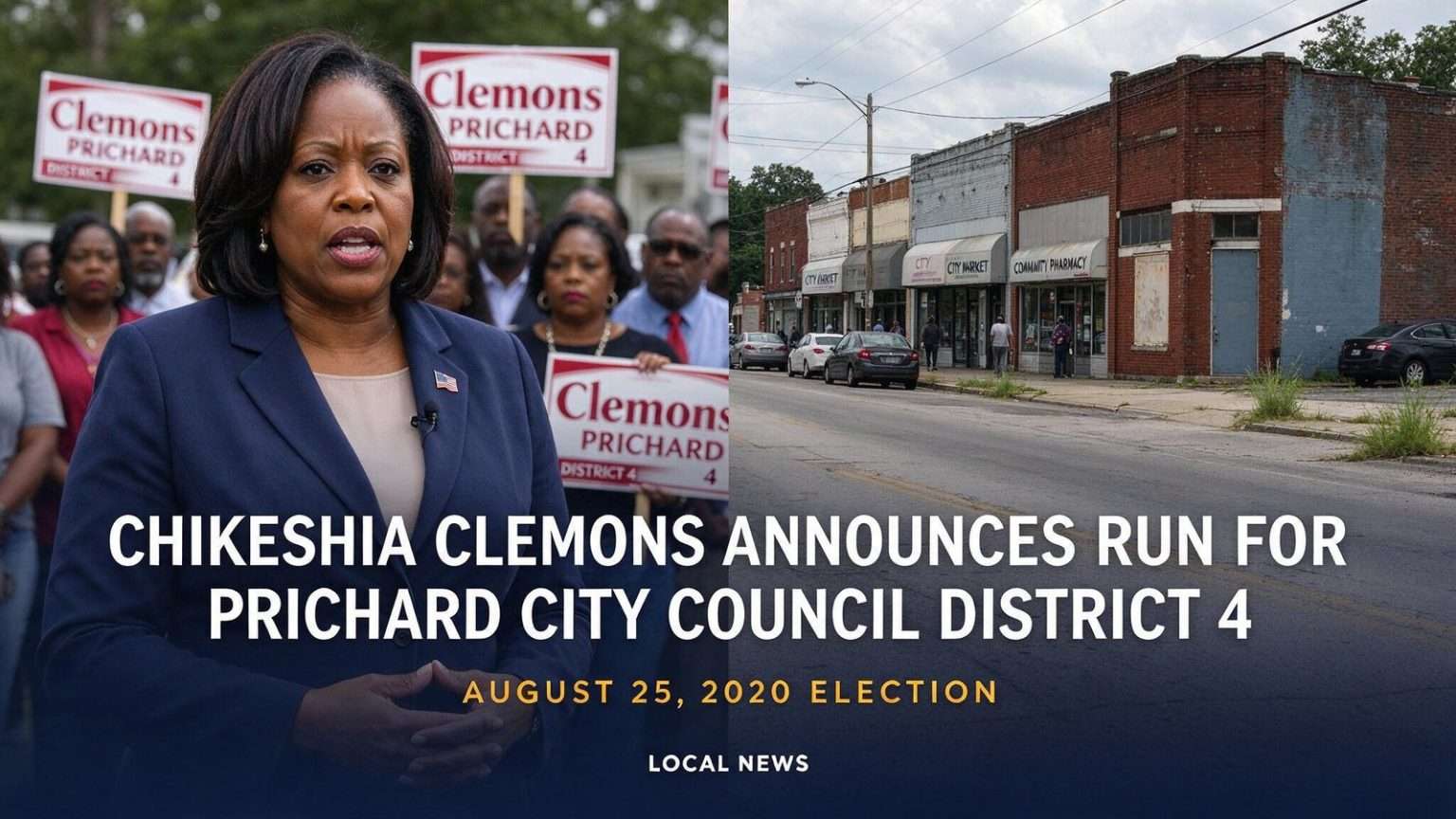
Chikeshia Clemons has announced she is running for Prichard City Council District 4, pledging to focus on rebuilding the city’s economy, supporting young residents and improving basic services. Her entry into the race adds a new voice to a municipal election season in one of the Mobile area’s oldest communities, where questions of economic development, blight and public services have dominated local political conversation for years. In her announcement, Clemons said she wants to help cultivate more Black-owned businesses and invest in the city’s development, clear away abandoned buildings and expand support for the city’s youth. “I pledge to listen to residents of District 4, act upon their request(s) and ask that you hold me accountable for improving city services,” Clemons said, urging voters to register ahead of the August 25, 2020 election.
A District Shaped by Economic Challenges
Prichard, a city of roughly 22,000 residents in Mobile County, has spent decades working to overcome the loss of manufacturing jobs and retail investment that once anchored its economy. The city filed for municipal bankruptcy twice, in 1999 and again in 2009, making it one of the most financially distressed municipalities in Alabama history. City leaders have since pursued redevelopment through grant programs, commercial corridor improvements and partnerships with county and state agencies, but many neighborhoods still show the scars of disinvestment in the form of vacant homes and overgrown commercial lots.
That reality is central to Clemons’ platform. Her pledge to clear away abandoned buildings speaks to a problem that goes beyond aesthetics: derelict structures depress neighboring property values, attract illegal dumping and pose fire and safety hazards for surrounding homes. Municipalities across the Gulf Coast have turned to demolition programs, blight courts and land banks to address similar issues, and Prichard’s own code enforcement efforts have been a recurring topic at city council meetings. Candidates for the council have frequently made blight removal a headline promise, and District 4 voters will likely weigh each contender’s record on that front.
Clemons’ emphasis on Black-owned businesses also fits the economic profile of the city. Prichard is predominantly African American, and community organizations in Mobile County have pushed in recent years for greater access to capital, contracting opportunities and technical support for minority entrepreneurs. Local business development advocates note that small enterprises along major corridors provide not only goods and services but also first jobs for young residents — the very constituency Clemons says she wants to support through expanded youth programming, mentorship and recreation.
The commercial geography of Prichard runs along corridors such as U.S. Highway 43, Bessemer Avenue and the streets surrounding the municipal complex on Craft Highway. Retail flight over the years shifted much of the area’s shopping traffic to neighboring Saraland, Chickasaw and Mobile, leaving local leaders to compete for grocery stores, restaurants and service businesses that can anchor neighborhood commerce. Council members in districts like the 4th often find themselves negotiating with property owners, pressing for code enforcement and chasing state and federal grant dollars to fund improvements that the city’s tight budget cannot absorb on its own.
From Viral Arrest to Campaign
Clemons is widely known for her 2018 arrest at a Saraland Waffle House, footage of which went viral and drew protests along with visits from attorney Benjamin Crump and the Rev. Al Sharpton. The incident became part of a national conversation about policing and the treatment of Black patrons and citizens in everyday encounters, and it thrust the Saraland and Mobile-area communities into coverage far beyond the Gulf Coast. Saraland borders Prichard to the north along U.S. Highway 43 and Interstate 65, so the case was watched closely across both cities. Crowds gathered in support of Clemons, and the case became a rallying point for activists in the Mobile area who saw it as emblematic of larger concerns about the criminal justice system.
She was convicted of disorderly conduct and resisting arrest in municipal court, but appealed and won a jury trial. In August 2019 a jury found her not guilty on the disorderly conduct count while convicting on resisting arrest. The split verdict closed out a case that had stretched on for more than a year, and Clemons emerged from it as a recognizable public figure in the Mobile area — a familiarity that now follows her onto the campaign trail in Prichard. The case also illustrated the role of jury trials in municipal appeals, a process that Alabama defendants can pursue when contesting convictions from city courts. Under Alabama law, a defendant convicted in municipal court is entitled to a trial de novo before a jury in circuit court, where the case is heard again from the beginning.
Her transition from courtroom defendant to council candidate reflects a pattern seen in communities across Alabama, where individuals whose encounters with the justice system drew public attention have channeled that visibility into civic engagement, advocacy and elected office. Civil rights figures such as Benjamin Crump and the Rev. Al Sharpton have long used high-profile cases to press for broader reforms, and the visits they made to the Gulf Coast highlighted the activism of local residents who organized protests and demanded accountability in the wake of the viral video.
For District 4 residents, the question in the August 25, 2020 contest will be how that experience translates into the day-to-day work of a city council: approving budgets, setting policy for public works, and holding city departments accountable for service delivery. Clemons has suggested that her own experience navigating the courts and speaking out publicly gives her a direct understanding of what it means when government institutions fall short of the people they serve.
What the Council Seat Involves
Prichard operates under a mayor-council form of government, with a seven-member council that sets municipal policy, adopts the annual budget and confirms key appointments. Council districts divide the city geographically, and each district’s representative serves as the first point of contact for residents dealing with potholes, streetlights, drainage, trash pickup and other basic services — precisely the “city services” Clemons’ pledge centers on. Council members typically serve four-year terms and earn a part-time salary, with most holding other jobs in the community.
The August 25, 2020 municipal election date applies to cities across Alabama holding regular municipal contests that year, and Clemons’ urging of early voter registration echoes longstanding efforts by civic groups in Mobile County to boost turnout in city elections, which historically draw far fewer voters than state or national races. Registration deadlines, absentee ballot rules and polling place locations are all administered locally, and candidates in Prichard’s races have traditionally leaned on door-to-door outreach and church and community meetings to reach voters. Absentee voting through the Mobile County circuit clerk’s office offers an option for residents who cannot reach the polls on election day, and 2020 brought added attention to those procedures as communities weighed precautions during the COVID-19 pandemic.
Youth investment, another pillar of Clemons’ announcement, has been a persistent theme in Prichard civic life. The city’s parks and recreation programs, after-school initiatives and partnerships with Mobile County Public Schools all fall within the influence of the council’s budget decisions. Advocates for young people in the city have pointed to the need for safe recreational spaces, summer employment and mentoring programs as alternatives to the pressures that come with concentrated poverty. Candidates who can connect those programs to concrete funding priorities tend to resonate with parents and grandparents who make up a large share of the municipal electorate.
The Road to August
As the campaign moves forward, residents of District 4 can expect discussions of economic development incentives, the pace of demolition and clearance of abandoned properties, funding for youth services, and the responsiveness of city departments to constituent complaints. Clemons has framed her candidacy in exactly those terms, promising accountability and an open line to the people she would represent. Municipal contests in Prichard are decided in the summer election unless a runoff is required, so the August vote carries decisive weight. Qualifying periods shape the field in the months before the vote, and independent momentum around a well-known candidate can reshape expectations in a district race that might otherwise draw limited attention.
Whether her story — from a viral arrest and a hard-won jury verdict to a bid for public office — becomes an asset with voters is the question the August election will answer. What is clear is that District 4’s electorate will have a choice among candidates offering competing visions for a city working to rebuild itself, and that the issues Clemons has placed at the center of her campaign — businesses, blight, youth and basic services — mirror the concerns residents raise most often in city hall’s public comment periods. For a city that has spent two decades clawing back from fiscal crisis, the 2020 council elections represent another chapter in that longer effort, and the voters of District 4 will help decide who carries it forward.