Mobile-Born Writer Albert Murray Honored in New York Magazine’s ‘9 Over 90’ Feature
Mobile-born writer Albert Murray, 94, is featured in New York magazine's '9 Over 90' spotlight on the city's influential elder statesmen of arts and.
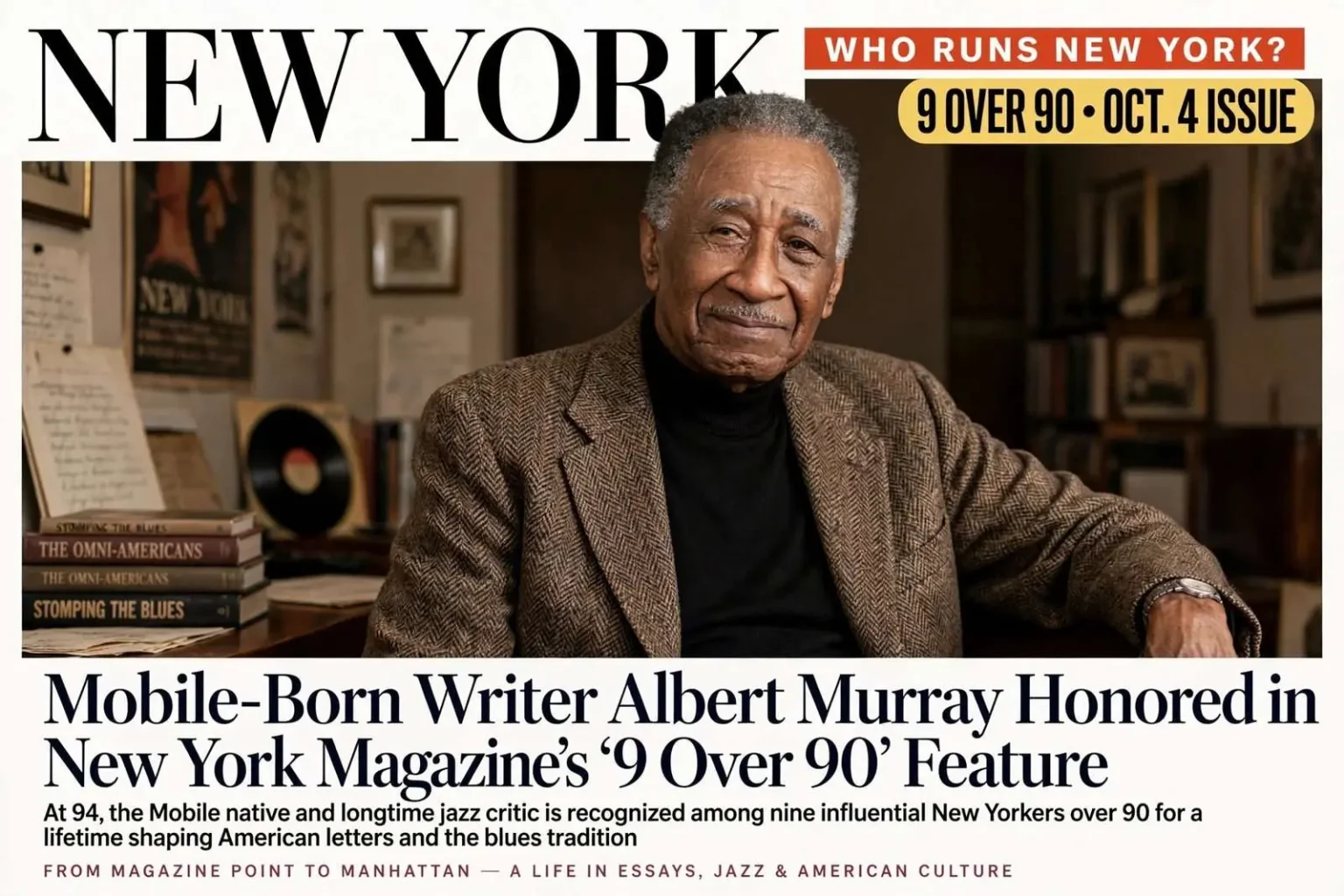
A Mobile native who has spent more than half a century shaping American letters and jazz criticism from New York City is getting fresh recognition this month. The Oct. 4 issue of New York magazine, in its cover package “Who Runs New York?,” includes a “9 Over 90” section spotlighting nine influential New Yorkers over the age of 90 — among them 94-year-old writer Albert Murray. The section places Murray alongside a cross-section of the city’s most durable figures, an unusual honor for a writer whose work has often sat outside the literary mainstream even as it shaped it.
The magazine’s exercise in cataloging influence is, on its face, about power in its usual forms — politics, finance, media and real estate. But the editors reached beyond those categories to include cultural figures whose authority rests on decades of ideas, and Murray’s inclusion testifies to how deeply his thinking has penetrated the city’s cultural conversation since he settled there after his military career.
The magazine’s brief profile calls Murray, author of the essay collection “The Omni-Americans” and the jazz history “Stomping the Blues,” a figure who “has remained at the center of the city’s intellectual life for decades.” It notes that his most recent novel, “The Magic Keys,” was published when he was 89. For a writer who published his first major book in his late fifties, that late-life productivity has become part of his legend, and the magazine’s editors clearly counted it among the reasons he still matters.
From Magazine Point to Manhattan
Murray was born in south Alabama in 1916 and raised in Mobile’s Magazine Point neighborhood, near the Africatown community founded by survivors of the Clotilda. The geography of his childhood matters to his work: Magazine Point sat in the industrial edge of the city, a community of working families whose lives, language and storytelling traditions would later surface in his fiction and essays. The nearby Africatown settlement, whose founders had endured one of the most notorious episodes in the history of the Atlantic slave trade, formed part of a landscape where memory and resilience were everyday facts.
He attended Tuskegee Institute, where he formed a lifelong friendship with fellow writer Ralph Ellison, before going on to a career that included teaching, service as an officer in the U.S. Air Force, and eventually a prolific run as a novelist, essayist and jazz historian after settling in New York. The Tuskegee years gave him both an education and a circle of peers, among them Ellison, whose own novel would redefine American literature and whose conversations with Murray about music, folklore and fiction continued for decades.
The friendship between Murray and Ellison became one of the celebrated intellectual partnerships of the postwar era. Their correspondence and conversation, carried on through years in which both men were writing books that challenged prevailing assumptions about Black American life, helped shape the ideas that would appear in Murray’s essays and Ellison’s fiction alike. New York, where both eventually settled, became the stage on which that dialogue played out.
Murray’s path to the city ran through the military. His years as an officer in the Air Force took him across the country and overseas, and he began writing in earnest during that period, turning out essays and manuscripts between assignments. By the time he retired from the service and committed himself fully to writing, he had accumulated the experiences and the discipline that would sustain one of the most distinctive bodies of work in American letters.
When his breakthrough books finally arrived, they arrived with unusual force. Murray wrote about Black American life not as a saga of victimhood but as a story of heroism, style and improvisation, insisting that the blues and the rituals of Black life constituted an indigenous American aristocracy of spirit rather than a literature of grievance.
Over the decades, Murray became a central figure in American letters, known for his writing on race, identity and the blues idiom in American culture, as well as his close collaborations with musicians including Duke Ellington. His essays argued that the blues was not a cry of despair but a discipline of style, a way of confronting adversity with elegance and grace, and that argument reframed how a generation of critics understood American music.
His books brought that sensibility to a wide range of subjects. He wrote memoir and reportage about returning to the South of his childhood, fiction that drew on the storytelling rhythms of Magazine Point and the broader Black South, and criticism that placed jazz at the center of the national imagination. Reviewers did not always agree with him, but few ignored him, and his ideas traveled through the work of other writers, critics and musicians who absorbed his vocabulary of heroism and improvisation.
The collaboration with Duke Ellington stands out in a career full of musical connections. Murray wrote about Ellington with an admiration that treated the bandleader not merely as an entertainer but as a composer of the first rank, an American original whose music embodied the elegance he found throughout the blues tradition. His conversations and writing about Ellington and other musicians helped define how jazz would be discussed in the years when the music was fighting for institutional respect.
He later served as a founding advisor to Jazz at Lincoln Center, helping shape one of the country’s leading jazz institutions. The organization’s rise from an ambitious concert series to a permanent institution with its own venue reflected exactly the kind of cultural legitimacy Murray had spent decades arguing that the music deserved. His role in its founding placed him, in his seventies and eighties, at the table where jazz’s institutional future was being decided.
Through all of it, Murray remained a public intellectual in the oldest sense: a writer whose apartment on the Upper West Side drew visitors from across the worlds of literature, music, academia and journalism, and whose conversation was regarded by those who experienced it as a performance in its own right. The New York magazine profile’s phrase about the center of the city’s intellectual life was not an exaggeration but a description of a living institution.
What the recognition means
Recognition of this kind carries meaning in two places at once. In New York, it places Murray among the figures whose longevity and influence define the city’s cultural hierarchy, alongside leaders from fields far removed from literature. In Mobile, it serves as a reminder that the city’s export to Manhattan has spent a lifetime shaping conversations that began in classrooms and neighborhoods far from Harlem.
New York magazine’s brief but pointed recognition is a reminder that one of Mobile’s own has spent a lifetime near the center of the city’s cultural conversation — still publishing new work into his 90s, and still, as the magazine put it, part of what runs New York. For Alabama readers, the profile is also an invitation to revisit the work of a writer whose celebration of the blues idiom and the Black South began in Magazine Point and never really left it behind.
The “9 Over 90” framing is itself worth considering. Listings of influential New Yorkers usually skew young, toward the executives and elected officials who hold formal power. By singling out nine people who had already spent ninety years shaping the city, the magazine acknowledged a different kind of influence — the accumulated authority of people whose ideas and institutions outlast any single administration or market cycle. Murray’s presence on that list places him in the company of figures whose work has become part of the city’s permanent furniture.
For readers encountering him for the first time through the magazine’s profile, Murray’s bibliography offers an unusual entry point, because his books cut across categories that publishers and bookstores usually keep separate. He wrote fiction that reads like memoir and criticism that reads like storytelling, and his essays moved between music, politics and literature with a confidence that made the boundaries feel unnecessary. Newcomers to his work often start with the essays and find their way to the novels, or the reverse, and either path leads into the same integrated vision of American culture.
His Alabama roots run through that vision at every turn. The storytelling tradition he absorbed in Magazine Point — the talk of front porches and barber shops, the legends and boasts and improvisations of neighbors — became the model for the fictional villages of his novels and the cadence of his prose. He described the South he grew up in with an unsentimental affection, insisting that its culture was cosmopolitan in substance long before it was recognized as such by critics elsewhere.
The proximity of Magazine Point to Africatown gave that perspective a particular depth. The community founded by the survivors of the Clotilda represented, in physical form, the continuity of memory that Murray celebrated in his writing: a group of people who had survived an unspeakable ordeal and built a town that kept its identity intact for generations. Writers and historians who have examined both communities note how much of the Gulf Coast’s cultural inheritance passes through neighborhoods like these, where ordinary working families preserved traditions that would eventually inform American art on a national scale.
Murray’s influence on younger generations of writers and critics has continued to grow since his books first appeared. Scholars have organized conferences around his work, his essays have returned to print in new editions, and musicians and writers alike cite his insistence on elegance under pressure as a formative standard. The profile in New York magazine reaches that audience along with the general reader, performing the useful service of reminding both that the writer is still present, still sharp, and still publishing.
For Mobile, the recognition also arrives amid renewed attention to the city’s role in the histories his work touches. Interest in Africatown and the story of the Clotilda has grown steadily, drawing visitors, researchers and journalists to the neighborhoods just north of downtown where Murray spent his boyhood. That attention has connected the city’s past to its present in new ways, and Murray’s national profile gives local readers another point of entry into that history.
The Oct. 4 issue will circulate in New York as a snapshot of who matters in the city this year. In Mobile, it reads differently — as confirmation that the boy from Magazine Point who left Alabama for Tuskegee and then for Manhattan carried the Gulf Coast with him all the way, and that the cultural capital he built over ninety-four years now counts, by the magazine’s reckoning, among the things that run New York.