Mobile City Council Weighs Fate of Crichton Recording Studio’s Zoning
Mobile's city council took up a rezoning request for a Crichton neighborhood recording studio that had operated for years without proper zoning approval.
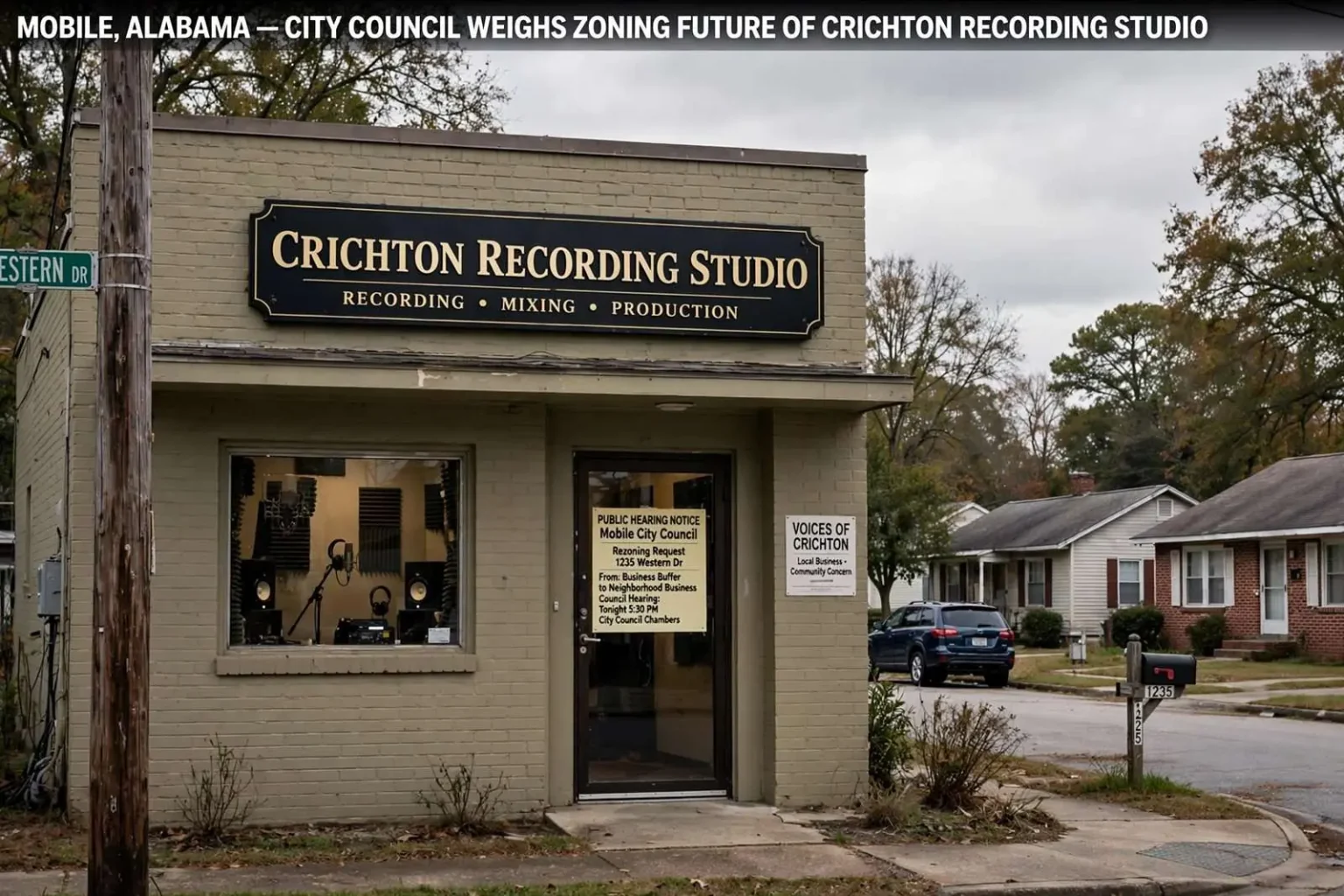
MOBILE, Alabama — The Mobile City Council took up the fate of a recording studio in the Crichton neighborhood during its regular meeting, considering a request to rezone the property on Western Drive from a “business buffer” designation to “neighborhood business.”
The studio, which had been operating out of the residential-adjacent property for roughly three years without the proper zoning classification, needed the change to legally continue operations at the site.
City planners and neighbors had weighed in on the request in the months leading up to the vote, with the Mobile Planning Commission previously declining to recommend approval. That recommendation left the council to decide the question on its own — a position the seven-member body regularly finds itself in when rezoning requests arrive with mixed reviews from the city’s planning staff and the neighborhoods they affect.
Supporters of the rezoning argued the studio provided a creative outlet and small business presence in a part of Mobile that could use investment, while some nearby property owners raised concerns about noise and the precedent that granting a “spot zoning” exception could set for future requests along the same corridor.
The Zoning Question Explained
The dispute turned on the difference between two zoning categories most residents never think about until they intersect. “Business buffer” designations exist to separate heavier commercial activity from residential areas, functioning as transitional zones where the city expects limited, low-impact uses. “Neighborhood business” allows a broader range of small-scale commercial operations — the kind of enterprises meant to serve nearby residents without bringing the traffic, hours or noise of general commercial development.
Whether a recording studio fits either category is exactly what the hearing was for. A studio produces periodic sound levels that neighbors can find intrusive, but it generates little traffic, operates by appointment and often overnight, and can anchor a block with steady, quiet business activity between sessions.
The “spot zoning” objection carried particular weight in the debate. Spot zoning occurs when a small parcel is rezoned to benefit a single owner in a way that departs from the surrounding area’s comprehensive plan, and granting such exceptions can invite a cascade of similar requests. Opponents argued that approving one studio’s request on Western Drive would make it harder to refuse the next application along the corridor; supporters countered that the studio’s three years of operation demonstrated exactly the kind of neighbor the zone could accommodate.
The council’s dilemma reflected the hard cases zoning boards face everywhere: a use that already exists, a neighborhood divided about whether it belongs, and a planning commission that has already said no.
Crichton’s Context
The Crichton neighborhood, in the northern part of Mobile, has spent years working to stabilize and rebuild its commercial corridors, and zoning decisions there carry stakes beyond a single property. Community groups in the area have long argued that the neighborhood needs functioning small businesses — the shops, services and gathering places that give a district life — and a locally rooted recording studio fits the profile of the kind of enterprise revitalization efforts hope to attract.
At the same time, residential streets in Crichton sit close to its commercial parcels, which is why buffer zones exist in the first place, and why neighbors’ noise concerns deserved a serious hearing rather than dismissal. The tension between welcoming investment and protecting residential quality of life is not unique to Crichton, but it is sharpest in neighborhoods where both goals remain works in progress.
Sidewalks for Toulminville
The council session also touched on several other pieces of city business. Councilman Fred Richardson highlighted a roughly $65,000 design contract for new sidewalks in the Toulminville area, a project he said he had pushed for since the late 1990s.
The long arc of the sidewalk request illustrates how municipal infrastructure actually moves: years of advocacy, then funding, then a design contract that precedes construction by months. Design work — surveying, engineering, drainage planning, right-of-way determination — is the unglamorous phase that determines whether sidewalks actually get built and whether they work for the pedestrians they’re meant to serve.
For Toulminville, sidewalks are more than a convenience. The neighborhood’s commercial corridors and school zones draw heavy pedestrian traffic, and walkers there have long contended with routes that force them onto the roadway. New sidewalks connect homes to bus stops, shops and campuses, and they represent exactly the kind of neighborhood-level improvement residents cite when they ask where their tax dollars go.
Doyle Park and a New Skateboard Park
Representatives from the Mobile Airport Authority and Airbus Mobile also appeared before the council to discuss ongoing revitalization work at Doyle Park, telling members that a recent 5K race held to benefit the park raised approximately $80,000 toward a new playground and other improvements.
The partnership reflects how Mobile’s largest corporate residents have become involved in neighborhood improvement. The Airport Authority’s interest in the park flows from its location near the airport corridor, and Airbus — which built its final assembly line in Mobile and has drawn national attention to the city — has invested in community projects as part of its presence in the region. An $80,000 single-event raise for a neighborhood playground is a notable figure for any community, and it signals the kind of public-private collaboration city officials have promoted.
Separately, Mobile Mayor Sandy Stimpson’s office announced that a groundbreaking ceremony was held the same day for a new skateboard park at Public Safety Memorial Park on Airport Boulevard, part of a broader push to add recreational amenities across the city.
The skateboard park adds to a citywide inventory of athletic facilities — fields, courts, gymnasiums and now concrete — that the administration has worked to expand and modernize. Skate parks in particular serve a constituency that traditional parks programming often misses, giving young skaters a dedicated, designed space instead of parking lots, plazas and stair sets that weren’t built for them.
The Rest of the Agenda
Council members also approved a handful of routine items during the meeting, including support for the Doyle Park revitalization effort and authorization to demolish a vacant structure on Alba Club Road.
Demolition authorizations are a recurring item on Mobile’s council agendas, part of the city’s ongoing effort to clear blighted and abandoned structures that drag down surrounding property values and attract hazards. Each vacant structure the city tears down requires authorization, funding and a process that gives owners notice — but the cumulative effect across a city is one of the most visible forms of neighborhood improvement government can deliver.
The council’s support for Doyle Park formalized the city’s role in the revitalization push that the Airport Authority and Airbus described, aligning municipal backing with the private and quasi-public fundraising that has driven the project’s momentum.
What the Zoning Vote Signals
However the Western Drive question was decided, the hearing offered a look at the choices Mobile faces as its neighborhoods evolve. Zoning is where a city’s priorities become binding law — where the abstractions of a comprehensive plan meet a specific property, a specific business and a specific group of neighbors with names and concerns.
For Crichton, the studio’s fate became a proxy for a larger question: whether the neighborhood’s corridors will fill with the small enterprises that make a district walkable and alive, and on what terms the residential streets nearby will accept them. The planning commission’s no recommendation set a conservative default; the council’s decision would either uphold it or carve out an exception whose consequences will show up in the next request, and the one after that.
The rest of the meeting’s business — sidewalks that took two decades to reach design, an $80,000 race for a playground, a groundbreaking for skaters, a vacant structure cleared — painted the fuller picture of a city working neighborhood by neighborhood, one contract and one vote at a time.
How Mobile’s Rezoning Process Works
The path that brought the Western Drive request to the council is the standard one for zoning changes in Mobile. A property owner files an application, the city’s planning staff reviews it against the comprehensive plan and surrounding land use, the Mobile Planning Commission holds a public hearing and issues a recommendation, and the City Council makes the final decision at its own hearing — where the applicant and neighbors both get their say.
The commission’s recommendation carries weight but not the final word. Councils across the country regularly override planning commissions in both directions, sometimes because local elected officials know their districts better than the staff’s maps can show, and sometimes because political pressure pushes against the professional recommendation. Either way, the public record — staff analysis, commission deliberation, neighbor testimony — shapes how the final vote is judged afterward.
For the studio’s operator, the stakes were existential: without the rezoning, three years of investment in a business on Western Drive had no legal path forward at that location. For the neighbors, the vote would define what their corner of Crichton looks and sounds like for years, since zoning changes rarely reverse once granted and businesses operate on them indefinitely.
The Noise Question on Both Sides
Noise was the practical heart of the opposition, and it deserves to be understood on its own terms. Recording studios are designed to contain sound — acoustic treatment is the core of the business — but hours of operation, parking turnover and loading activity all generate their own rhythms that differ from a quiet residential street.
Supporters argued, with reason, that a well-run studio is among the quieter commercial neighbors a residential area can have compared with a restaurant, a service station or a retail store with steady daytime traffic. Opponents’ concern was less about decibels than precedent: that a use granted by exception becomes a standard applied down the corridor, parcel by parcel, until the buffer the city drew on the map exists only on paper.
Both arguments were legitimate, which is precisely what made the request a genuine judgment call rather than a procedural formality — the kind of decision the council exists to make.
A Meeting That Showed the City at Work
Taken together, the evening’s agenda traced the full range of what a city council does: adjudicating a land-use dispute that will shape one neighborhood’s future, funding pedestrian infrastructure two decades in the making, partnering with the port city’s biggest employers on a playground, breaking ground on recreational facilities, and clearing the vacant structures that hold blocks back. Each item was small in isolation; accumulated, they are what neighborhood change in Mobile actually looks like — measured in contracts, votes and groundbreakings rather than grand announcements.