University of South Alabama Mobile
Mobile Officials Contrast Handling of 2012 Gil Collar Shooting With Ferguson Unrest
Mobile County law enforcement leaders say swift, transparent communication set the 2012 Gil Collar shooting response apart from the unrest that followed Ferguson.
As national attention remained fixed on Ferguson, Missouri, in late 2014, Mobile County law enforcement leaders pushed back on comparisons that some national outlets drew between that case and the 2012 shooting of a University of South Alabama student on campus, arguing the two incidents were handled in fundamentally different ways.
The USA student, an 18-year-old, was shot and killed by a campus-area officer after behaving erratically and unclothed, a situation later attributed to his having taken a synthetic drug. The shooting divided the university community and drew intense scrutiny at the time, but local officials say it never approached the scale of the unrest seen in Ferguson following the shooting of Michael Brown.
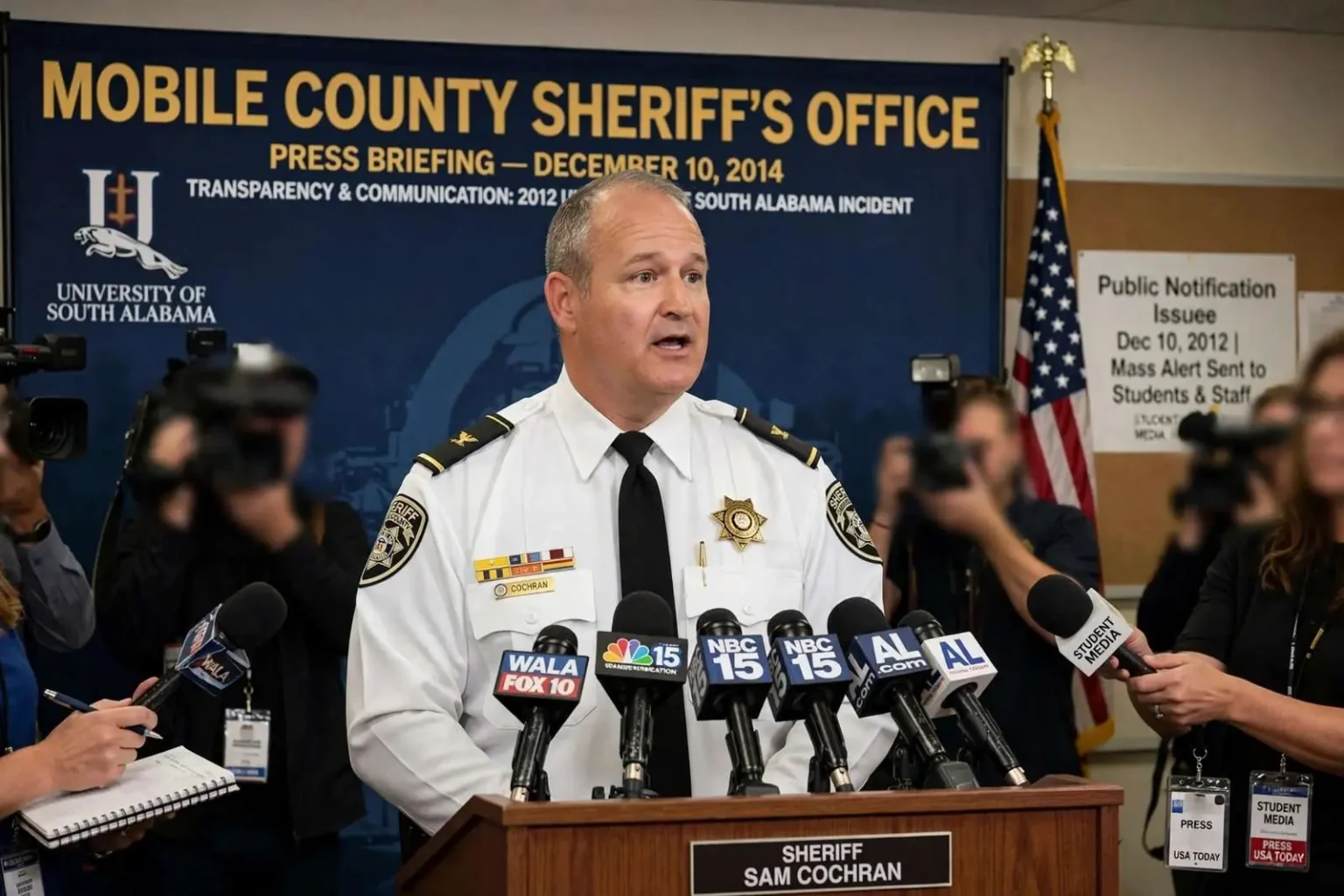
Mobile County Sheriff Sam Cochran told reporters that communication was the deciding factor in how each case played out. Within about half a day of the USA shooting, the university held a news conference and issued a public statement describing what had happened, while the school’s public relations office sent a mass notification to students and staff.
Coverage of the shooting quickly reached national and international news outlets. About a week after the shooting, Cochran invited members of the media, including student journalists, to view surveillance footage of the incident. He said members of the public, especially parents of prospective students, were anxious for information, and that releasing the video helped ease concerns.
“I think the communication calmed people down,” Cochran said, contrasting that approach with what he described as a much slower release of information in Ferguson, where authorities went roughly two months without disclosing key details about the encounter between the officer and Brown.
A spokeswoman for the sheriff’s office added that keeping media outlets informed directly from official sources helps prevent speculation from filling an information vacuum. She said race, which became a central issue in Ferguson, was never a significant factor in how the Mobile case unfolded or was perceived locally.
How the local response took shape
Mobile County’s district attorney at the time said the office made a point of keeping the media and the public aware of developments as the investigation into the USA shooting proceeded, crediting close working relationships between local law enforcement, prosecutors and journalists for a comparatively calm public response.
The comparisons resurfaced two years after the original shooting as Ferguson dominated national headlines, prompting South Alabama officials to reflect on the lessons learned from their own community’s experience with a high-profile police shooting.
The University of South Alabama sits in the heart of west Mobile and ranks among the largest universities on the Gulf Coast, with a campus that functions much like a small city, complete with its own police force, housing, medical facilities and thousands of students moving through it every day. When an officer-involved shooting occurs in that kind of environment, officials face a narrow window in which to establish the facts before rumor takes hold.
In the Mobile case, that window was used quickly. University leaders did not wait for the investigation to conclude before speaking publicly, and the sheriff’s office followed through by opening its own files to scrutiny, including the unusual step of allowing reporters and student journalists to view the surveillance footage themselves rather than relying on secondhand descriptions.
That decision carried risk, since the video showed the shooting itself, but Cochran argued that the alternative, allowing the public to imagine what the footage contained, was worse. Parents weighing whether to send their children to the university wanted to know what had happened and how the institution responded, and he said the video answered questions that a written statement could not.
Why communication became the dividing line
The Ferguson case unfolded in almost the opposite manner. Authorities there released little information in the crucial early days, and the void was filled by conflicting accounts, mounting protests and national media coverage that kept the St. Louis suburb in the spotlight for months. By the time key details emerged, the public narrative had hardened in ways that official statements could no longer shape.
Cochran and other Mobile County officials studied that dynamic and drew a straightforward conclusion: speed and transparency in the first hours and days of a crisis do more to preserve public calm than any amount of messaging after the fact. A news conference held within half a day, a mass notification to students and staff, and a willingness to show the underlying evidence all worked together, in their view, to keep the community engaged rather than enraged.
Emergency managers and public information officers across the Gulf Coast have increasingly adopted the same playbook. Mass text and email alert systems now reach students within minutes, and agencies train spokespeople to brief reporters on a regular cycle even when there is little new to report, on the theory that an official voice in the room crowds out speculation.
The sheriff’s office spokeswoman noted that the relationship works in both directions. When reporters know they will get timely, accurate updates from investigators, they are less likely to chase anonymous sources, and when the public sees consistent information coming from official channels, conspiracy theories have less room to grow.
The decision to show the surveillance footage also placed Mobile ahead of a national argument that has only intensified since. Across the country, agencies have wrestled with when to release video of officer-involved encounters, balancing the integrity of ongoing investigations against a public that increasingly expects to see such evidence for itself. Mobile’s experience suggested that erring on the side of release, once the basic facts are established, builds trust rather than undermining it.
Race, which transformed the Ferguson shooting into a national referendum on policing, played a markedly different role in Mobile. The spokeswoman said it was never a significant factor in how the case unfolded or was perceived locally, and local leaders have pointed to that difference as evidence that community relationships are built long before a crisis arrives.
Mobile County, like any large Southern county, has its own complicated history with race and policing, but officials said the response to the USA shooting reflected years of routine cooperation among the sheriff’s office, the district attorney, city police departments and the news organizations that cover them. Those relationships are maintained in ordinary times, they argue, and that is what makes them hold under pressure.
For families across the Gulf Coast, the episode carried practical weight as well. Parents of current and prospective students followed the case closely, and the university’s candor in the days after the shooting became part of the calculus many families used in judging how the institution would respond in a future emergency. Officials have said that reputational benefit, earned through transparency, outlasted the negative headlines of the shooting itself.
The drug factor in the 2012 case
Another element that distinguished the Mobile case was the finding that the student had taken a synthetic drug before his death. Synthetic substances, often sold under labels that suggest nothing more potent than potpourri or bath salts, have been linked across the Gulf Coast and nationwide to episodes of extreme agitation, disorientation and unpredictable behavior, and first responders in the region have repeatedly encountered individuals in the grip of such reactions.
In the 2012 incident, the officer who fired was confronted by an unclothed, erratic young man whose behavior, investigators later determined, was attributable to the synthetic drug he had ingested. The circumstances prompted discussion locally about how officers are trained to respond to individuals in medical or psychological crisis, a subject that has since become a recurring topic in law enforcement circles across Alabama.
For university officials, the episode also underscored the dangers that synthetic drugs pose to students. Unlike regulated substances, their chemical contents vary from batch to batch, their effects are unpredictable, and their use has been tied to severe reactions even in otherwise healthy young adults, warnings that area schools have continued to emphasize in student health messaging.
Lessons that outlasted the headlines
Two years on, the contrast between Mobile and Ferguson served as more than a point of local pride. It became a case study in how the handling of information, as much as the underlying incident itself, determines whether a community processes a tragedy through its institutions or takes to the streets.
Officials in Mobile County have said the experience reinforced practices they intend to keep: early and repeated public briefings, direct engagement with journalists including students, and prompt release of evidence where doing so serves the public interest. The sheriff’s office and the university emerged from the episode with their credibility intact, which they credit to the decisions made in the first hours after the shooting.
For residents of Mobile County, the episode offered a measure of reassurance that, should a similar crisis occur, the agencies responsible would talk to them first, quickly and candidly. That, Cochran suggested, is the difference between a community that grieves together and one that fractures, and it is a lesson he believed Ferguson’s turmoil had taught the entire country at a painful cost.