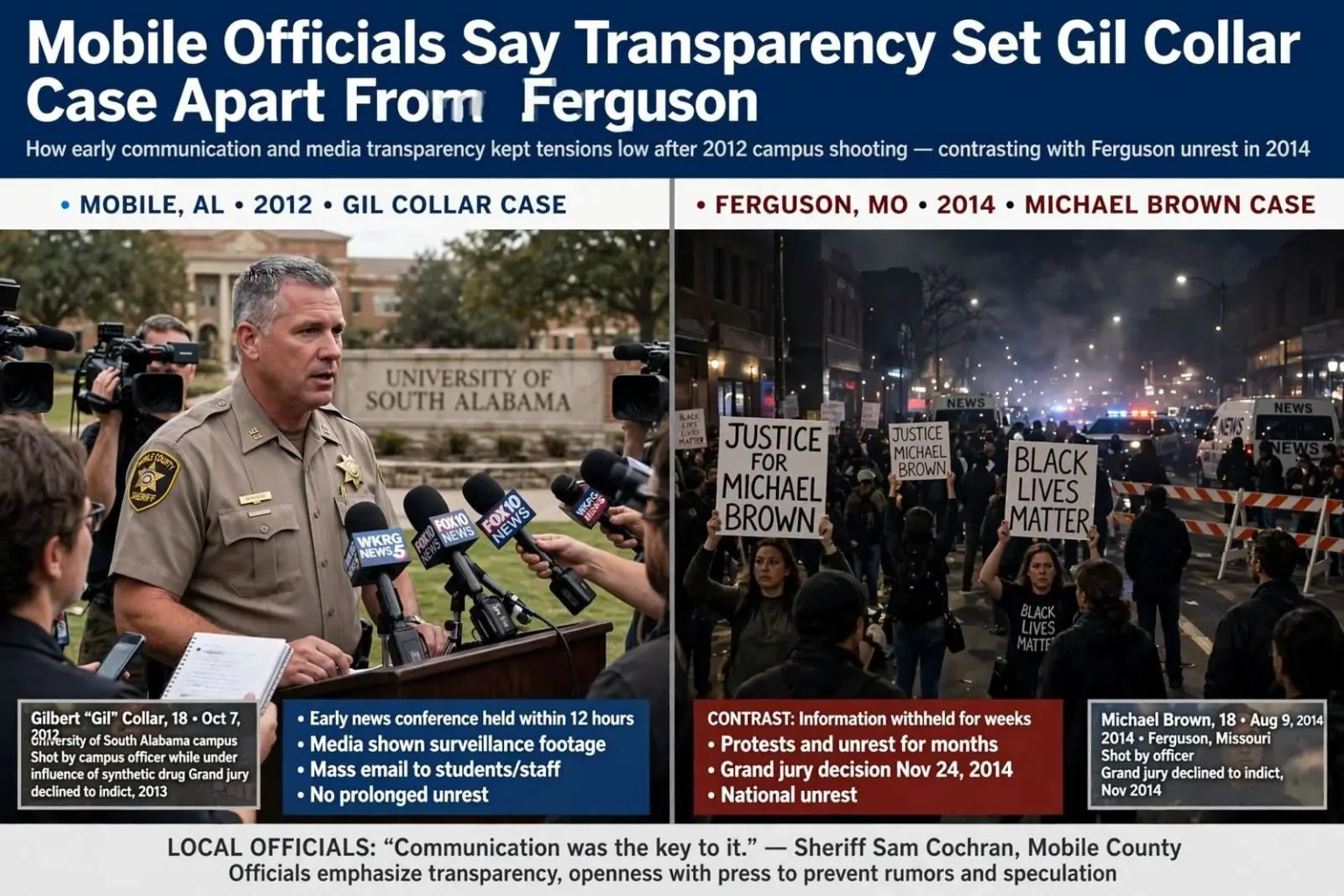
Law enforcement officials speaking at a news conferenceMobile County officials credited open communication with easing tensions after the Gil Collar shooting.

As protests over the police shooting in Ferguson, Missouri, dominated national headlines in late 2014, some commentators reached back to a case from the Gulf Coast for comparison: the 2012 death of University of South Alabama freshman Gilbert “Gil” Collar. Local officials in Mobile pushed back hard on the parallel, arguing that the two situations were fundamentally different and, above all, handled in very different ways.

Collar, 18, was shot and killed on the University of South Alabama campus by a campus police officer while he was unclothed and, investigators later determined, under the influence of a synthetic drug. The shooting rattled the university community, but according to Mobile County officials it never spiraled into the kind of prolonged unrest that followed the death of Michael Brown in Ferguson. The difference, they said, came down largely to communication.

“Communication was the key to it,” Mobile County Sheriff Sam Cochran said. Less than 12 hours after Collar’s death, the university held a news conference and released a statement. School officials described a philosophy of being as open and transparent as possible with students and the public during a crisis, and a mass email went out to students and staff. Coverage of the incident quickly spread far beyond Alabama, reaching national and international outlets.

A week after the shooting, Cochran took a further step that he credited with easing tensions: he invited members of the news media, including student journalists, to view the surveillance footage of the encounter from the officer’s vantage point. Reporters watched the recording twice and were allowed to describe what they saw. “In the Gil Collar case, the community was very concerned,” Cochran said, noting that parents were asking whether the campus was safe. “I think the communication calmed people down.” By contrast, he argued, authorities in Ferguson withheld information for weeks, fueling speculation.

Sheriff’s spokeswoman Lori Myles said a strong working relationship with the press is essential to preventing rumors from filling an information vacuum. “The media is going to publish information directly from the source,” she said, adding that Ferguson officials could have benefited from holding early news conferences. She also pointed to a central distinction between the two cases: “They’re focusing on race. This was never that.”

Mobile County District Attorney Ashley Rich agreed that the Collar case was managed “more effectively,” crediting close cooperation among prosecutors, law enforcement and journalists. “We felt that it was very important to make the media aware of what was going on, and that didn’t allow for rampant speculation,” she said.

See also  Spring Hill College Public Safety Gets Nearly $20,000 in Radio Equipment

For Cochran, the episode reinforced a broader lesson about how such incidents are perceived. “Shootings are not as they appear on TV,” he said, arguing that letting the public see the evidence for itself allowed both sides of the story to be told. The Collar case remained a painful chapter for the university, but local leaders held it up as an example of how transparency can keep a community tragedy from becoming a crisis of trust.

Mobile is the county seat of Mobile County in southwest Alabama and the state’s only saltwater port. Situated where the Mobile River meets Mobile Bay near the northern Gulf of Mexico, the city has long served as a commercial and cultural gateway between Alabama and the wider Gulf Coast. Founded in 1702 as Fort Louis de la Louisiane and ruled in turn by France, Britain, and Spain before joining the United States in 1813, Mobile carries a layered heritage distinct from the rest of the state.

Today Mobile anchors a metropolitan area spanning Mobile County and neighboring Baldwin County, and it remains a center for shipping, aerospace, healthcare, and higher education in the region. Its downtown and waterfront have seen sustained revitalization, while historic neighborhoods preserve architecture from its colonial and antebellum past. The city’s identity is shaped as much by its working port and industrial base as by its festivals and food culture, making it a frequent focal point for news about growth and change in southern Alabama.

Alabama is a state in the southeastern United States bordered by Tennessee, Georgia, Florida, the Gulf of Mexico, and Mississippi. Often called the Heart of Dixie, it spans Appalachian foothills in the north and flat coastal plains in the south. Its largest cities include Birmingham, Montgomery, Huntsville, and Mobile.

Alabama’s history encompasses Indigenous roots, Spanish and French colonial settlement, a cotton-plantation economy, the Civil War and Reconstruction, and the Civil Rights Movement of the 1950s and 1960s, followed by a shift toward manufacturing, aerospace, and technology. Local news across the state frequently reflects this mix of tradition and change.

The Gulf of Mexico borders Alabama’s southern edge and defines much of the state’s coastal identity. Alabama’s Gulf coastline, centered on Dauphin Island, Gulf Shores, and Orange Beach, supports a tourism industry built around beaches, charter fishing, and marine recreation, while offshore waters host shipping lanes and energy interests.

See also  38 Years Ago This Week: Led Zeppelin Played Mobile

The Gulf’s warm, shallow shelf and exposure to hurricanes make weather and disaster preparedness recurring concerns for communities from Mobile to Baldwin County. The marine environment also underpins commercial seafood harvests that have sustained Gulf Coast families for generations, tying the region’s economy and culture closely to the water.

Education in South Alabama spans public school systems in Mobile and Baldwin counties, a network of private and parochial schools, and institutions of higher learning including the University of South Alabama, Spring Hill College, and community colleges. Public-school governance rests with locally elected boards.

Boards oversee budgets, curricula, and facilities, often amid debates over funding equity and student achievement. The region’s colleges contribute not only to the workforce pipeline but also to healthcare, research, and cultural life, and education policy set in Montgomery frequently shapes what local districts can do.

Schools are also central to community stability. Enrollment trends, facility conditions, and graduation outcomes are watched closely by families and employers alike, making education a persistent focus of public attention and news coverage across the Gulf Coast.

Local journalism serves as the connective tissue of communities like those across South Alabama, informing residents about government, schools, public safety, and the events that shape daily life. Outlets covering Mobile and Baldwin County help hold institutions accountable and give voice to neighborhood concerns larger media may overlook.

In an era of shifting advertising revenue and the rise of digital platforms, community news organizations have had to adapt how they gather and deliver information. The persistence of regional reporting remains important for civic engagement, particularly on issues such as coastal development, education, and local governance that directly affect residents.

The relationship between a local newsroom and its community is reciprocal: readers supply tips, context, and a sense of what matters, while the reporting provides a shared record of decisions and events. That loop is essential to a well-informed public.

Local law enforcement across South Alabama is carried out by municipal police departments, county sheriff’s offices, and state agencies that together cover a mix of urban, suburban, and rural territory. City departments handle policing within municipal limits, while sheriff’s offices provide courthouse security, jail operations, and patrol in unincorporated areas.

Cooperation among these agencies, and with federal partners, is central to tackling problems that cross jurisdictional lines, from drug trafficking to violent crime. Joint task forces that pair federal agents with local officers have become a standard mechanism for sharing information and concentrating resources on threats that no single agency could address alone.

See also  2009 Was a Big Year for New Music From Mobile Bay Artists

Public-safety agencies in the region also contend with staffing, training, and community-relations challenges common to departments nationwide. How they allocate patrols, respond to calls, and engage neighborhoods is a regular subject of local oversight and news coverage, particularly where residents expect both accountability and visible protection.

Local government in the Mobile area operates through a combination of mayor-council or commission structures at the municipal level and a county commission in Mobile County, with elected officials handling budgets, public safety, infrastructure, and zoning. Baldwin County has its own commission and a collection of incorporated municipalities.

Decisions made in council chambers and commission meetings affect roads, school funding, economic development, and quality of life, which is why coverage of local government is a staple of regional journalism. The interplay between city, county, and state authorities often determines how effectively the area can address shared challenges.

Because many services residents rely on are delivered at the local level, the choices of elected officials have direct, everyday consequences. Budget priorities, in particular, reveal a community’s values and shape the trajectory of growth and public welfare for years to come.

Collegiate athletics are a major part of life in southern Alabama, where the University of South Alabama in Mobile fields the Jaguars across a range of sports. The university’s football program, which began competition in the 2000s, has become a rallying point for students, alumni, and residents and a source of regional pride.

Beyond the campus, youth, high-school, and recreational leagues across Mobile and Baldwin counties sustain a deep local sports culture, and tailgating and game-day traditions reflect the social fabric of the community. Coverage of local teams regularly intersects with broader themes of economic impact, community engagement, and the role of athletics in mid-sized Southern cities.