Mobile County Metro Jail Hits Record 1,806 Inmates in Sweltering Summer
Warden Trey Oliver said the Mobile County Metro Jail set an all-time population record of 1,806 inmates, far above its designed capacity, as summer heat and rising numbers strained the facility.
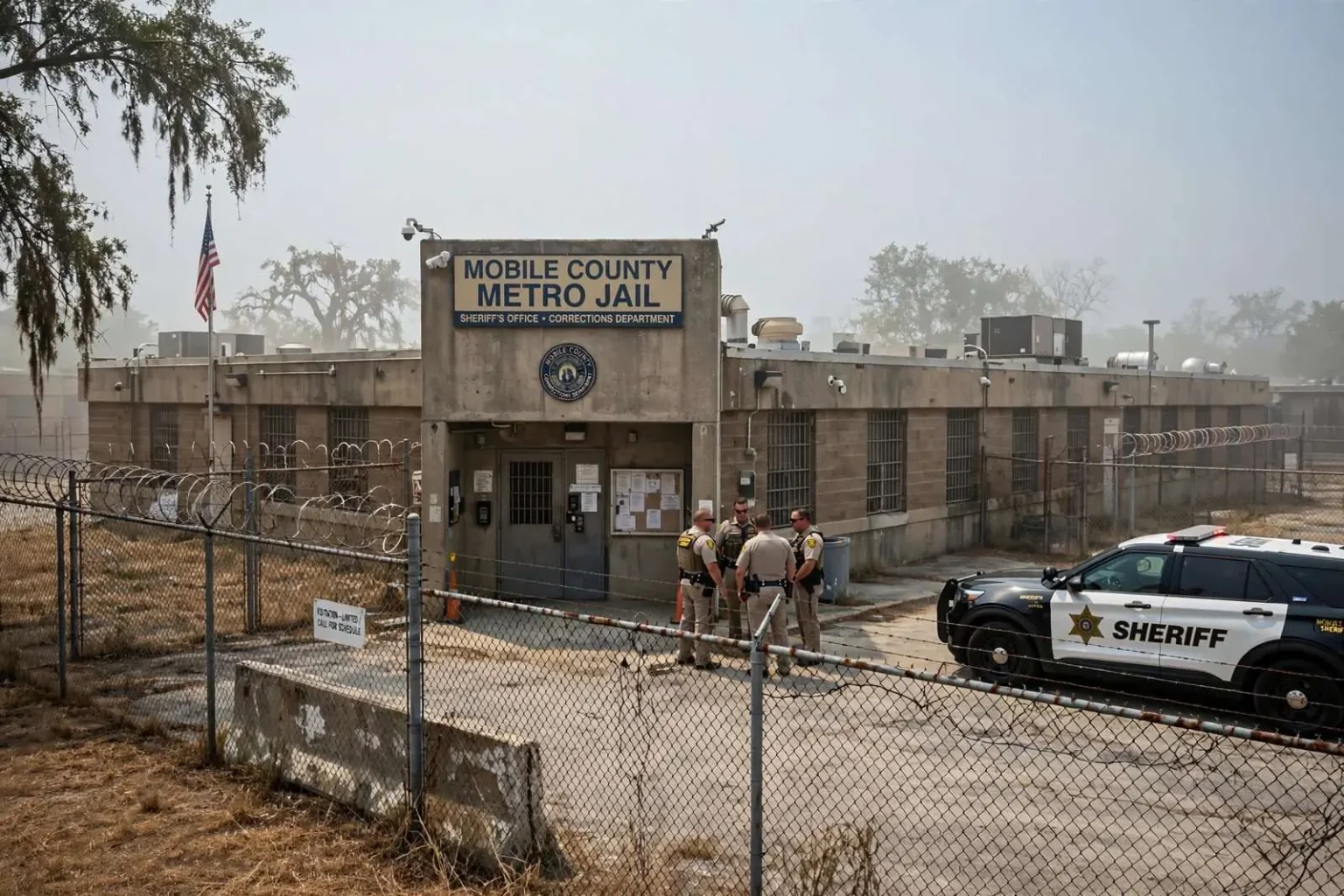
The Mobile County Metro Jail, never a pleasant place, becomes something closer to a purgatory in the depths of a Gulf Coast summer, when scorching temperatures and swelling inmate counts test everyone who toils or tarries behind its walls. This year proved no exception, according to Warden Trey Oliver, who reported that the jail had recently set an all-time population record.
A couple of weeks earlier, Oliver said, the jail held 1,806 inmates. Of those, 259 were women, 18 of them pregnant and three of those classified as “high risk” pregnancies. The numbers landed hard against the building’s design: the Metro Jail was built to house a maximum of 1,187 inmates, meaning it was running well beyond its intended capacity.
Behind the statistics stood a daily reality of crowded cells, stretched staff and the logistical strain of housing hundreds more people than the facility was ever meant to hold. The summer heat only sharpened the difficulty.
Crowding of that magnitude reshapes every routine inside a jail. Feeding 1,800 people three times a day in a kitchen built for far fewer, scheduling time in dayrooms and exercise yards so that housing units do not stack up on one another, moving inmates to court dates and medical appointments through corridors never designed for the traffic — each operation that a facility at design capacity handles smoothly becomes a logistical problem when the population overruns the blueprint. Sanitation, laundry, medical screening and visitation all compete for the same stretched hours and the same staff.
The medical picture adds a layer of urgency. Housing 18 pregnant inmates, three of them classified high risk, in an overcrowded facility means the jail’s medical contractor must manage obstetric appointments, specialist transports and the possibility of emergencies on top of the jail’s ordinary health care load — with every hospital trip requiring security escorts drawn from the same stretched ranks guarding the rest of the building.
The record count also arrives with financial weight. Every inmate beyond the budgeted population costs the county money — food, medical care, staffing overtime, laundry and transportation are all driven by headcount — and unbudgeted growth in the jail roster ripples through the sheriff’s annual spending request. A facility built for 1,187 operating at more than 1,800 is, in budget terms, a facility permanently running an emergency rate that its funding was never sized to sustain.
The Warden’s Candid View
Oliver, for his part, insisted he had it easier than the officers under his command. “My job is fun,” he said. “Those poor officers in the back, their job is very stressful and difficult on a GOOD day — the noises, the odors, the slurs, the disrespect, the mental illness, the bad behavior, the thefts, the assaults, the crowded conditions, the homeless, the needy, the bitchy, the dangerous, the suicidal.”
“I should be writing a book,” he added. “Most folks have no clue what goes on behind these walls.”
The blunt inventory offered a rare public glimpse into the pressures of running an overcrowded county lockup, where the population reflects everything from serious crime to untreated mental illness and homelessness.
Corrections officers work in an environment most residents never see, and the stress they describe is not rhetorical. Deputies and jailers spend entire shifts inside housing units where conflicts can turn violent without warning, where verbal abuse is constant, and where the people in their custody include the suicidal, the seriously mentally ill and the medically fragile. Overtime fills the gaps when shifts run short, and chronic overtime is itself a strain that wears on judgment, family life and retention — a cycle that makes understaffing worse the longer it lasts.
The warden’s remark about writing a book reflected a frustration common among the people who run county jails: the public generally encounters the jail only as a place others disappear into, with little understanding of what happens inside. Jails differ from prisons in tempo — the population turns over constantly as people are arrested, bonded, released or sentenced — which means intake processing, classification and release paperwork never stop, and every day begins with a housing roster that must be solved from scratch.
A ‘Revolving Door’ Under Scrutiny
The crowding fed into a broader civic conversation about the jail. Mobile City Councilwoman Gina Gregory planned to host a District 7 community meeting at 6:30 p.m. on Tuesday, Aug. 14, at the Mobile Museum of Art, a follow-up to earlier discussions that brought the jail’s conditions and the county’s criminal justice pressures before the public.
District 7 reaches into west Mobile, and Gregory’s meetings have drawn residents with direct questions about crime, policing and what happens to the people officers arrest. The jail’s record population gave those questions new force: a facility holding more than 600 people beyond its design capacity is not merely a county operations problem but a signal that the front end of the justice system — arrests, bonds, court delays and transfers to state custody — is moving more slowly than the streets are producing cases.
Jail populations are the product of every decision made upstream. County jails hold the newly arrested awaiting bond, defendants who cannot afford release, state inmates waiting for prison beds, and people serving short sentences of their own. When state prisons are full, state-serving inmates back up in county facilities; when courts backlogs grow, pretrial detainees wait longer; when mental health beds are scarce, the jail becomes the community’s largest de facto psychiatric facility. Each bottleneck adds bodies to the count, and none of them can be fixed inside the jail itself.
Alabama’s prison overcrowding has weighed on county jails across the state for years, and Mobile County has been among the facilities feeling it most. State inmates — people already sentenced to the Department of Corrections — wait in county cells for transfer when the state system has no room, and counties receive only a fraction of the cost of housing them. Every hundred state inmates parked in a county jail is a hundred beds unavailable for the county’s own arrestees, a subsidy flowing silently from county taxpayers to the state system.
The summer season compounds every structural problem the jail carries. Heat drives tempers shorter in crowded housing units, medical complaints rise, and the building’s cooling systems work against both the Gulf’s humidity and the body heat of a population hundreds beyond design capacity. Officers working long shifts in that environment face the same physical strain as the people in their custody, and incidents — fights, medical emergencies, suicide attempts — cluster in the hottest weeks of the year, pulling already thin staffing toward wherever the next crisis forms.
Mental illness runs through the population in ways the justice system is still learning to measure. Officers on the street encounter people in crisis and have few alternatives to arrest when treatment beds are unavailable; magistrates and judges set bonds knowing the jail is the only secured bed available; and jail medical staff manage psychiatric medications and suicide watch with resources built for a much smaller population. The result is a facility that houses more people with serious mental illness on any given day than most treatment centers in the region — a reality jail administrators describe but cannot solve.
What Relief Would Take
Solutions discussed in county facilities across Alabama tend to fall into a familiar set. Speeding case resolution shortens stays; expanding bond review and pretrial supervision releases people who are neither dangerous nor flight risks; state prison transfers, when they move, free county beds; and diversion programs — mental health courts, drug courts, crisis intervention training for police — keep people out of the jail in the first place. Each requires coordination among the sheriff, the district attorney, the judges, the county commission and the municipalities whose officers make the arrests.
The Aug. 14 community meeting fits that coordinating role. No single official controls the jail’s population, but public meetings are where the pieces get laid side by side — where residents hear what overcrowding costs, officials hear what neighborhoods are experiencing, and the political pressure for reform gathers whatever force it has. Gregory’s District 7 session was designed as part of that continuing conversation rather than a one-time airing of grievances.
Until those upstream fixes arrive, the jail’s daily arithmetic remains what Oliver described: more people than beds, more heat than the building was designed to shed, and officers absorbing the difference. The record of 1,806 stands as both a statistic and a warning — a measure of how far the system has run past its limits, and of the distance between what the county’s justice machinery was built to handle and what it now processes every day.