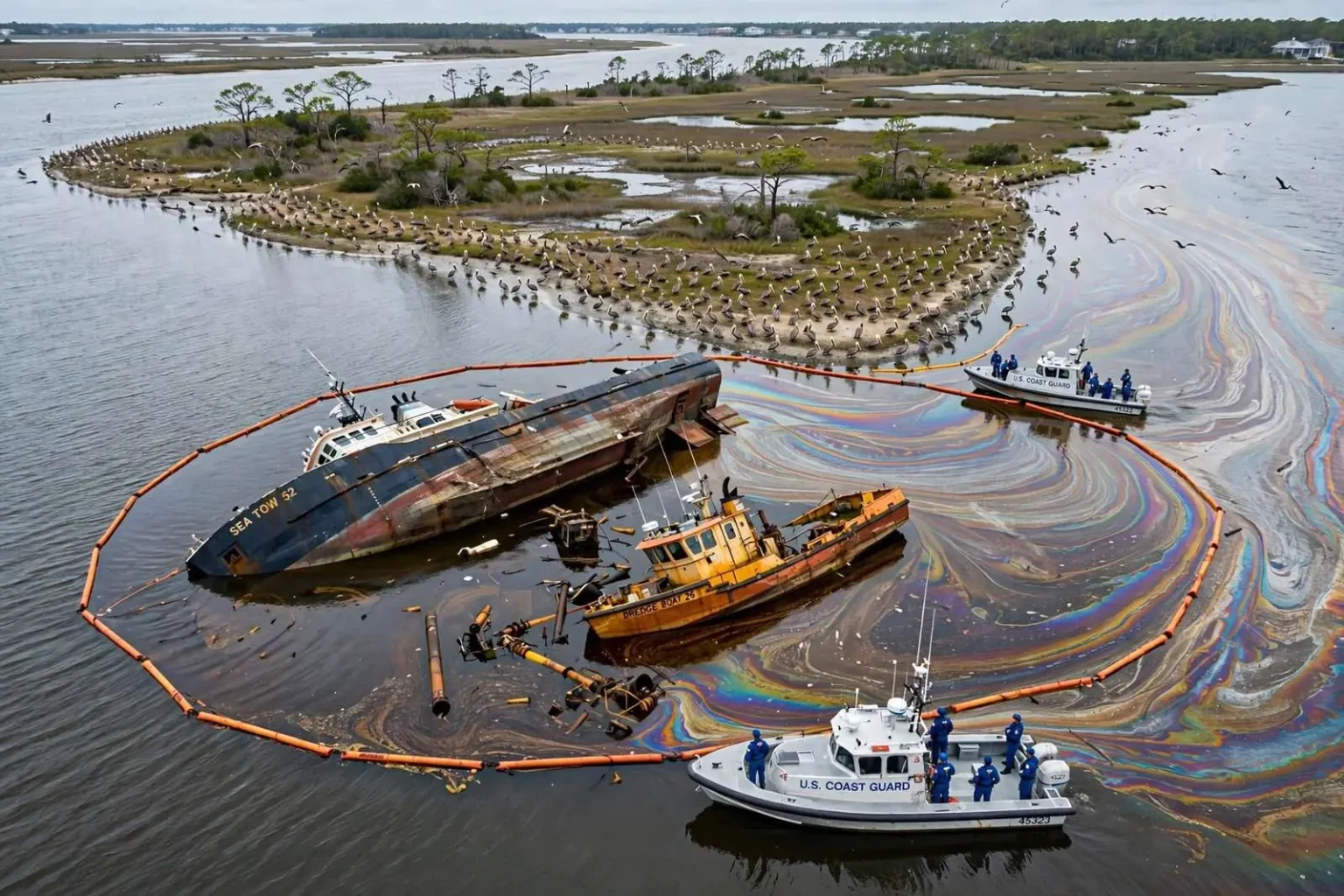
Coast Guard vessel responding near the Mobile ship channel after two boats sankResponse crews worked to contain an oil sheen after two vessels sank in the Mobile ship channel.

Two vessels sank in the Mobile shipping channel late one night, leaving behind an oil sheen roughly 50 yards wide and stretching about a mile, according to the U.S. Coast Guard’s Mobile sector.

A 52-foot towing vessel and a 26-foot dredging boat both went down north of Gaillard Island around 10:46 p.m., Coast Guard officials said. Crews aboard a third vessel in the area, the towing boat Miss Sammy Lee, responded to distress calls and rescued everyone aboard both sinking boats before Coast Guard watchstanders in Mobile were alerted to the incident.

After the rescue, a Coast Guard Station Dauphin Island small boat crew transferred the rescued crew members from the Miss Sammy Lee to Dog River Marina, where they were brought safely ashore. No injuries were reported in connection with the sinkings.

All three vessels had been conducting dredging operations in the area at the time of the incident, officials said. Response crews moved quickly to contain the spill, deploying a containment boom around the wreckage of the two sunken boats, which together were carrying an estimated 2,000 gallons of fuel and lubricating oil.

Coast Guard officials said response teams remained on scene working through recovery efforts in the days following the sinkings, and were developing a salvage plan to remove the vessels from the channel. Because the ship channel serves as a key route for maritime traffic moving in and out of the Port of Mobile, authorities worked to monitor the sheen and prevent it from spreading further while salvage operations were organized.

The Coast Guard’s Mobile sector, which oversees a stretch of waterways along the central Gulf Coast, said it would continue to provide updates as the situation developed. Vessel sinkings involving fuel spills in and around the Mobile ship channel are taken seriously given the channel’s role as a heavily trafficked corridor for commercial shipping, and officials said the response was aimed at limiting environmental impact while the wreckage was assessed and eventually removed.

Mobile is the county seat of Mobile County in southwest Alabama and the state’s only saltwater port. Situated where the Mobile River meets Mobile Bay near the northern Gulf of Mexico, the city has long served as a commercial and cultural gateway between Alabama and the wider Gulf Coast. Founded in 1702 as Fort Louis de la Louisiane and ruled in turn by France, Britain, and Spain before joining the United States in 1813, Mobile carries a layered heritage distinct from the rest of the state.

See also  Alabama Historical Commission Confirms Mobile River Wreck as the Clotilda

Today Mobile anchors a metropolitan area spanning Mobile County and neighboring Baldwin County, and it remains a center for shipping, aerospace, healthcare, and higher education in the region. Its downtown and waterfront have seen sustained revitalization, while historic neighborhoods preserve architecture from its colonial and antebellum past. The city’s identity is shaped as much by its working port and industrial base as by its festivals and food culture, making it a frequent focal point for news about growth and change in southern Alabama.

The Gulf of Mexico borders Alabama’s southern edge and defines much of the state’s coastal identity. Alabama’s Gulf coastline, centered on Dauphin Island, Gulf Shores, and Orange Beach, supports a tourism industry built around beaches, charter fishing, and marine recreation, while offshore waters host shipping lanes and energy interests.

The Gulf’s warm, shallow shelf and exposure to hurricanes make weather and disaster preparedness recurring concerns for communities from Mobile to Baldwin County. The marine environment also underpins commercial seafood harvests that have sustained Gulf Coast families for generations, tying the region’s economy and culture closely to the water.

The natural environment is central to life on the Gulf Coast, where barrier islands, bays, rivers, and wetlands support fisheries, recreation, and storm protection. Coastal Alabama faces challenges common to low-lying regions, including hurricane exposure, erosion, and the management of fragile ecosystems.

The Mobile-Tensaw Delta, one of the largest river deltas in the country, is a particularly significant natural asset. Conservation efforts, fisheries regulation, and shoreline restoration are frequent points of collaboration among state agencies, federal bodies like the Army Corps of Engineers, and environmental groups.

How the region plans for growth while protecting its natural assets is a recurring theme in local reporting. The tension between development pressure and ecological stewardship plays out in zoning fights, infrastructure projects, and disaster-recovery decisions that shape the coast for generations.

The economy of the Mobile region is diversified across shipping and logistics, aerospace and shipbuilding, healthcare, tourism, and manufacturing. The Port of Mobile is one of the nation’s busiest seaports and a cornerstone of the local and state economy.

Major employers in aviation and defense contribute to a skilled workforce, while economic-development organizations aim to attract investment and jobs through incentives and infrastructure improvements. Small businesses, from restaurants to professional services, form the backbone of neighborhood commerce.

See also  A Facebook Page and a Promise: Nathan Davis Challenges Jim Barton in District 104

The health of the regional economy is a frequent subject of public discussion and reporting. Workforce development, recruitment of industry, and the fortunes of local retailers all feed into a broader picture of how the Gulf Coast competes and adapts in a changing national economy.

Behavioral-health care on the Gulf Coast is provided by a mix of community mental-health organizations, hospital systems, and private practitioners. Community centers play an especially important role in serving patients who might otherwise lack access to care, often coordinating with courts, jails, and social services.

Demand for these services has grown alongside heightened public awareness of mental illness and the lasting effects of disasters such as hurricanes. Workforce shortages of psychiatrists and other clinicians are a persistent challenge nationwide, and they shape how providers allocate limited staff time between direct patient care and the administrative and legal obligations that accompany treatment.

The intersection of mental health and the justice system is a national concern as well as a local one. Communities across the country have debated how best to divert people in crisis away from jails and toward treatment, a conversation that informs how courts, clinicians, and advocates approach commitment hearings and related proceedings.

Collegiate athletics are a major part of life in southern Alabama, where the University of South Alabama in Mobile fields the Jaguars across a range of sports. The university’s football program, which began competition in the 2000s, has become a rallying point for students, alumni, and residents and a source of regional pride.

Beyond the campus, youth, high-school, and recreational leagues across Mobile and Baldwin counties sustain a deep local sports culture, and tailgating and game-day traditions reflect the social fabric of the community. Coverage of local teams regularly intersects with broader themes of economic impact, community engagement, and the role of athletics in mid-sized Southern cities.

Sports also serve as a lens on community investment. Stadium construction, scheduling, and the success of local programs ripple into nearby businesses and neighborhoods, making them a recurring and widely followed subject in regional reporting.

Baldwin County sits directly east of Mobile County across Mobile Bay and is the largest county in Alabama by land area. It encompasses the Eastern Shore communities of Daphne, Fairhope, Spanish Fort, and Foley and stretches south to the beaches of Gulf Shores and Orange Beach along the Gulf of Mexico.

See also  Bankhead Tunnel to Close Two Nights for Fiber Optic Upgrades: ALDOT

Long among the fastest-growing counties in the state, Baldwin blends suburban development near the bay with tourism-driven coastal economies. Its proximity to Mobile and its position on the Eastern Shore make it a recurring subject of regional news covering growth, infrastructure, schools, and the balance between development and coastal preservation.

Mobile Bay is a shallow estuary in southern Alabama where freshwater from the Mobile, Tensaw, and other rivers mixes with saltwater from the Gulf of Mexico. It is among the largest estuarine systems in the United States and supports commercial and recreational fishing, shipping through the Port of Mobile, and wetlands that buffer the coastline from storms.

The bay’s Eastern Shore, in Baldwin County, includes Daphne, Fairhope, and Spanish Fort, while the Western Shore lies in Mobile County. Its ecology and economy have guided settlement for centuries, and the bay figures in regional debates over development, navigation, and conservation. Events on either shore are routinely covered as part of the interconnected life of the Mobile metro area.

Alabama is a state in the southeastern United States bordered by Tennessee, Georgia, Florida, the Gulf of Mexico, and Mississippi. Often called the Heart of Dixie, it spans Appalachian foothills in the north and flat coastal plains in the south. Its largest cities include Birmingham, Montgomery, Huntsville, and Mobile.

Alabama’s history encompasses Indigenous roots, Spanish and French colonial settlement, a cotton-plantation economy, the Civil War and Reconstruction, and the Civil Rights Movement of the 1950s and 1960s, followed by a shift toward manufacturing, aerospace, and technology. Local news across the state frequently reflects this mix of tradition and change.

The Federal Bureau of Investigation is the principal investigative arm of the United States Department of Justice, tasked with protecting the country against terrorist threats, foreign intelligence operations, cyber attacks, and major criminal activity. Established in 1908, the bureau operates a network of field offices across the country, each responsible for federal law-enforcement matters within its region.