The Port of Mobile Just Landed on a List With the Golden Gate Bridge and the Transcontinental Railroad
The American Road & Transportation Builders Association named the Port of Mobile one of '250 transportation projects that helped build America,' putting the nearly century-old Alabama port on a list with the Golden Gate Bridge and the Transcontinental Railroad.
The Port of Mobile has been named one of “250 transportation projects that helped build America” by the American Road & Transportation Builders Association, placing the nearly century-old Alabama waterway alongside the Interstate Highway System, the Transcontinental Railroad and the Golden Gate Bridge on a list marking the nation’s 250th anniversary. The recognition, announced this week, highlights infrastructure projects the association says played an outsized role in strengthening the American economy and connecting communities across the country.
The Port of Mobile, established in 1928, was one of five Alabama transportation landmarks to make the list, alongside the Bankhead Tunnel, the Mobile River/Cochrane-Africatown USA Bridge, the Tennessee-Tombigbee Waterway, and the Jubilee Parkway and George Wallace Tunnel — all fixtures of the Mobile County landscape or the broader Alabama transportation network. The state’s showing on the list reflected how heavily its economy has run through Gulf Coast infrastructure, from the port’s riverfront terminals to the crossings that carry traffic beneath the Mobile River and along the Bayway.
A bridge between Alabama and the world
Alabama Port Authority Director and CEO Doug Otto said the honor reflects nearly a century of the port serving as a bridge between Alabama businesses and the rest of the world.
“For nearly a century, the Port of Mobile has connected Alabama businesses to markets around the world while also supporting jobs and economic growth across our state,” Otto said. “We’re proud of that legacy, and we’re honored that ARTBA has recognized the Port as one of the transportation projects that helped build America. We remain committed to investing in the infrastructure and capacity needed to serve Alabama and its people for generations to come.”
For South Alabama, the honor is more than symbolic. The port remains one of the state’s most significant economic engines, supporting roughly one in every seven jobs in Alabama and generating more than $415 billion in statewide economic impact since 2019, according to figures released alongside the recognition. Those numbers reflect not just the dockworkers and shipping crews directly employed at the port, but the wide network of trucking, warehousing, manufacturing and logistics jobs across the region that depend on cargo moving in and out of Mobile.
Investment on the waterfront
The Alabama Port Authority, which oversees the facility, has leaned into that growth in recent years. Officials say the state and the authority have put more than $2 billion into capital improvements at the port over the last decade — investments in deeper berths, expanded container capacity and modernized equipment aimed at keeping Mobile competitive with larger Gulf Coast ports in Houston and New Orleans.
“With more than $2 billion in capital investments taking place over the last decade, the Alabama Port Authority continues to invest in the infrastructure, capacity and connectivity that will support economic growth across Alabama for generations to come,” port officials said in announcing the recognition.
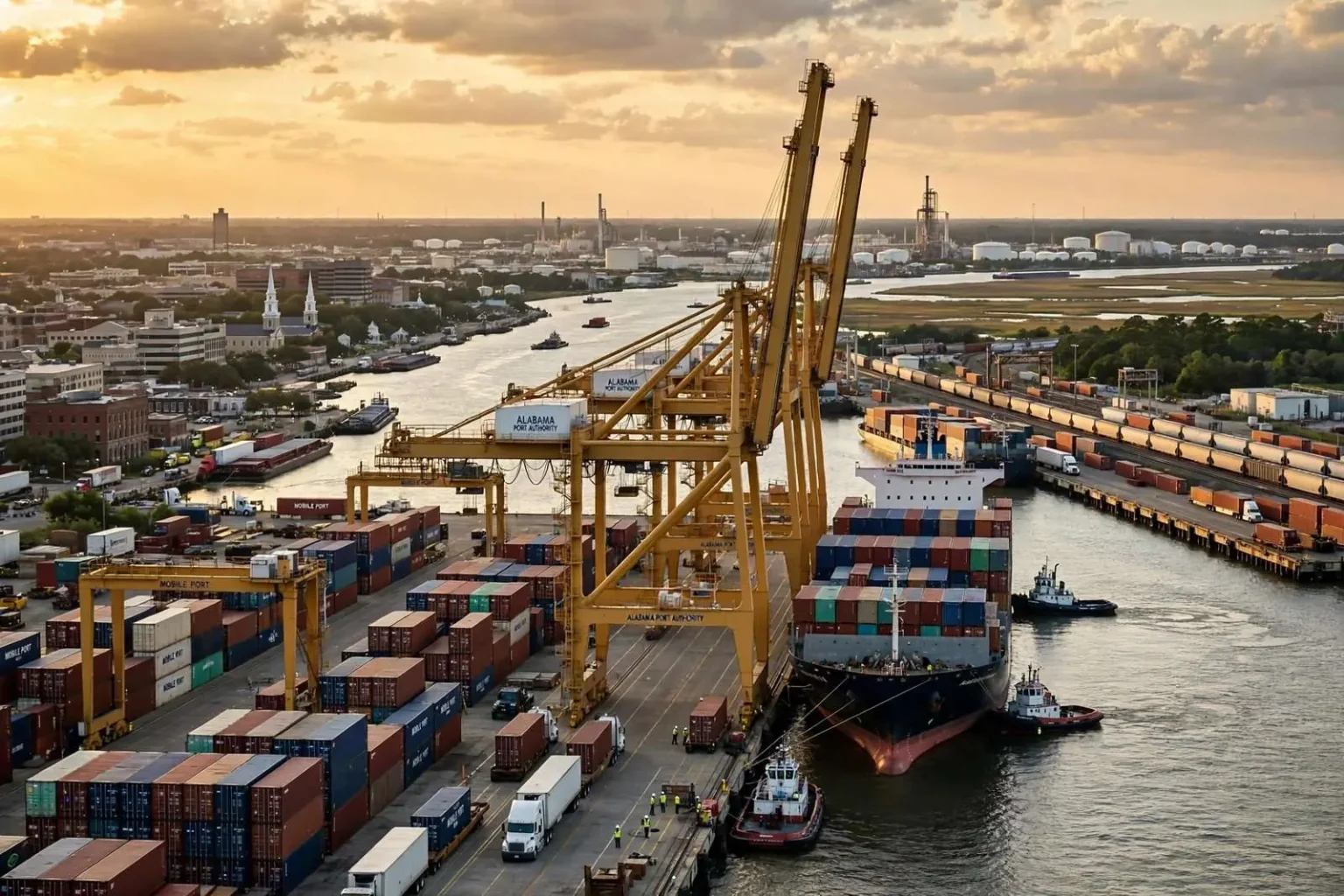
That investment posture has transformed the working waterfront. Container terminals expanded along the riverfront, new cranes towered over the skyline south of downtown, and the channel deepening work aimed to let the largest vessels calling in the Gulf reach Mobile’s berths fully loaded. Each expansion widened the port’s reach into the interior — auto manufacturing, forest products, agriculture and retail goods all move through the terminal complex, binding Alabama’s factories and farms to markets across the hemisphere and beyond.
A list built for the nation’s 250th
The America250 list is being rolled out nationally throughout the year as the country approaches its semiquincentennial, with ARTBA highlighting one project from each state alongside a smaller number of nationally significant sites. The association, which represents the firms and workers who build the nation’s transportation infrastructure, framed the project as a way of marking the anniversary through the physical works that made national commerce possible — railroads, highways, bridges, tunnels, ports and waterways assembled across two and a half centuries.
For Mobile, the timing places a spotlight on a working waterfront that residents pass every day but that rarely gets national attention on the same stage as landmarks like the Golden Gate Bridge. The Port of Mobile handles a broad mix of cargo, from steel and forest products to grain, coal and containerized goods, and its terminals stretch for miles along the Mobile River just south of downtown.
The company the port keeps on Alabama’s portion of the list says much about how the state was built. The Bankhead Tunnel and the George Wallace Tunnel carried traffic beneath the Mobile River, physically joining downtown Mobile to the Eastern Shore. The Jubilee Parkway — the Bayway — spans Mobile Bay on Interstate 10, tying the port city to Baldwin County’s beaches and growing communities. The Cochrane-Africatown USA Bridge, rising near the historic Africatown community founded by the survivors of the Clotilda, links north Mobile to the industrial river corridor. And the Tennessee-Tombigbee Waterway, the massive Army Corps project completed in the 1980s, connected the Tennessee River to the Gulf through northeast Mississippi and west Alabama, giving inland shippers a route to Mobile’s docks.
Deep roots on the riverfront
City and county leaders have repeatedly pointed to the port as central to Mobile’s identity as a shipping and manufacturing hub, a role that predates Alabama statehood and that officials say will only grow as further terminal expansions come online in the years ahead. The modern port authority’s founding in 1928 organized what had been decades of riverfront commerce into a public corporation with the mandate to build terminals, attract shipping lines and develop the waterfront as a public asset.
The port’s story runs through nearly every chapter of Mobile’s economic history: cotton exported downriver in the antebellum decades, timber and naval stores shipped in the industrial era, coal and steel moving through the twentieth century, and the container revolution reshaping the riverfront in the modern one. Each era left its infrastructure, and each generation of investment built on the last — the same logic that ARTBA’s anniversary list set out to honor.
Recognition alongside the Transcontinental Railroad and the Interstate Highway System may strike some locals as grand company for a port that most Mobilians encounter as a line of cranes on the skyline. But the port’s numbers — one in seven Alabama jobs, more than $415 billion in economic impact since 2019, and more than $2 billion in capital investment over the past decade — make the case on their own. The harbor that gave the city its name and its reason for being remains, nearly a century into its modern organization, the engine the rest of the state rides to the world.
Competing in the Gulf port market
The capital investment race that port officials described was not undertaken for trophies. Mobile competes for shipping lines and cargo contracts against Houston and New Orleans, two of the busiest ports in the Western Hemisphere, each with deeper drafts, larger terminals and sprawling petrochemical complexes of their own. Mobile’s answer to that competition has been to position itself as the efficient middle ground — closer to key inland markets than Texas, more flexible than New Orleans, and aggressive on turnaround times and rail connectivity to the Midwest and Southeast.
Container shipping reshaped that contest. As ocean carriers consolidated into alliances deploying ever-larger vessels, ports across the Gulf scrambled to deepen channels, buy bigger cranes and expand berth space to handle ships that simply could not have been worked a generation ago. Mobile’s terminals invested through that transition, and the port’s container volumes grew steadily as retailers and manufacturers shifted cargo through the Gulf to reach population centers in the Southeast. The deepening of the Mobile ship channel stands as the signature project in that campaign, extending the reach of the largest vessels all the way up the bay and river to the public terminals.
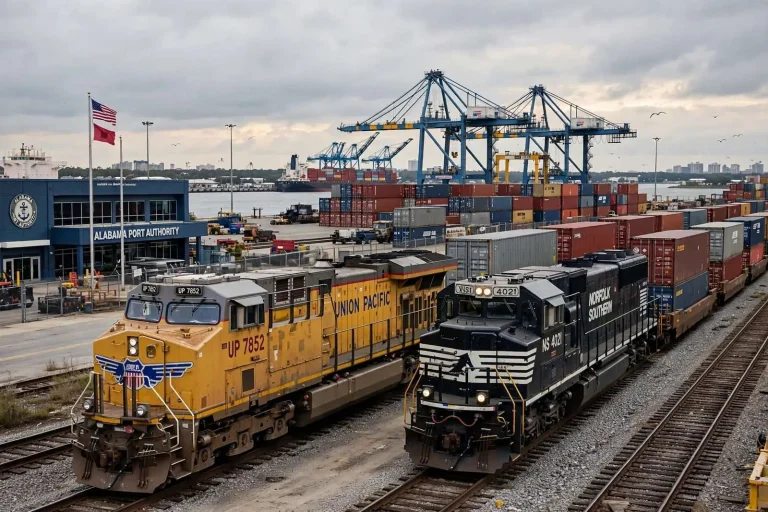
Behind the cranes sits the wider logistics network that the port’s job and impact figures capture. Rail lines run from the terminals into the interior; trucking corridors connect the docks to distribution centers across Alabama and neighboring states; warehouse construction followed the cargo. The one-in-seven jobs figure reflects that footprint — dockworkers, yes, but also the truck drivers, railroad crews, warehouse workers and factory employees whose paychecks depend on cargo flowing through Mobile Harbor.
What the port means to Mobile County
Locally, the port shapes the geography and economy of Mobile County in ways residents encounter daily whether or not they ever set foot on a terminal. Industrial development follows the river — steel, chemical, paper and forest-product facilities line the corridor — and municipal budgets draw on the tax base that port-dependent industry supports. The Alabama State Port Authority’s terminals sit alongside private terminals, shipyards and bulk operations in a continuum of waterfront commerce that stretches for miles.
The recognition from ARTBA also lands amid ongoing public conversation about the waterfront’s future: how the port balances industrial growth with the neighborhoods that border it, how the Africatown community’s history and health intersect with the industry that surrounds it, and how the city reclaims access to its own riverfront even as the working harbor expands. The same waterway that carried the port to a place on the nation’s 250th list carried the first waves of enslaved Alabamians to the colony two centuries before, and the port’s past and present remain inseparable from the city’s own.
For the port authority, the anniversary honor served as both a celebration and an argument — a reminder to the state’s policymakers and taxpayers that the infrastructure they fund at the mouth of the Mobile River pays dividends across all 67 counties. Nearly a hundred years after its founding, the institution built to connect Alabama to the world remains in the expansion business, betting that the next generation of Gulf commerce will move through Mobile as surely as the last one did.