Obama’s Alabama Campaign Removes 40 Would-Be Delegates, and the Faithful Feel the Sting
Barack Obama's Alabama campaign invoked a dormant rule to install its own convention delegates, cutting about 40 candidates from the ballot. Those passed over described hurt, anger and grudging understanding.
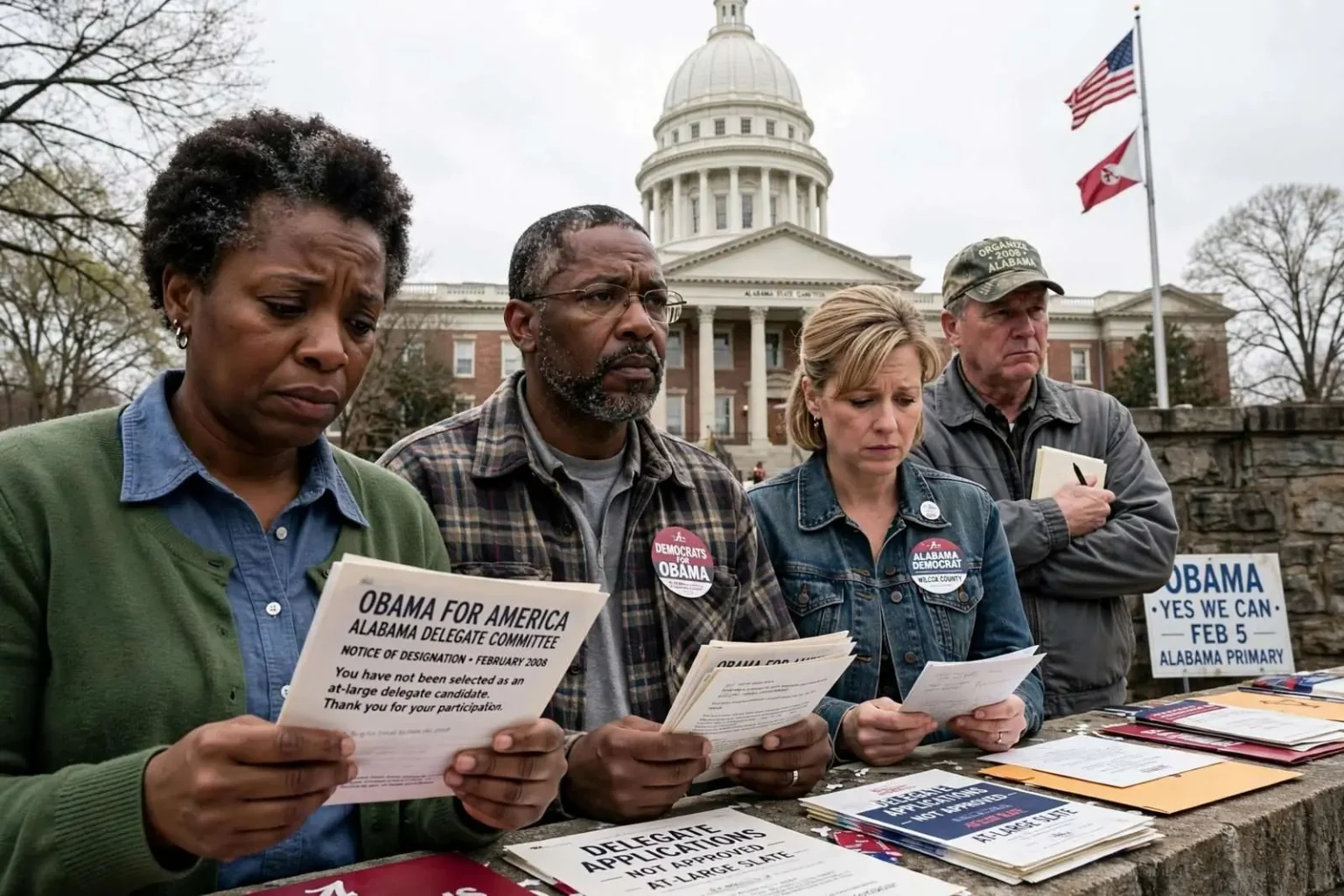
Love hurts. That was the lesson delivered in the spring of 2008 to several dozen Alabama Democrats who had filed, campaigned and been notarized as pledged delegate candidates for Barack Obama, only to learn that their names would not appear on any ballot. The Obama campaign, moving to secure the Alabama delegation it would take to the Democratic National Convention in Denver that August, dusted off a party rule that had not been used in more than twenty years. Rather than let the State Democratic Executive Committee elect the at-large Obama delegates, the campaign installed them. About 40 candidates for those slots were removed from consideration.
The decision came during a primary season that had already rewritten the rules of Democratic politics. Obama’s victory in the Iowa caucuses and his subsequent surge had turned the 2008 nomination contest into a battle not just for delegates but for the soul of the party. In Alabama, where the primary was held on Feb. 5 — Super Tuesday — Obama won 56% of the vote to Hillary Clinton’s 42%, carrying the state’s Black Belt counties by overwhelming margins while Clinton ran strong in the Birmingham suburbs and the northern counties.
The Rationale, and the Resentment
The reasoning circulating among Democrats was straightforward, if awkward to say aloud. An election conducted by the full State Democratic Executive Committee would have allowed Hillary Clinton’s supporters to help choose Obama’s delegates, and the campaign wanted delegates who would be less susceptible to pressure from Joe Reed, the longtime chairman of the Alabama Democratic Conference and a leading Clinton backer. Reed rejected any suggestion that he or the ADC would have tampered with Obama’s delegates. The campaign, he said, simply preferred to play favorites at the expense of rank and file Democrats.
Others intimated a longer game: that more influential Democrats were being seated to lay groundwork for a 2010 run for governor by Obama’s Alabama campaign leader, U.S. Rep. Artur Davis, who did in fact run for governor that year and lost the primary. Davis, then a rising star in the Congressional Black Caucus, had been one of Obama’s earliest and most visible supporters in the Deep South. His gubernatorial bid would test whether the coalition Obama built could translate to statewide office in Alabama.
The Delegates Installed
The delegates installed for Obama included Ginger Avery, Amy Burks, Giles Perkins and state Sen. Hank Sanders, D-Selma. Alternates included Roger Bedford III, Janet Y. Buskey, Doris Dozier Crenshaw, Tammy Knight Fleming, Patricia Bozeman Henderson and Frank D. McPhillips. These names represented a cross-section of the Alabama Democratic establishment — lawyers, legislators, civil rights veterans, and party operatives — chosen for their loyalty to the campaign and their reliability on the convention floor.
State Party Chairman Joe Turnham was careful to place the decision outside the party’s hands. “That was up to the (Obama) campaign committee,” he said. Turnham’s positioning reflected the delicate balance state parties had to strike in 2008: maintain neutrality in the primary while ensuring the eventual nominee had a functional state operation. The Alabama Democratic Party, weakened by decades of Republican gains at the state level, was in no position to alienate the likely nominee.
In Their Own Words
For the Democrats who found themselves removed, the experience was a mix of pride and betrayal. Many had invested time, money, and emotional energy in a campaign that had inspired them. “I worked my heart out for Barack Obama,” said one removed candidate, a schoolteacher from Wilcox County who asked not to be named. “I went door to door in communities that hadn’t seen a Democratic organizer in years. And then I get a letter saying, essentially, ‘thanks, but we’ll take it from here.'”
Another, a young attorney from Mobile, described the moment she learned she’d been replaced. “I got a call from the campaign’s Birmingham office. Very polite. Very scripted. They said the campaign had ‘exercised its right’ under Party Rule 12.C to appoint at-large delegates. I asked if there was an appeal. They said no. I asked if I could at least be an alternate. They said the alternate slots were filled. I hung up and cried.”
Not everyone was bitter. A retired state employee from Montgomery who had been removed said he understood the strategic logic. “Look, I want Barack Obama to be president. If the campaign thinks they need certain people in Denver to make sure that happens, I’m not going to stand in the way. But it doesn’t mean it doesn’t sting.”
Party Rules and Precedent
Party Rule 12.C, the provision invoked by the Obama campaign, allows a presidential candidate to approve or veto at-large delegates pledged to them. The rule had been on the books since the 1980s but was rarely used because most nomination contests were settled before the delegate selection process reached this stage. In 2008, the prolonged battle between Obama and Clinton meant that delegate selection in every state became a proxy fight.
Alabama’s Democratic Party bylaws allocate at-large delegates — those not tied to a specific congressional district — based on the statewide primary vote. With Obama winning 56%, he was entitled to the majority of the state’s at-large slots. The question was who would fill them. Traditionally, the SDEC — a body of roughly 300 party activists, elected officials, and constituency group representatives — would elect the at-large delegates at a post-primary meeting. But Rule 12.C gave the campaign the right to bypass that process.
Legal challenges were considered but ultimately abandoned. The Democratic National Committee’s rules committee had already signaled it would uphold campaigns’ rights under Rule 12.C, and a challenge would have risked Alabama’s entire delegation being seated without a vote in Denver — a nightmare scenario for a state party desperate for relevance.
The Alabama Democratic Conference’s Role
Joe Reed and the Alabama Democratic Conference loomed large over the controversy. The ADC, founded in 1960 as the political arm of the state’s Black educators, had become the most powerful African American political organization in Alabama. Reed’s endorsement was coveted by any Democrat seeking statewide office. In 2008, the ADC backed Clinton early, citing her long relationships with Black leaders and her policy commitments on education and healthcare.
The Obama campaign’s calculation was that ADC influence over the SDEC — where ADC members held significant sway — could result in delegates who were nominally pledged to Obama but personally loyal to Reed. In a close convention, such delegates could theoretically be persuaded to switch sides or abstain on procedural votes. The campaign decided the risk, however small, was not worth taking.
Reed, for his part, framed the episode as evidence of the campaign’s disrespect for Black political infrastructure. “They came into our state, used our networks, asked for our votes, and then told us we couldn’t be trusted to pick delegates,” he said in an interview that spring. “That’s not how you build a party.”
Artur Davis and the 2010 Connection
The speculation about Artur Davis’s gubernatorial ambitions added another layer. Davis, a Harvard Law School graduate who had unseated a Republican incumbent in Alabama’s 7th Congressional District in 2002, was seen as the most viable Black candidate for governor in state history. His alignment with Obama was both ideological and strategic — Davis had modeled his congressional campaigns on the kind of multiracial coalition Obama was building nationally.
By 2010, Davis would run for governor and lose the Democratic primary to Ron Sparks, the state agriculture commissioner, by a margin of 62% to 38%. The defeat was attributed to several factors: Davis’s vote against the Affordable Care Act, which alienated Black voters; his perceived distance from the state party apparatus; and the ADC’s active opposition. Reed and the ADC backed Sparks, and the conference’s get-out-the-vote operation in the Black Belt proved decisive.
In retrospect, the 2008 delegate fight looks like an early skirmish in that conflict. The delegates installed for Obama — many of them Davis allies — would have formed the core of his convention delegation two years later. But the ADC’s influence over the SDEC meant that even with Obama’s appointees in place, the state party’s grassroots machinery remained in Reed’s hands.
A National Pattern
Alabama was not unique. Across the country, the Obama campaign used Rule 12.C and similar provisions to secure delegate slates in states where Clinton held institutional advantages. In Texas, Nevada, and Pennsylvania, similar complaints surfaced from removed candidates. The Clinton campaign, for its part, employed its own procedural tactics, particularly in caucus states where organization could outweigh raw vote totals.
The 2008 contest forced the Democratic Party to confront the tension between grassroots participation and nominee-centered control. In the years that followed, the DNC revised its delegate selection rules to reduce the role of superdelegates and increase transparency in at-large selection — changes driven in part by the controversies of that spring.
Aftermath in Alabama
For the 40-odd Alabamians who were removed, the convention in Denver went on without them. Most watched on television. Some attended as guests of the state party but without credentials. A few remained active in Democratic politics; others drifted away, disillusioned by what they saw as a betrayal of the participatory ethos that had drawn them to Obama’s campaign.
Obama went on to win the nomination and the presidency. In Alabama, he lost the general election to John McCain by 21 points — a margin that reflected the state’s deep Republican lean but also the limits of the coalition he had built. The delegate fight of 2008 faded into a footnote, remembered mainly by those who lived it. But for a generation of Alabama Democrats, it was a lesson in how power works: even a movement built on “yes we can” sometimes decides that “no, you can’t” is the safer bet.