Is Mobile’s Golden Age Right Now? A Realtor Makes the Case for the Present Tense
Oyster stands on Government Street, the Lyric Theatre, wartime shipyards running around the clock -- all had a claim. But in the third entry of a series on Mobile's golden age, one Mobilian argues the best chapter is the one being written now.
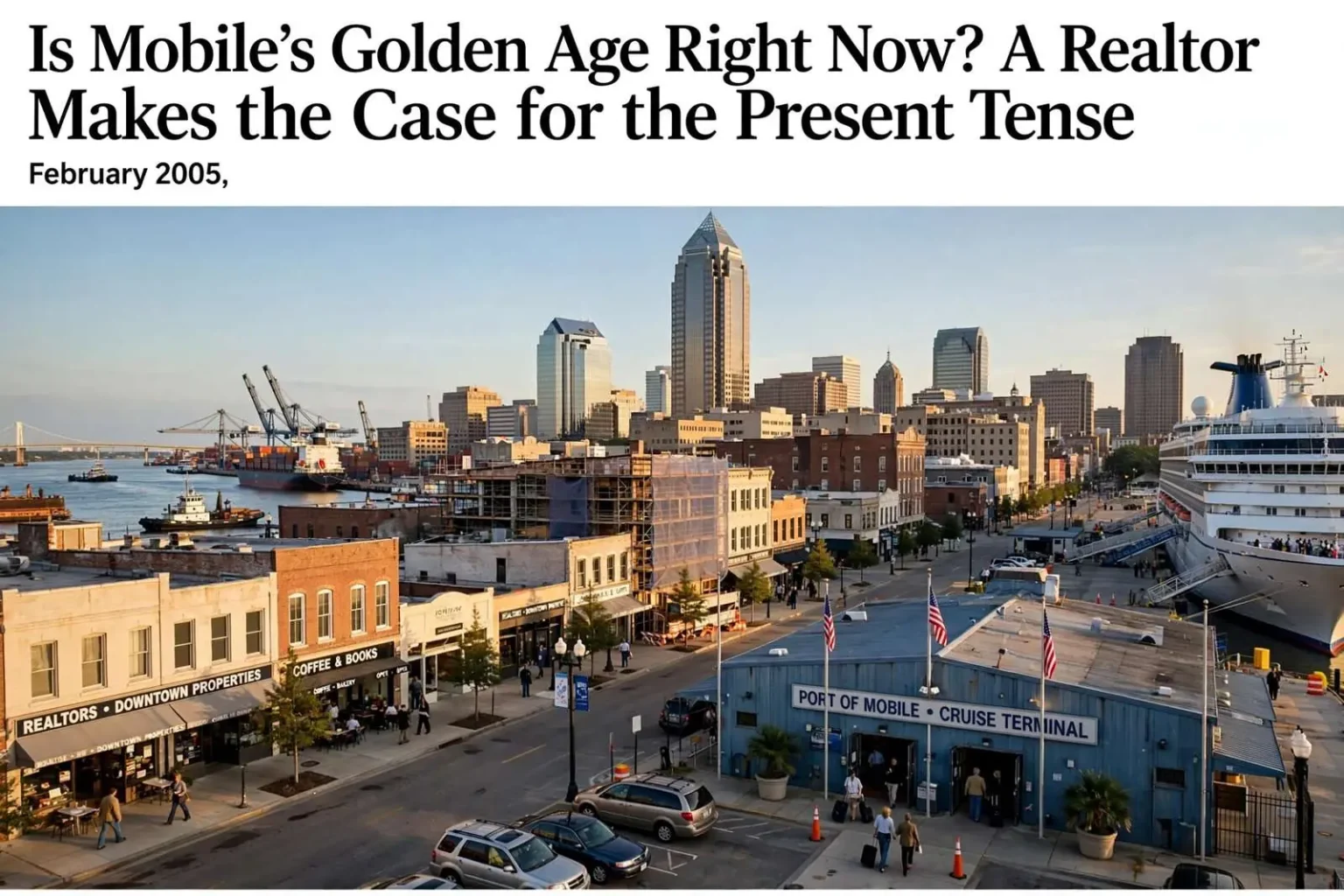
MOBILE — Most people asked to name a city’s golden age reach backward. In the third installment of a series inviting Mobilians to identify theirs, a Mobile realtor, songwriter and filmmaker did something less expected. He surveyed the candidates, gave each its due, and then argued that the golden age might be happening right now.
His opening caveat is an honest one: it is difficult to sell what we never knew, even for students of Mobile’s history. What follows is offered as imagination as much as memory.
The exercise itself said something about the city. A civic series asking residents to pick a golden age is a rare invitation — most communities never stop to ask when they were at their best, and the answers say as much about the present as about the past.
The Cotton Port and the Packet Steamers
He imagines the packet steamer and cotton port days as heady ones. He grew up hearing tales of life just before 1900 — when oysters were shucked at the foot of Government Street and sold on the half shell to anyone passing by, and when the Lyric Theatre played host to the best live entertainment on the touring circuit.
That long span, running from before the War Between the States into the early years of the twentieth century, must have been an exciting time to be in Mobile, he writes — excluding, of course, the dark years of the war itself and of Reconstruction.
It is a fair qualification, and one worth keeping in view: the wealth that flowed across those cotton docks was produced by enslaved labor, and the prosperity was not shared.
The packet steamers were the scheduled freight and passenger boats that tied Mobile’s wharves to the plantations and river towns up the Mobile, Alabama and Tombigbee rivers, carrying cotton down and goods and people back up. The oyster stands along Government Street were the everyday counterpart of that trade — a port city’s cheap, abundant street food, sold steps from the water that produced it. The Lyric Theatre, meanwhile, anchored the vaudeville-era entertainment district, booking touring companies and headliners on the southern circuit.
The War Years
The Second World War era, he says, would certainly qualify as well. The evidence is not hard to assemble.
Brookley Field turned Mobile into a major military aviation and supply hub. The Bankhead Tunnel opened beneath the Mobile River. Alabama Dry Dock and Shipbuilding ran at a scale the city had never seen. And workers poured in so fast that housing collapsed under the strain — producing the notorious “hot beds,” rooms rented by the shift, around the clock, so that a bed never had time to cool between one worker rising and the next lying down.
It was a boom, and by any economic measure a golden one. It was also, as anyone who lived through it could attest, a city bursting at its seams.
The scale of the transformation is hard to overstate. Brookley Field employed thousands and reshaped the city’s western side; ADDSCO’s ways along the river built vessels at a wartime tempo; and the tunnel under the river gave the city a piece of infrastructure it had wanted for decades. A city that had spent the Depression lean was suddenly short of everything — housing, transit, schools — because the work kept arriving faster than the city could grow around it.
Between the golden ages
Antebellum Mobile ranked among the leading cotton export points of the South, second only to New Orleans in many seasons, and the mercantile wealth of that era built the city’s oldest institutions. Mobile’s carnival societies — among the oldest in the country — grew out of the same age of port prosperity, and their parades remained the city’s signature celebration long after the cotton trade itself faded.
The city between the wars and after the boom had a quieter story: the cotton trade giving way to pulp, paper and chemicals; Brookley Field’s postwar closure removing a major pillar of the economy; and the slow westward drift of population that pulled homes, stores and churches out of the old grid and toward the western suburbs. Each shift left its mark on downtown, and each made the next revival harder to imagine from inside the city limits.
That history is what makes the realtor’s exercise revealing. A golden-age question asks a city to rank its own eras, and Mobile’s honest ranking has to weigh boom times — the cotton port, the wartime shipyards — against the human cost each one carried: enslaved labor behind the first, and overcrowded, improvised living conditions behind the second. The realtor named both qualifications himself.
What a “golden age” claim usually measures is a combination of growth, confidence and outside attention. By those yardsticks, the Mobile of February 2005 had a genuine case: a redeveloping downtown, new money arriving from outside, a working port adding passenger traffic, and a city government that at least presented itself as open to the whole community. Whether those ingredients would compound or fade was exactly the bet the entry placed.
The Case for Now
And yet, writing in February 2005, he makes his choice: he honestly believes that right now might be Mobile’s golden age. His reasons are worth setting out, because they capture precisely how the city’s civic optimists were reading the moment.
Government that works, and includes
He credits Mayor Mike Dow’s administration as proactive and, in his words, truly inclusive — for the first time since Jim Crow.
It is a striking claim to make in a city then heading into an open mayoral race in which the leading candidate was an African-American county commissioner.
Dow’s City Hall had spent more than a decade pressing projects — downtown redevelopment, the convention center, airport and port upgrades — with an administration that made a point of recruiting across racial lines. Whether every constituent shared the realtor’s assessment was another matter, but the claim of inclusion was itself a sign of how far the city’s self-description had moved from its segregated past.
Resilience after industrial loss
Mobile absorbed the staggering loss of both of its major paper mill employers — along with the odor each of them had denied responsibility for — and, he writes, did not miss a beat.
The mill closures removed two of the region’s largest industrial payrolls in quick succession, and with them a signature of Mobile’s economic identity that had defined the city for generations. Optimists read the city’s ability to keep functioning — and to keep attracting investment — as proof of a diversified base; skeptics saw a hollowing out. The realtor’s verdict came down firmly on the first side.
Major outside investment
The Retirement Systems of Alabama, under David Bronner, was pouring money into downtown, most visibly in the RSA tower and the restoration of landmark properties.
Bronner’s public pension fund had become one of Alabama’s most consequential developers, and its Mobile projects — office towers, hotels, and rehabilitated historic buildings — put a visible new skyline piece above the older downtown grid. For a city that had watched its commercial core thin out, the RSA commitment was the clearest sign that outside capital believed in Mobile’s future.
Cruise ships
Passenger cruise service from the Port of Mobile was newly established and, at that moment, looked like a durable tourism engine.
The arrival of a homeported cruise line gave Mobile a claim it had never held: a passenger terminal, regular sailings, and a tourism revenue stream that bypassed the beaches entirely. City leaders counted on it as a permanent feature of the port’s mix.
Downtown revitalization
The work had begun, with more visible on the horizon.
Streetscaping, restaurant openings, loft conversions and a growing entertainment strip were already changing the pattern of downtown evenings — a reversal of decades in which the core emptied after business hours.
New names in Old Mobile
Newcomers were moving into a city long known for the closed circles of its oldest families.
Mobile’s reputation for insular old-family society was a standing joke and a real barrier at once. The influx of new residents — drawn by jobs, the port, and the RSA investment — was quietly loosening those circles, in the realtor’s telling, and making the city easier to enter from the outside.
“Our best is still ahead,” he concludes. “And it looks golden.”
The Value of the Answer
Read two decades later, the entry is a useful artifact.
Some of its optimism was well placed: downtown Mobile did continue its revival, and the RSA investments left a permanent mark on the skyline.
Some of it proved fragile. Cruise service from Mobile would prove far more volatile than anyone expected, departing and returning more than once.
The paper mill jobs did not come back.
But the deeper point survives the scorekeeping. Every previous golden age in the list — the cotton port, the packet steamers, the wartime shipyards — looked like ordinary hard work to the people living through it. The oysters at the foot of Government Street were just lunch. The hot beds were just a place to sleep.
Golden ages are almost always identified in retrospect, by people who were not there. Which is what makes an answer in the present tense a small act of nerve: a bet, placed in 2005, that the city was in the middle of something worth remembering.