Two People Died at a Thomasville Red Light. The Truck Driver Who Hit Them Will Serve Almost No Additional Time.
The driver of an 18-wheeler that rear-ended vehicles stopped at a Thomasville red light in 2025, killing two people, has pleaded guilty to two counts of criminally negligent homicide.
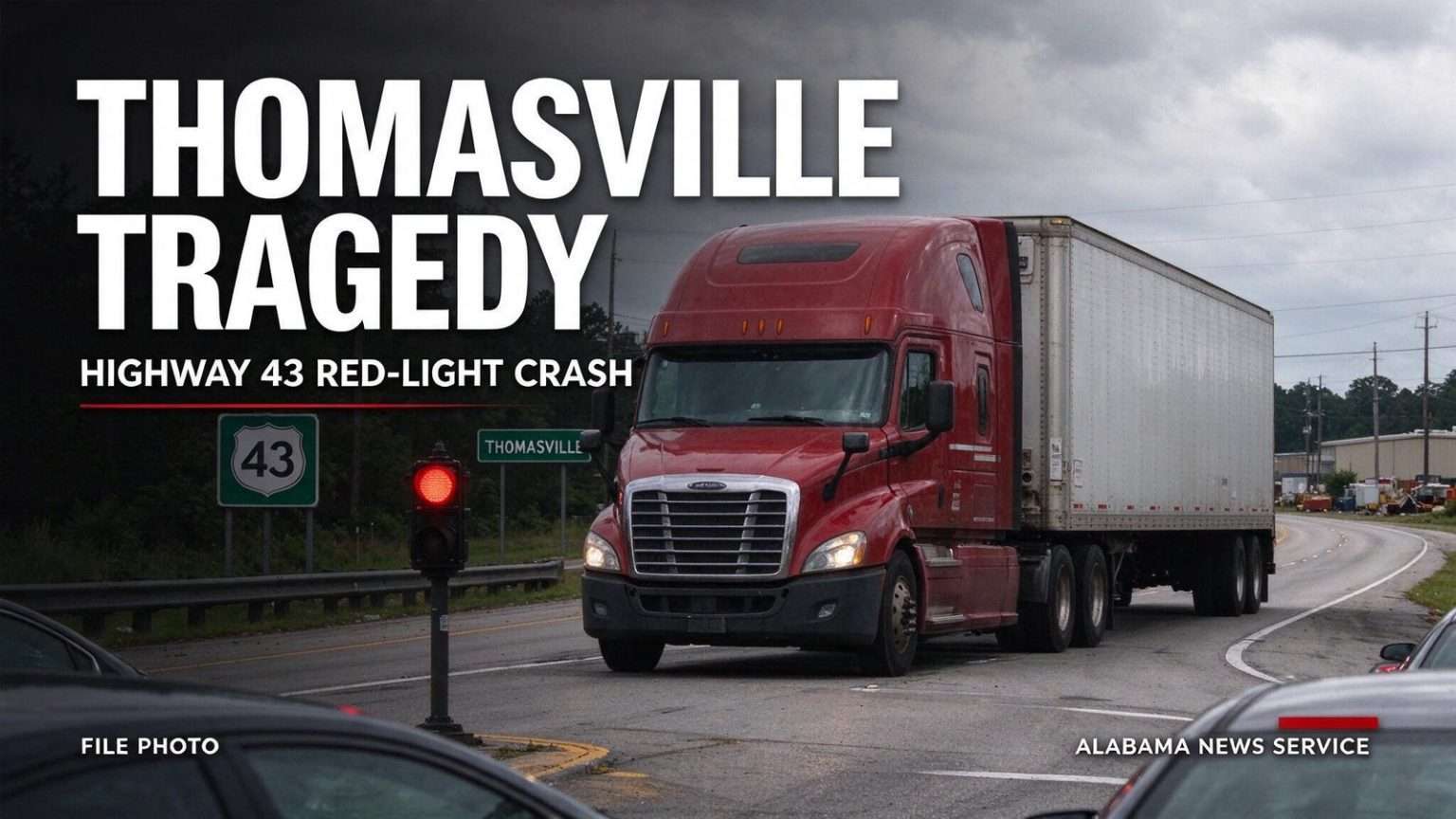
In May 2025, traffic on Highway 43 southbound in Thomasville was stopped at a red light. An 18-wheeler did not stop. Two people died. The driver has now pleaded guilty — and because of time already served, he will spend little additional time in custody.
According to court documents, Andrii Dmyterko pleaded guilty on Thursday, July 9, to two counts of criminally negligent homicide. The plea resolves the criminal case arising from one of the most jarring categories of highway collision: a fully loaded commercial truck striking a line of stopped cars in daylight, at an intersection where drivers ahead had done nothing wrong.
Dmyterko was driving an 18-wheeler southbound on Highway 43 in Thomasville when he crashed into the back of multiple vehicles that were stopped at a red light. The original criminal complaint alleged that Dmyterko was attempting to answer his phone when the crash occurred. Four other people were injured in addition to the two who died.
Woodie Beck III and Ashley Springer were killed in the crash. Their deaths transformed an ordinary traffic signal stop on a Thomasville thoroughfare into a scene of devastation that residents of the Clarke County seat have continued to talk about in the months since, and the plea hearing brought the criminal side of the case to a conclusion that many in the community have found difficult to accept.
The sentence
Dmyterko was sentenced to two years in prison — one year for each count. However, he is receiving credit for the one year and 65 days he has already served awaiting resolution of the case, leaving only a fraction of the sentence left to serve. The arithmetic is a feature of how the charge was brought and resolved, not an anomaly in the paperwork: two counts of the least severe homicide offense on Alabama’s books, sentenced consecutively, largely satisfied by pretrial custody.
Dmyterko was in the United States on a work visa. His immigration status now passes to federal authorities, and a criminal conviction of this kind typically triggers review of whether the holder may remain in the country. The sentencing hearing did not change the underlying facts: two people are dead, four were hurt, and the criminal system’s answer is measured in the months that remain on a two-year term.
For the families of Woodie Beck III and Ashley Springer, the arithmetic of the outcome is unlikely to feel like much of a reckoning. Criminal cases answer the state’s question — what law was broken and what punishment follows — and Alabama’s sentencing structure answers that question narrowly here. It does not measure loss, and it does not foreclose the civil claims that families in comparable crashes often bring against drivers and the companies whose trucks they operate.
Understanding the charge
Criminally negligent homicide is the least severe of Alabama’s homicide charges. It applies when a person causes a death through criminal negligence — meaning they failed to perceive a substantial and unjustifiable risk that a reasonable person would have recognized. It carries a lighter penalty than manslaughter or murder, which require recklessness or intent.
The distinction comes down to the state of mind the law assigns to the defendant. Murder involves intent. Manslaughter involves recklessness — a conscious disregard of a known risk. Criminal negligence sits a step lower: the person did not perceive the risk at all, and the law treats that failure to perceive, when the risk was substantial and obvious, as a crime. Prosecutors weighing charges after a fatal crash must decide where the driver’s conduct falls on that ladder, and the difference can mean decades in prison or, as here, a sentence measured largely in time already served.
The allegation that the driver was reaching for his phone placed the case squarely in the territory of distraction — conduct that juries and judges in Alabama have seen with growing frequency as phones have become inseparable from daily life. Whether a moment of inattention rises to recklessness or remains negligence is often the central fight in fatal-distracted-driving cases, and here it produced the state’s lightest homicide charge.
The physics of a truck that did not stop
The broader issue on Highway 43: rear-end collisions into stopped traffic by heavy commercial vehicles are among the most preventable categories of fatal crash, and distraction is the recurring factor. A loaded tractor-trailer traveling at highway speed needs substantially longer to stop than a passenger car — hundreds of feet more, depending on speed, load and brake condition — which means a truck driver’s attention must return to the road well before a car driver’s would to leave room to stop.
When that attention is elsewhere, the consequences scale with the weight. A passenger car rear-ending a sedan at a red light might produce whiplash and bent metal. An 80,000-pound combination vehicle doing the same at highway speed turns the stopped vehicles into the second collision. The people in the struck cars have no opportunity to react; the crash is over for them before they know it has begun. That asymmetry is why commercial drivers are held to federal hours-of-service, inspection and licensing standards that ordinary motorists never face.
Thomasville sits along Highway 43, a corridor that mixes local traffic with heavy commercial trucks moving between southwestern Alabama’s industrial and port facilities and points north. Trucks and stopped traffic share the same lanes through town, and the red lights that protect residents’ daily errands depend entirely on the attention of every driver approaching them, including those behind the wheel of the largest vehicles on the road.
Federal safety regulators have pushed the trucking industry toward collision-avoidance technology — automatic emergency braking, lane-departure warnings, dash cameras — precisely because human attention fails. Whether the tractor-trailer in the Thomasville crash carried such equipment has not been made public, but the crash has joined the long list of cases that industry safety advocates cite when arguing that such systems should be standard rather than optional.
The corridor and the community
Highway 43 is Thomasville’s main artery, the road residents use for school runs, work commutes and trips to the grocery store, and it carries truck traffic year-round. Anyone who drives it regularly passes the intersection where the crash happened, and the collision’s circumstances — stopped traffic, an ordinary afternoon, a driver reaching for a phone — land close to home in a town of this size, where the victims were neighbors rather than names on a wire report.
Clarke County’s court system handled the prosecution, and the plea hearing in July drew attention from across the region. Residents following the case have asked the question that recurs in every case of this shape: how does a crash that killed two people and injured four resolve with almost no additional jail time? The legal answer is the charge selection and sentencing structure described above; the human answer is that the criminal justice system’s metrics — charges, counts, credit for time served — were never designed to feel proportional to grief.
The case also serves as a reminder that reaches beyond Thomasville: the distance between an ordinary commute and a fatal crash can be one unanswered phone call. Alabama law prohibits texting while driving, and drivers of commercial vehicles face federal rules restricting handheld phone use entirely. The facts alleged in the Dmyterko complaint — a driver reaching for a phone while bearing down on stopped traffic — describe the exact conduct those rules exist to prevent.
For the Beck and Springer families, the plea closes the criminal chapter. What remains — the civil system, the memory of two neighbors, and a highway corridor that looks the same as it did before May 2025 — belongs to the community that watched the case move from tragedy to resolution in fourteen months.
What happens next
With the criminal case resolved by plea, the remaining accountability runs through the civil courts, where the victims’ families and the injured can pursue claims against the driver and any company connected to the truck. Civil cases ask a different question than criminal ones — who bears financial responsibility for the harm — and they operate on a lower standard of proof. Cases arising from commercial crashes often name the trucking company, maintenance contractors or shippers alongside the driver, and discovery in those cases can surface records the criminal case never examined: driver logs, phone records, maintenance files and training history.
The work visa that brought Dmyterko to the United States adds a further dimension. A felony conviction places a person’s immigration status before federal authorities, and the timeline of any removal proceedings is a federal matter that unfolds independently of the state court’s sentence. What that means in practice — how much of the remaining sentence is served in state custody before any federal transfer — will become clear in the months ahead.
A recurring pattern on Alabama roads
Crashes like the one on Highway 43 follow a pattern that safety officials have documented for years: a line of traffic stopped at a signal, a commercial vehicle approaching at speed, and a driver whose attention drifted at the worst possible moment. The stops themselves — red lights, turn queues, construction zones — are the most dangerous places for the drivers and passengers who are simply waiting, because they rely entirely on the judgment of everyone approaching from behind.
The countermeasures are known. For truck drivers, that means full attention on the road, adequate following distance, and speed adjusted for traffic conditions. For the companies operating the trucks, it means hiring oversight, cameras and braking technology, and a culture that treats a phone in a driver’s hand as the emergency it is. For drivers of passenger cars, the lesson is less about their own vehicles and more about awareness: a stopped position at a red light is one of the more exposed places on any highway, and the mirror check that becomes habit among experienced drivers exists for exactly the reason Thomasville learned in May 2025.
Two people — Woodie Beck III and Ashley Springer — went about an ordinary day on an ordinary road and did not come home. Four others were injured. The driver who caused it answered to a charge that carries a two-year sentence, mostly served already. The gap between those two facts is not a clerical error; it is the deliberate design of Alabama’s criminal law, and it is the outcome the system was built to produce when it classifies a killing as negligence rather than recklessness or intent. Whether that design serves the community’s sense of justice is a question Thomasville will keep asking long after the case file closes.