An Orange Beach Councilman Stepped Out of a Meeting, and Now the School Board’s Lawyer Wants to Talk About Who’s In Charge of What
A jurisdictional dispute between the Orange Beach City Council and the school board attorney has prompted a request for a formal presentation clarifying the boundaries between the two bodies.
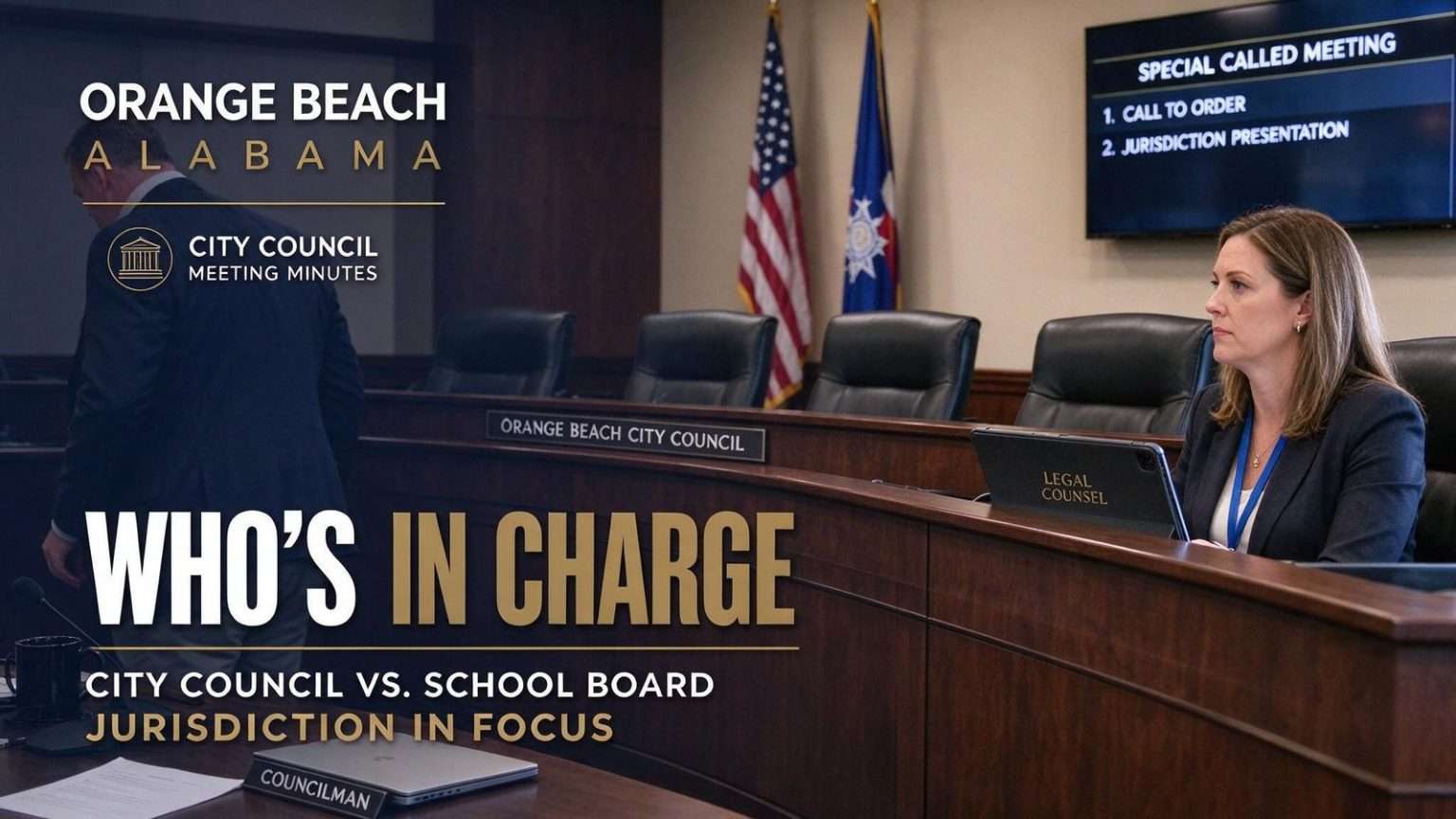
A dispute over jurisdiction between the Orange Beach City Council and the city’s school board attorney surfaced after a councilman stepped out during a recent meeting, prompting the board’s attorney to request a presentation clarifying the boundaries between the two bodies’ authority. The request, aimed at establishing written clarity, comes as the young city school system continues to define its relationship with the city government that helped create it.
The episode points to a broader governance question that has become more common as Alabama cities like Orange Beach establish or expand their own municipal school systems separate from county school districts: exactly where a city council’s authority ends and an independently governed school board’s authority begins. In a small city, where the same handful of officials frequently cross paths at civic events and share the same constituents, those boundaries can blur in ways that larger cities rarely experience.
What Sparked the Dispute
The flashpoint was a recent meeting at which a councilman stepped out, an incident that the school board’s attorney cited in requesting a formal presentation on jurisdictional boundaries. Further details on the specific meeting incident that prompted the request, along with the substance of the jurisdictional questions at issue, were not immediately available.
What is clear is the posture of the request. Rather than filing a formal challenge or escalating to litigation, the board’s attorney asked for a presentation — an educational exercise designed to lay out, in front of both bodies, what state law says about who decides what. The approach signals a desire to resolve the dispute through clarification rather than confrontation.
Why Jurisdiction Lines Matter
These jurisdictional lines matter practically for budget approval, personnel decisions and policy authority, and disputes over them can create friction between city officials and school board members even when both bodies are ultimately accountable to the same city’s residents. A city council typically controls the tax dollars and capital projects that fund a school system, while an independent school board holds statutory authority over hiring, curriculum and day-to-day operations.
When those spheres overlap — a construction project, a personnel dispute, a policy decision with financial implications — questions arise about which body has the final say. In newly independent systems, those questions surface more often because the working relationships are still being built and written procedures have not yet settled into habit.
The request for a formal presentation on jurisdiction suggests school board officials want written clarity on the issue rather than relying on informal understandings that can vary depending on which council members and board members are involved in a given dispute. Documentation, in other words, is meant to outlast the personalities.
Orange Beach’s Young School System
Orange Beach is one of Alabama’s newest city school systems. For generations, the city’s students attended schools operated by the Baldwin County Public School System, and later by neighboring Gulf Shores after that city broke away to form its own district. Orange Beach pursued its own separation, and the city’s schools now operate under a municipal board with its own superintendent, budget and policies.
The creation of the system followed a path several Alabama cities have taken in recent decades. Under state law, forming a city school district requires the city to transfer school property and tax support away from the county system, a process that involves negotiations, legislative action and a payback arrangement to the district being left. The result is a system that is legally independent of the county but financially and civically intertwined with the city that created it.
That entanglement is precisely where jurisdiction questions arise. The city funds and often builds the facilities; the board runs the schools inside them. Whether a particular decision belongs to the council, the board or both is a question new systems answer gradually, sometimes through disputes like the one now playing out in Orange Beach.
A Growing Alabama Phenomenon
Alabama’s map of municipal school systems has been expanding for years, with cities large and small choosing to run their own districts rather than sending students and tax dollars to county systems. The motivations vary — local control, identity, responsiveness and the perception that city systems direct more resources to their own students — but the governance challenges are remarkably consistent across the state.
City councils and school boards in newly formed systems must negotiate everything from facility leases to resource officers to shared athletic facilities, and each agreement is an exercise in drawing the jurisdiction line. Attorneys for both bodies spend considerable time on these questions, and a formal presentation of the sort requested in Orange Beach is a familiar tool for getting everyone onto the same page.
Observers of municipal governance note that early disputes, handled well, can actually strengthen a young system. A clearly documented understanding of authority prevents larger conflicts later, and the fact that both sides are addressing the issue through a presentation rather than a lawsuit suggests both are investing in the relationship.
How These Disputes Typically Resolve
Governance disputes between city councils and school boards usually end in one of three ways: a written memorandum of understanding, a policy adopted by both bodies, or simply the passage of time as working relationships mature. Formal presentations like the one requested in Orange Beach often serve as the starting point for the first two outcomes, because they put the legal framework on the record in a way both boards can reference later.
Attorneys generally recommend that new systems document their answers to recurring questions — who signs off on facility spending, who controls parking lots and athletic venues after hours, how resource officers are funded and supervised. Each documented answer becomes precedent, and over a few years the gray areas shrink until the two bodies operate smoothly in their own lanes.
The alternative is unproductive friction. In small cities, council members and board members are neighbors, and public disputes can harden into factions that complicate every future decision, from budget season to superintendent searches. That risk is exactly what a clarification session is designed to head off.
What Happens Next
The requested presentation will presumably be scheduled at a future meeting of one or both bodies, giving the school board’s attorney an opportunity to walk through the legal division of authority. City council members will have the chance to ask questions, and both bodies can begin closing the gaps in their understanding.
Residents of Orange Beach, who fund the schools through city taxes and elect the council that approves those budgets, have a stake in the outcome. A school system that operates smoothly with its city government is better positioned to focus on classrooms, teachers and student achievement rather than internal governance disputes.
Neither body has suggested the disagreement will escalate, and the tone of the request — clarification rather than confrontation — points toward a cooperative resolution. For a young school system still writing its own playbook, the episode may prove less a crisis than a routine, even healthy, step in growing up as an independent district.
The Larger Stakes for a Small City
Orange Beach’s school system is more than an educational institution — it is a pillar of the city’s identity. The beachfront city invested heavily in building a district it could call its own, and the schools now anchor community life in the same way the city’s sports complex, performing arts venues and waterfront do. Residents who supported the split from the county system did so expecting local control to translate into local pride, and early years of any such system carry outsized symbolic weight.
That expectation raises the stakes of governance disputes. Every disagreement between the council and the board gets read by residents against the promise made when the system was created: that a city-run district would serve the city better. Officials on both sides know that perception matters, which helps explain why the response to the recent friction has been a request for legal clarity rather than public recrimination.
Small-city governance also has a structural quirk that larger systems avoid: the pool of engaged civic leaders is small, and the same people often serve on overlapping boards, foundations and committees. Boundaries that would be obvious in a large city — where council and board members rarely share social circles — require more explicit definition in a town where everyone knows everyone.
Lessons From Other Alabama Systems
Other Alabama cities that have formed or expanded their own systems have faced similar growing pains, and their experiences offer a template. Systems that established clear written agreements early — covering everything from facility ownership to the funding of school resource officers — tend to report smoother operations, while systems that relied on goodwill alone have periodically found themselves in public disputes over who decides what.
Gulf Shores, Orange Beach’s neighbor and former shared district, navigated its own separation from the county system and offers a nearby example of how a new district defines its relationship with its city over time. Across the state, older city systems in places like Hoover, Madison and Saraland — the latter often cited as a model of a successful municipal split — show that the early governance questions eventually give way to stable, institutionalized working relationships.
Saraland’s experience in particular is instructive for Baldwin County’s two newest city systems. The Mobile County city’s split produced a district that has since been widely praised, and part of its success came from setting expectations between the city council and the school board early and in writing. That is essentially what Orange Beach’s school board attorney is now proposing: put the rules on the record before the next dispute tests them.