Orange Beach Council Set to Fund Sea Turtle Facility Upgrade, Weigh AC Hotel PUD Changes
Orange Beach's City Council is set to fund new life-support equipment at its sea turtle facility and consider redesigning the AC Hotel by Marriott's parking, among a packed Tuesday agenda.
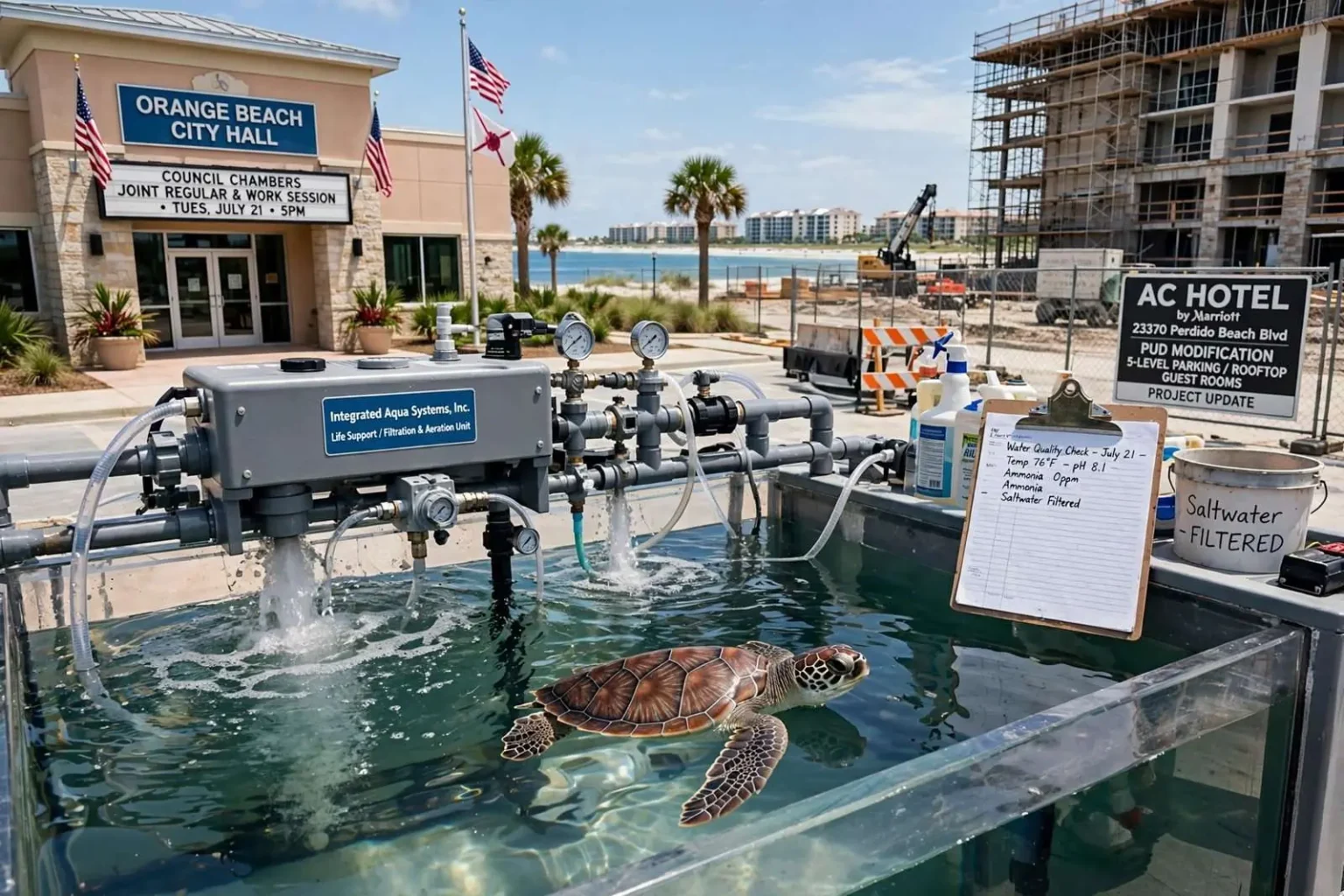
Orange Beach leaders are set to take up a busy agenda at tonight’s joint regular and work session meeting, including funding for sea turtle rehabilitation equipment and a redesign of a planned Marriott hotel near the beach. The City Council is scheduled to vote on a resolution awarding an $84,297.04 bid to Integrated Aqua Systems, Inc. for new life-support equipment at the Coastal Alabama Sea Turtle Facility. The upgrade is intended to support the city’s ongoing work caring for injured and rehabilitating sea turtles along the coast.
The meeting is scheduled for this evening, Tuesday, July 21, at 5 p.m. in the Council Chambers at Orange Beach City Hall. Joint regular and work sessions have become the city’s standard format for heavier agendas, allowing the council to discuss items in detail during the work portion before taking formal votes in the regular session. Residents and visitors alike can attend, and the combination format keeps a single evening from stretching into two separate meetings during the height of the summer season.
The sea turtle facility investment reflects the city’s unusual position as one of the few municipalities in the country that directly funds and operates marine wildlife rehabilitation infrastructure. Loggerhead, green and Kemp’s ridley sea turtles nest along the Baldwin County beaches each summer, and Orange Beach has built a public-facing rescue operation around that fact, giving residents and tourists a rare window into the work of responding to strandings, boat-strike injuries and cold-stunned animals. New life-support systems — filtration, aeration and water-quality equipment — are the operational core of any such facility, since sick turtles require tightly controlled water conditions for weeks or months before release.
Integrated Aqua Systems, Inc., a California-based supplier of aquatic life-support systems, has built equipment for public aquariums, research institutions and animal care facilities nationwide. The bid award places the Orange Beach operation on a professional footing comparable to larger institutions, and the timing matters: summer is peak stranding and nesting season, when demand on the facility is heaviest and every hour of downtime in a life-support system can cost an animal its recovery.
The AC Hotel Redesign
Also on the agenda is a Planned Unit Development modification for the AC Hotel by Marriott, proposed for 23370 Perdido Beach Boulevard at the site of the former Romar Beach Baptist Church. The amendment would eliminate a previously approved off-site parking lot located more than a mile from the hotel. In its place, developers would add a new level atop the hotel’s existing parking structure to provide all 160 required on-site spaces, while also relocating eight guest rooms to the rooftop level.
The change addresses one of the most common friction points in Orange Beach development: parking. A mile removed from its guests, an off-site lot forces hotel visitors to walk or shuttle across one of the city’s busiest beach corridors, adding traffic turns at intersections that already strain during summer weekends. Consolidating all 160 spaces into the structure itself keeps vehicles on the property, shortens pedestrian crossings and removes the operational cost of shuttling guests. Moving eight rooms to the rooftop is the trade-off that makes the additional parking level fit within the approved building envelope, and rooftop rooms along Perdido Beach Boulevard typically command premium views of the Gulf and the bay.
Planned Unit Development approvals give Orange Beach flexibility to negotiate larger, mixed projects in exchange for conditions the city sets up front, and modifications like this one go back through the council rather than being handled administratively. The former church site has drawn attention precisely because it sits on Perdido Beach Boulevard, the city’s main beachfront artery, where every change in traffic pattern or building height affects neighbors along a strip that mixes condominium towers, older cottages and newer hotels. Council discussion of the modification is expected to touch on height, lighting and how construction staging will be managed on a corridor already busy with seasonal traffic.
Estuary Program and Neighborhood Speeds
The council’s agenda includes several other notable items. Jason Kudulis, executive director of the Mobile Bay National Estuary Program, is scheduled to give a presentation to the council. The estuary program, part of the national network of estuary programs sanctioned under the Clean Water Act, works across Mobile and Baldwin counties on water quality, habitat restoration, and the health of the bays and bayous that feed the region’s seafood and tourism economies. For Orange Beach, whose canals, dunes and back bays are the raw material of its visitor economy, the program’s work on stormwater management and living shorelines has direct municipal consequences, and the presentation gives council members a chance to align city projects with regional restoration priorities.
Council members will also hold a second reading on an ordinance lowering speed limits from 25 mph to 15 mph on several streets within the Lauder Place subdivision, including Barracuda Street, Cobia Avenue, Sailfish Lane, Tarpon Street and Yellowfin Street. Second readings are the formal step before adoption in Alabama municipal practice, giving the ordinance its final public airing before the vote. Lowering a residential street from 25 to 15 mph is a meaningful change: at 15 mph a driver’s stopping distance shrinks dramatically, and neighborhoods like Lauder Place — built around winding streets with limited sightlines and heavy pedestrian, golf-cart and bicycle traffic in season — are exactly the places where such reductions have the largest safety effect. Residents of canal-side subdivisions in Orange Beach have pushed for years for slower speeds on narrow streets where vacation rental traffic meets year-round families.
Emergency Medical Capacity in Peak Season
On the public safety front, the council will consider a mutual aid agreement with Lifeguard Ambulance Service, doing business as Medstar EMS, aimed at preventing the city’s medical transport system from being overwhelmed during peak tourist season. Mutual aid agreements are the standard tool municipal governments use to formalize backup arrangements between emergency providers: when a city’s primary ambulance resources are committed, the agreement lets partner units respond without the delays of ad hoc negotiation in the middle of an emergency.
The underlying problem is arithmetic. Orange Beach’s resident population swells enormously during summer weekends and holiday periods, and call volumes rise with it — beach injuries, heat emergencies, wrecks on Perdido Beach Boulevard and the Foley Beach Express, and water rescues that require transport. A municipal EMS operation sized for a small city cannot scale to a resort town’s peak population without partners. Formalizing the relationship with Medstar EMS gives dispatchers a defined protocol instead of a phone call, and gives residents assurance that a surge day will not leave them waiting for an ambulance that is three calls deep.
Members will also weigh a memorandum of understanding with the Baldwin County Sheriff’s Office to assign local police officers to work in coordination with sheriff’s deputies, extending coverage across jurisdictions during the city’s busiest periods. Orange Beach’s police department handles a summer workload closer to that of a mid-sized city than a town of its resident count, and cooperative arrangements with the sheriff’s office let both agencies share the burden of traffic control, beach calls and late-night disturbances without duplicative spending. Such agreements also smooth radio interoperability and pursuit coordination along the county’s beach corridors, where city limits sit close together and incidents routinely cross jurisdictional lines.
How the Pieces Fit Together
Taken as a whole, the agenda sketches the governing challenges that define Orange Beach: a city that must maintain wildlife and environmental programs, negotiate with major hotel developers, keep neighborhoods safe for year-round residents, and provision emergency services for a population that multiplies each summer. None of these problems exists in a comparable Alabama municipality at the same scale, which is why the city’s agendas routinely contain items — sea turtle equipment, lifeguard contracts, rooftop hotel rooms — that would look out of place in a typical inland city hall.
The sea turtle facility vote, in particular, sits at the intersection of conservation and civic identity. The city’s commitment to turtle rescue began as a volunteer-driven response to strandings and nest disturbances along the shared beach, and has matured into a facility with professional equipment, interpretive programming for visitors, and partnerships with state and federal wildlife agencies. Each upgrade raises the survival odds for animals that federal law protects and that Gulf Coast tourism markets as part of the region’s natural identity. The $84,297.04 bid is a modest line item by municipal standards, but it sustains a program that draws school groups, news coverage and visitor goodwill throughout the season.
The hotel modification, meanwhile, shows how the city’s development framework adapts to a maturing market. Early Orange Beach development built on generous parking assumptions and sprawling lots; the current wave of mid-rise branded hotels on Perdido Beach Boulevard trades density for walkability and views, and PUD amendments are where those trade-offs get worked out in public. Consolidating parking on-site, relocating rooms upward, and eliminating a distant lot all push the project toward the pattern the city has favored: compact buildings that keep cars off neighborhood streets and keep the beach corridor moving.
What Residents Should Watch
For residents, the practical outcomes are concrete. Lauder Place drivers will see new speed limit signs if the ordinance passes, and enforcement typically follows a grace period while the changes are publicized. Emergency response during peak weekends will depend on how the mutual aid and sheriff’s office agreements are structured, including response-time commitments and cost-sharing terms that determine whether the partnerships hold up in the heaviest weeks. And the AC Hotel decision will shape construction activity on Perdido Beach Boulevard for the next several seasons, from staging lanes to the eventual traffic pattern at the hotel’s entrance.
The Kudulis presentation, meanwhile, may preview future grant opportunities. The Mobile Bay National Estuary Program channels state and federal restoration funding into local projects — dune restoration, stormwater retrofits, canal water-quality work — that can offset municipal costs when cities align their priorities with the program’s plans. Orange Beach officials have historically used such partnerships to leverage the city’s budget across its environmental agenda, and tonight’s session is the venue where those next projects are likely to surface.
Whether every item passes or some are carried over, the meeting illustrates how a small resort city governs at commercial speed. Between turtle equipment bids, rooftop room counts, ambulance contracts and 15-mph zones, the council is managing the ordinary machinery of a city whose summer population and visitor expectations dwarf its size — and whose quality of life, for both residents and tourists, depends on getting those details right.