Sheriff Candidate Pamela Laffitte Urges Mobile to Freeze Reserve Transfers Over $14.7 Million Fraud Loss
Mobile County sheriff candidate Pamela Laffitte is asking the mayor and City Council to halt any use of reserve funds to replace the $14.7 million fraud loss until all investigations are complete.
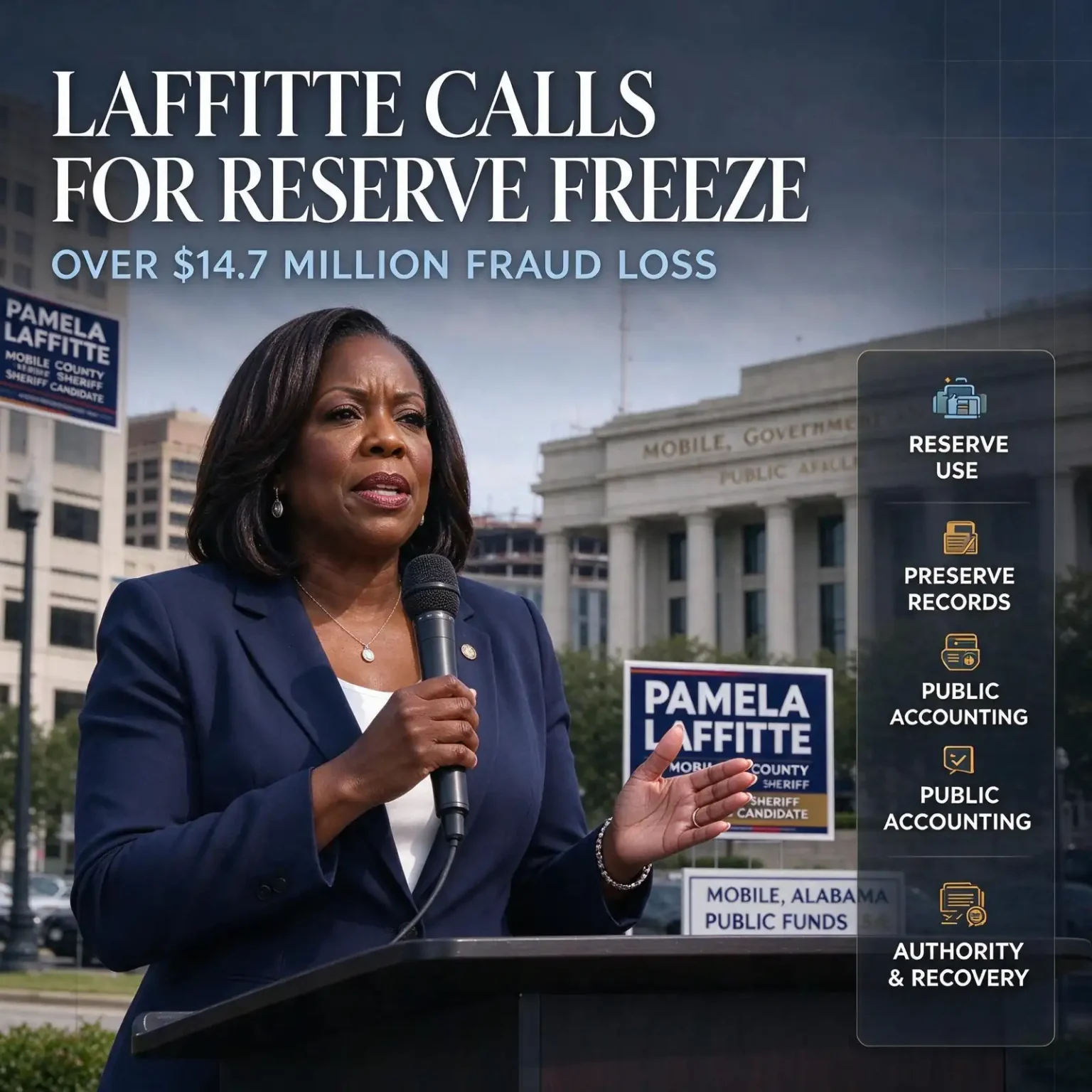
MOBILE, Ala. — Mobile County sheriff candidate Pamela Laffitte on Wednesday called on Mayor Spiro Cheriogotis, the Mobile City Council and the city officials who manage reserve funds to freeze any use of reserves to replace the $14.7 million the city lost in a criminal financial scheme until every investigation into the loss is finished.
Laffitte, the Democratic nominee for sheriff in the Nov. 3 general election, said the request covers any transfer or use of reserve money intended to make up for the loss until the city’s independent review and all related federal, state and local investigations are completed.
“Taxpayers deserve answers before public money is moved—not explanations after the fact,” Laffitte said. “I am calling on the Mayor, City Council, and responsible financial officials to take immediate action within their legal authority to preserve these reserve funds while the investigations proceed.”
What Laffitte is asking for
In her statement, Laffitte urged city officials to:
- Halt any transfer or use of reserve funds meant to replace the reported $14.7 million until the investigations are complete.
- Preserve all relevant financial records.
- Provide a public accounting of the loss to the extent the law allows.
- Clearly explain who has authority over any proposed transfer of reserve money and what oversight applies.
- Describe the steps being taken to recover the money.
She also asked the mayor and council for a written response identifying which officials or departments have the authority to approve or carry out such transfers and what lawful measures could be used to pause them while the investigations continue.
“Public funds must be handled lawfully, transparently, and with accountability. Before reserve money is moved, the public deserves a clear explanation and appropriate oversight,” Laffitte said.
Laffitte’s statement drew a line between the fraud loss and another financial issue now before city leaders, the proposed Midtown tax increment financing, or TIF, district. She emphasized that the two are separate matters and made no allegation that they are connected.
What the city has said about covering the loss
The city disclosed the loss Tuesday evening, Oct. 20, saying $14.7 million in city funds had been transferred to a “fraudulent entity” and that the FBI and the U.S. Secret Service were investigating. That statement said that “because of the City’s strong financial reserves and other available contingencies,” the loss would not affect the city’s financial stability, services or the completion timeline of capital projects.
At a news conference Wednesday, Cheriogotis said the money was a single payment in a series of large transactions tied to construction of the new Regions Arena downtown. He said the payment was made in early October and that he learned of it Friday, Oct. 16. The mayor said the loss would be covered by a contingency of about $15 million built into the arena budget, and that the project is still expected to finish within budget. He said the city will try to recover the money through the criminal investigations, its cyber-insurance carrier and other means, though he acknowledged insurance will not make the city whole and that future capital projects could be affected next year. South AL News has full coverage of the mayor’s account of the $14.7 million Mobile city fraud.
How Mobile handles city money
Mobile operates under a mayor-council form of government. The mayor oversees day-to-day operations, including the city’s finance department, while the seven-member City Council approves the budget and authorizes spending. The council has also written into city ordinance its practice of building up the city’s reserve, or rainy day, fund, a step Finance Committee Chairman Josh Woods pointed to this week as a reason the city can absorb the loss.
The city itself has hired a national law firm and a forensic accounting firm to review its financial policies and procedures, and the mayor has already ordered that payments of $1 million or more be made by hand-delivered check rather than wire or electronic transfer. Several council members, including Ben Reynolds, Cory Penn, Dr. Samantha Ingram and CJ Small, have said they want detailed answers about how the payment was made and whether safeguards failed.
About the candidate and the race
Laffitte is a retired corrections sergeant with the Mobile County Sheriff’s Office. Her campaign materials say she spent 26 years with the office; she has also worked as a public safety dispatcher and served more than a decade in the U.S. Air Force Reserve. She is challenging Republican Sheriff Paul Burch, who is seeking a second term, in the Nov. 3 general election.
The sheriff’s office does not oversee the City of Mobile’s finances. The fraud investigation is being led by federal agencies, with the involvement of the Mobile Police Department and the U.S. Attorney’s Office. Laffitte framed her statement as a call for transparency and accountability in the handling of public money.
What comes next
The federal investigations and the city’s internal review are ongoing, and the administration has said it will share more information when it can do so responsibly. Residents who want to follow the issue can attend or watch the City Council’s regular Tuesday meetings at Government Plaza in downtown Mobile. Anyone who has been a victim of fraud, or has information about one, can file a complaint with the FBI’s Internet Crime Complaint Center at IC3.gov.