Mobile city fraud: $14.7 million lost to scheme as FBI, Secret Service investigate
The City of Mobile lost $14.7 million in city funds to a criminal scheme, Mayor Spiro Cheriogotis' administration said. The FBI and Secret Service are investigating; officials say services won't be affected.
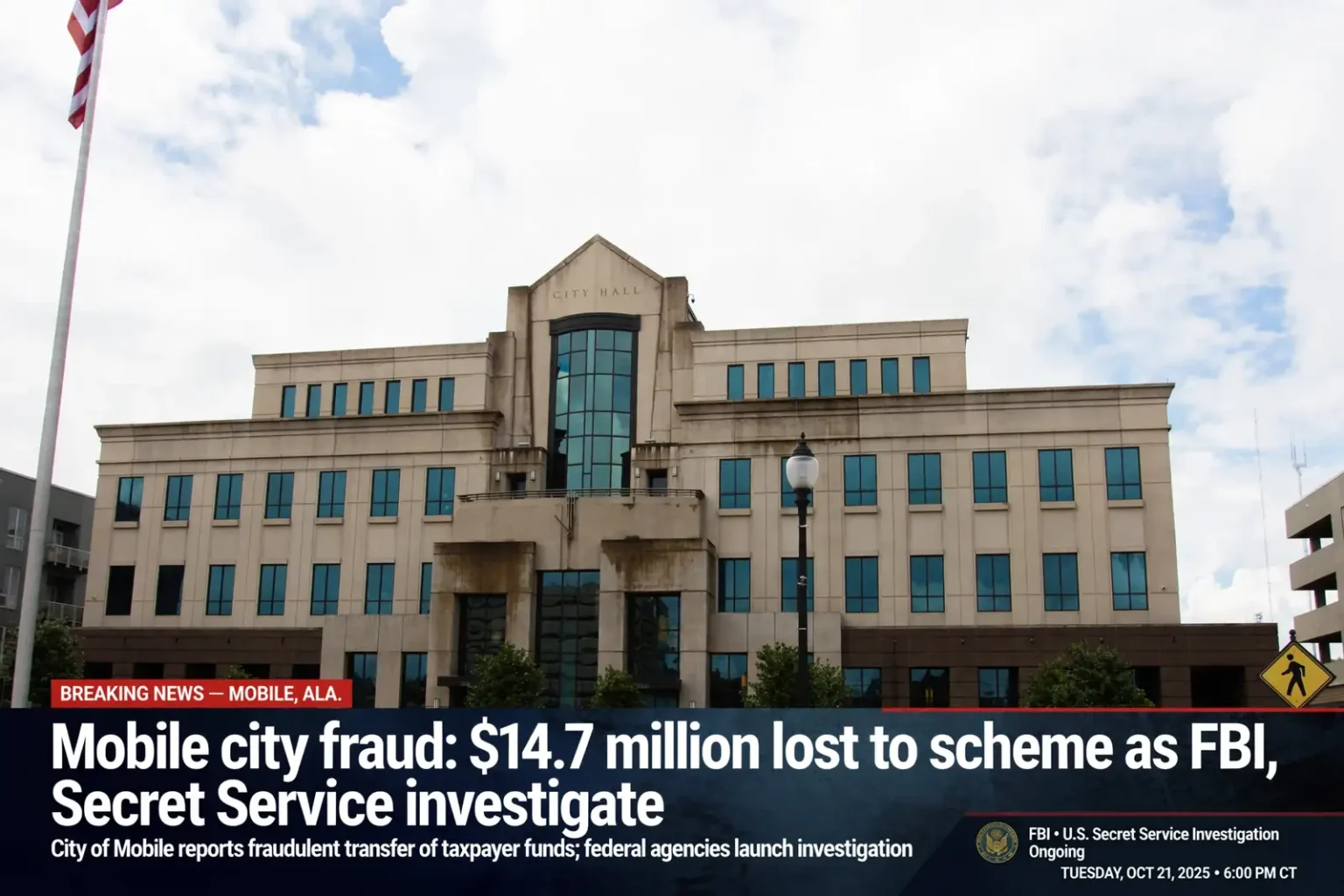
MOBILE, Ala. — The City of Mobile lost $14.7 million in taxpayer money to a criminal scheme that sent city funds to a fraudulent entity, Mayor Spiro Cheriogotis’ administration disclosed Tuesday evening. The Mobile city fraud is now under investigation by the FBI and the U.S. Secret Service, city officials said.
In a news release sent around 6 p.m. Tuesday, the administration said the city “recently discovered that it was the target of a criminal scheme resulting in the transfer of $14.7 million in city funds to a fraudulent entity.” Officials said they notified federal investigators as soon as the fraud was discovered.
“We are cooperating fully with investigators and taking every available step to recover the funds and bring the responsible party to justice,” the release states.
The statement offered few details beyond the amount and the agencies involved. It did not say who received the money, how the transfer was carried out or why the funds were sent.
What the city has said so far
The administration’s announcement focused on three main points:
- The city was the target of a criminal scheme that resulted in $14.7 million in city funds being transferred to a fraudulent entity.
- The FBI and the U.S. Secret Service were notified as soon as the fraud was discovered, and the city is cooperating fully with their investigation.
- The loss has no immediate effect on the city’s financial stability or its ability to deliver services, which the administration attributed to “the city’s strong financial reserves.”
Beyond those points, the administration has said little. A city spokesman declined to answer questions about several key details, including when the fraud took place, whether it involved intentional misconduct by any city employee, whether the city carries insurance that could cover the loss and whether the administration plans to change its financial and accounting practices as a result.
No arrests or charges have been announced, and no individual or business has been publicly identified as being responsible.
Council members briefed, but specifics remain scarce
Members of the Mobile City Council said the administration briefed them on the matter earlier Tuesday, before the public announcement. Even so, council members said they do not know many of the specifics.
Councilman Ben Reynolds said he hopes the federal investigation will lead to criminal charges against those responsible.
Councilman Josh Woods, who chairs the council’s Finance Committee, referred questions about what happened to the administration, but he stressed the seriousness of the loss.
“This is a serious matter because this is taxpayers’ money,” Woods said.
Oversight role for the City Council
Mobile operates under a mayor-council form of government, in which the mayor runs the city’s day-to-day operations, including its finance department, and the seven-member City Council, elected from districts, sets policy, approves the budget and authorizes spending. That structure gives council members a direct interest in understanding how a loss of this size happened and whether the city’s internal controls need to be strengthened.
The disclosure comes less than a year into Cheriogotis’ tenure. He took office in late 2025, succeeding Sandy Stimpson, who led the city for three terms. The administration has not said whether the fraud occurred before or after the change in leadership, one of the timing questions the city spokesman declined to answer.
Reserves expected to cushion the blow
Woods said he is confident the city can absorb the financial hit without cutting city services, pointing to the reserves the city has built up over time.
“The city has done a great job of building financial reserves,” he said.
He noted that the council recently formalized a practice of expanding the city’s rainy day account, turning what had been a policy into law.
“We took it seriously,” Woods said. “We made it an ordinance.”
Neither Woods nor the administration provided a figure for the current size of the city’s reserves or said whether money would be drawn from them to make up for the loss.
A rainy day fund, sometimes called a reserve or stabilization fund, is money a government sets aside to cover unexpected costs or revenue shortfalls, such as those caused by a recession, a natural disaster or, in this case, a major financial loss. Putting the practice into a city ordinance makes the commitment to build and maintain those reserves part of the city’s code, rather than a decision left to each year’s budget. For a coastal city like Mobile, which must be prepared for hurricanes and other emergencies, healthy reserves are also viewed by credit rating agencies as a sign of financial strength.
While the administration said the loss will not affect day-to-day operations, $14.7 million is a substantial sum for any city government. Money spent replenishing reserves or covering the loss is money that is not available for other priorities, which is why the questions of insurance coverage and recovery of the funds are likely to be closely watched.
Insurance is one of the biggest open questions. Many public entities carry crime or cyber insurance policies that can cover certain kinds of fraud losses, though coverage depends on the specific terms of each policy, including limits, deductibles and exclusions for particular types of schemes. The city has not said whether it holds such coverage or whether a claim has been filed, so it is not yet clear how much of the $14.7 million, if any, could be offset that way.
Why federal agencies are involved
The involvement of both the FBI and the U.S. Secret Service reflects the nature of large-scale financial crimes. The FBI investigates a broad range of federal crimes, including wire fraud and other schemes that move money electronically across state lines or international borders. The Secret Service, best known for protecting the president, was originally created to combat counterfeiting and still has a major investigative role in financial crimes, including fraud targeting the nation’s financial and payment systems.
When fraudulently obtained money is moved quickly, prompt notification of federal authorities and the financial institutions involved can sometimes help freeze accounts or recover a portion of the funds before they are moved again. City officials said they contacted federal investigators as soon as the fraud was discovered and that they are taking “every available step” to recover the money. They have not said whether any of the funds have been recovered so far.
Victims of internet-enabled fraud, including organizations, can also file reports with the FBI’s Internet Crime Complaint Center, known as IC3, which collects complaints and shares information with investigators. The FBI has said that reporting quickly gives investigators the best chance of tracing money before it disappears.
A common threat for governments and businesses
The city has not described how the scheme worked, and it is not known what method was used in this case. In general, however, federal authorities have repeatedly warned that government agencies, school systems and businesses are frequent targets of fraud schemes designed to trick organizations into sending payments to accounts controlled by criminals. Such schemes often rely on impersonation, such as a fraudster posing as a trusted vendor, contractor or official and requesting that payments be redirected to a new bank account.
Common safeguards recommended for organizations that handle large payments include:
- Verifying any request to change payment or banking information by calling a known contact at a phone number already on file, rather than one provided in the request.
- Requiring more than one person to approve large transfers.
- Training employees to recognize suspicious requests, especially those marked as urgent.
- Reporting suspected fraud immediately to the financial institution and to law enforcement.
Whether any of those safeguards were in place, or whether the city plans to change its procedures, has not been addressed by the administration.
What comes next
The federal investigation is ongoing, and city officials have not said when they expect to release more information. Key questions remain unanswered, including how and when the fraud occurred, who was behind it, whether any of the money can be recovered and whether insurance will cover any part of the loss.
Council members are expected to keep pressing for details, particularly as the Finance Committee reviews the city’s financial position. Reynolds has said he hopes the investigation results in criminal charges. Anyone who is eventually charged in connection with the scheme would be presumed innocent unless and until proven guilty in court.
Residents who want to follow the matter can watch for updates from the city and attend or view the City Council’s regular public meetings at Government Plaza in downtown Mobile, where council members may raise questions about the loss and the city’s response. Anyone with information about the scheme can contact the FBI, which accepts tips through its website and local field offices, including the field office in Mobile.
For Mobile residents, the immediate message from city leaders is that services such as police, fire, sanitation and public works will continue as usual. The longer-term questions of accountability and recovery will depend on the outcome of the federal investigation and on what the administration chooses to share with the council and the public in the weeks ahead.