Causeway Classic Wooden Boat Show returns Saturday to benefit Child Advocacy Center
The third Causeway Classic Wooden Boat Show is Saturday, Oct. 24, at Bluegill Restaurant in Spanish Fort, with $10 admission benefiting the Child Advocacy Center of Mobile.
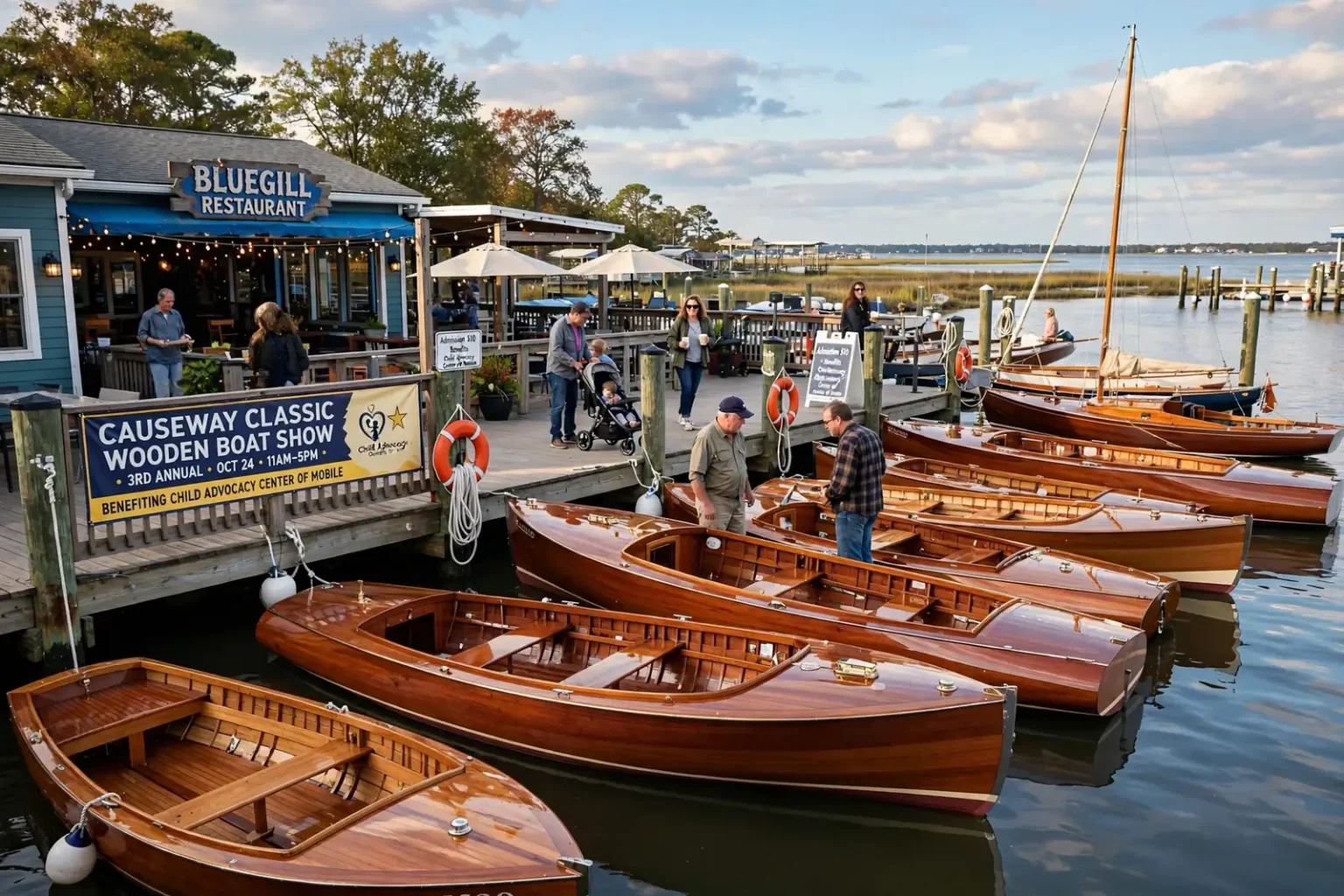
SPANISH FORT, Ala. — Polished mahogany, gleaming varnish and decades of coastal boating tradition will line the water on the Mobile Bay Causeway this Saturday, Oct. 24, when the Causeway Classic Wooden Boat Show returns for its third year. The event raises money for the Child Advocacy Center of Mobile, which serves children who have experienced abuse.
The show runs from 11 a.m. to 5 p.m. at Bluegill Restaurant, 3775 Battleship Parkway in Spanish Fort. Admission is $10, and the money collected at the gate goes to the Child Advocacy Center, often called the CAC.
Event details at a glance
- What: Causeway Classic Wooden Boat Show, third annual
- When: Saturday, Oct. 24, 11 a.m. to 5 p.m.
- Where: Bluegill Restaurant, 3775 Battleship Parkway, Spanish Fort
- Cost: $10 admission
- Benefits: Child Advocacy Center of Mobile
- Boats registered: More than 43
A growing showcase of coastal craftsmanship
The Causeway Classic brings together local wooden boat enthusiasts and families to celebrate the region’s coastal heritage. Organizers say more than 43 boats are registered for this year’s show, giving visitors plenty to see whether they have spent a lifetime around boats or simply enjoy a day by the water.
Wooden boats hold a special place in Gulf Coast history. Long before fiberglass hulls became the norm in the second half of the 20th century, the boats that worked and played on Mobile Bay and the Delta were built of wood, from small skiffs and fishing boats to elegant runabouts with varnished decks. Keeping those boats in shape takes patience and skill, and owners often spend years restoring and maintaining them. Shows like the Causeway Classic give those owners a chance to share their work and give the public an up-close look at craftsmanship that has become increasingly rare.
Wooden boat shows around the country typically feature a mix of vessels: restored classic runabouts from well-known builders of the mid-20th century, handmade skiffs and rowboats, sailboats and new boats built by hobbyists using traditional methods. For many owners, each boat carries a story, whether it was passed down through a family, rescued from a barn and rebuilt plank by plank or built from scratch in a backyard workshop. Those stories are often as much of a draw for visitors as the boats themselves.
Anna Park, a spokeswoman for the Child Advocacy Center of Mobile, said the show blends history with a purpose.
“It is a wonderful opportunity to preserve and showcase a piece of our local history while bringing the community together for a meaningful cause,” Park said.
She added that the center is especially grateful that a growing local tradition has chosen to support children and families in the community.
“With more than 43 boats registered, there is plenty to admire for longtime boating enthusiasts and families who simply want to spend time enjoying something special about our area,” Park said. “Beyond the boats themselves, what makes this event special is the generosity behind it.”
Supporting the Child Advocacy Center of Mobile
The Child Advocacy Center of Mobile serves children in the Mobile area who are experiencing or have experienced abuse. The center brings together a multidisciplinary team that includes law enforcement officers, mental health providers, medical professionals, victim advocates and child protective services workers, all working together to investigate abuse and help children recover.
That team approach is the hallmark of child advocacy centers across the country. Before such centers existed, a child who disclosed abuse might have to tell the story again and again to police, social workers, doctors and prosecutors in a series of unfamiliar offices. Child advocacy centers aim to coordinate those agencies under one roof in a child-friendly setting, reducing the number of times a child must relive a traumatic experience while still giving investigators the information they need. The centers also connect children and their non-offending family members with counseling and other services to help them heal.
Abuse can be hard to spot, and children often do not tell anyone right away. Child welfare experts point to signs such as unexplained injuries, sudden changes in behavior or school performance, fearfulness around a particular person, withdrawal from friends and activities, or behavior that seems inappropriate for a child’s age. None of those signs proves abuse on its own, but they can be reasons for a trusted adult to pay closer attention and seek help.
Park said the CAC provides its services at no cost to families, and that community fundraisers are a key part of keeping it that way.
“The funds raised through community support help us continue providing essential services at no cost to families, including services that help children begin healing and move forward,” Park said.
The need is significant. According to Park, approximately 2,400 children came to the CAC for services last year.
Raising awareness as well as money
Organizers and CAC leaders say the Causeway Classic is about more than boats or dollars. The show also raises awareness of child abuse within the Mobile community, a subject that can be difficult to talk about but that affects families in every part of the region.
“Events like the Causeway Classic do more than raise money — they also raise awareness and remind families that they are not alone,” Park said. “We are incredibly thankful to the organizers, boat owners, sponsors, and attendees who help us make a lasting difference in the lives of children across our community.”
Park said community events like this one serve as a reminder of what neighbors can accomplish together. “Every year, community events like this remind us how much of an impact we can make when people come together to support children and families who need us,” she said.
How the show began
The Causeway Classic started in 2024 with a personal purpose. The first show was organized by Channing Flowers to raise money for Flowers’ father, Chan Flowers, who was recovering from Guillain-Barré syndrome.
Guillain-Barré syndrome is a rare autoimmune disorder in which the body’s immune system attacks the peripheral nerves, the nerves outside the brain and spinal cord. It can cause muscle weakness and numbness and, in serious cases, paralysis. Recovery can take months and often involves extended rehabilitation, which can bring heavy medical and personal costs for patients and their families.
From that first event built around one family’s need, the show has grown into a community tradition that now benefits children across the Mobile area. Its return for a third year, with dozens of boats registered, reflects both the enthusiasm of the region’s wooden boat owners and the community’s willingness to turn a shared interest into support for a good cause.
Planning your visit to the Causeway
The show’s setting is part of its appeal. Battleship Parkway, better known locally as the Causeway, stretches across the head of Mobile Bay between Mobile and the Eastern Shore and is home to a string of waterfront seafood restaurants, bait shops and boat launches. The road takes its name from the USS Alabama, the World War II battleship on display at Battleship Memorial Park at the western end of the Causeway.
Spanish Fort, at the eastern end of the Causeway, is one of the Eastern Shore cities in Baldwin County, along with Daphne and Fairhope. The city takes its name from a Spanish fortification that once stood in the area and is also known for the Civil War Battle of Spanish Fort, fought in 1865 as part of the campaign for Mobile. Today, the Causeway end of the city is a popular spot for waterfront dining and sunset views over the bay and the Mobile-Tensaw Delta.
Visitors can stroll among the boats along the water, talk with owners about their vessels and stay for an evening on the Causeway, where several local restaurants are within a short distance of the show. A few tips for attendees:
- Check ahead of time on accepted payment options for the $10 admission.
- Plan for the outdoor setting with sunscreen, comfortable shoes and water.
- Ask before touching any boat; many are restored by hand and are cherished by their owners.
- Arrive early for the best choice of parking along the busy Causeway.
How to help children in the community
For many attendees, the simplest way to help is to show up. Every $10 admission adds to the total raised for the center, and a strong turnout also shows boat owners and sponsors that the community values the event, encouraging them to come back next year. Organizers and CAC leaders have credited the owners who bring their boats, the sponsors who help cover costs and the visitors who buy tickets for making the event possible.
Beyond attending the show, people who want to support children who have experienced abuse can learn more about the Child Advocacy Center of Mobile and its services through the organization directly. Anyone who suspects a child is being abused or neglected should report it to local law enforcement or the Alabama Department of Human Resources. If a child is in immediate danger, call 911.