Brewton Low-Country Boil Thanks Linemen, First Responders After Hurricane Isaias
Local businesses and leaders hosted a Brewton low-country boil Sunday to thank hundreds of first responders, linemen and volunteers helping Brewton and East Brewton recover from Hurricane Isaias.
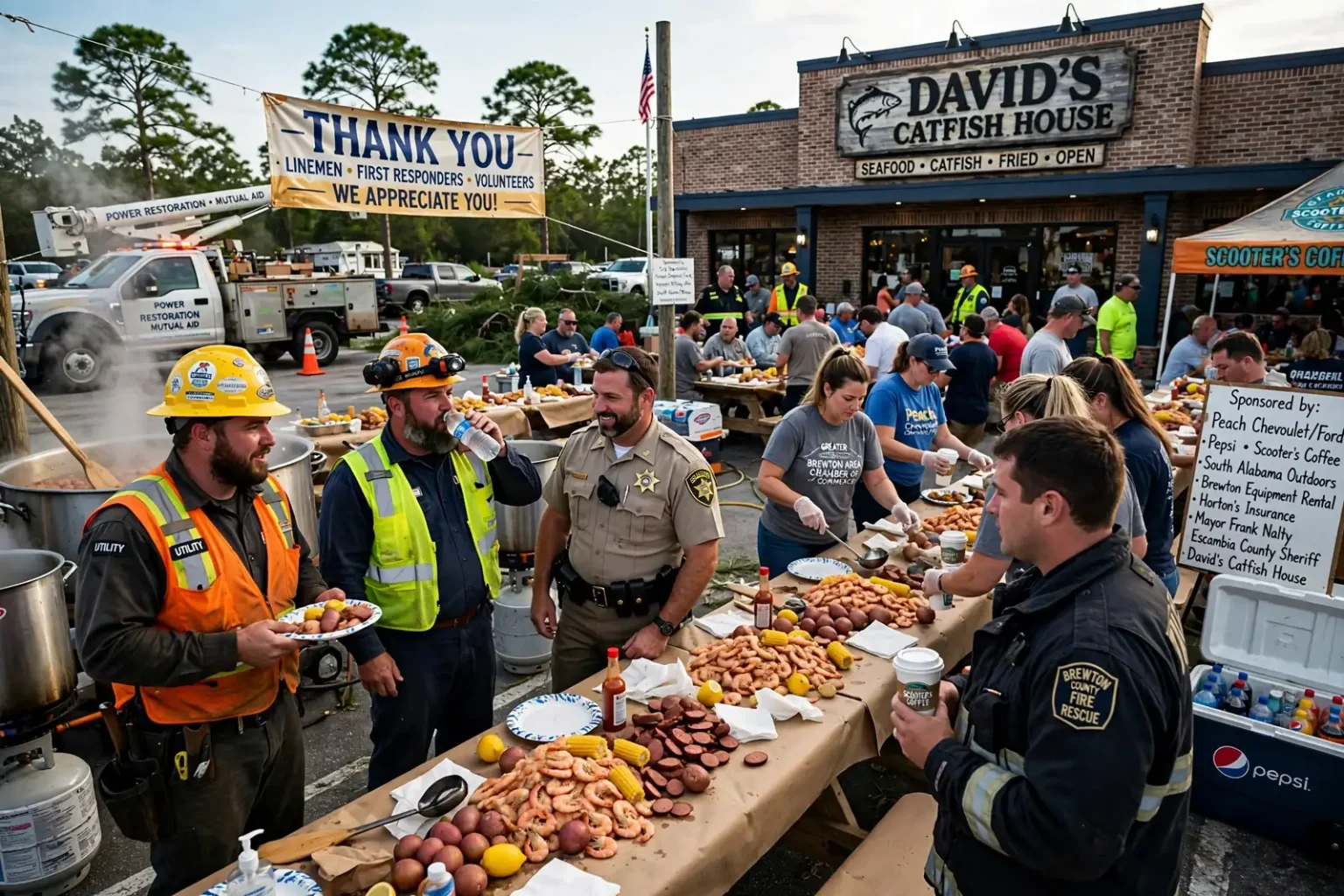
BREWTON, Ala. — A Brewton low-country boil turned a restaurant parking lot into an open-air dining room on Sunday afternoon, as local business owners and community leaders fed hundreds of first responders, utility linemen and volunteers who have spent the past week helping Brewton and East Brewton recover from Hurricane Isaias.
The meal was the idea of Josh Godwin, owner of David’s Catfish House, and Chip Peach, who wanted to give the out-of-town crews and local helpers a moment to sit down, eat and hear a word of thanks from the people they have been serving. What started as a plan between two men quickly drew a long list of sponsors and helping hands from across the community.
A simple idea to say thank you
For more than a week, the Brewton and East Brewton area has been filled with people who came to help. Volunteers converged on the two neighboring cities to make repairs, clear debris, remove fallen trees and serve meals to residents affected by the storm. Alongside them, first responders and power line crews worked long shifts to make the area safe and get the lights back on.
Godwin said the boil was meant as a straightforward gesture of gratitude for all of that work.
“We just wanted to do something to show our appreciation,” Godwin said. “Chip and I came up with this plan to offer up a low-country boil as a way to show our thanks.”
Once the two settled on the idea, others in the community were quick to sign on. Businesses, elected officials and civic volunteers stepped forward to help pay for the food and to cook and serve it.
Sponsors from across the community
The Sunday afternoon meal was sponsored by a mix of local businesses, regional companies and public officials. The sponsors included:
- Peach Chevrolet/Ford
- David’s Catfish House
- Pepsi
- Scooter’s Coffee
- South Alabama Outdoors
- Brewton Equipment Rental
- Mayor Frank Nalty
- Horton’s Insurance
- Escambia County Sheriff Heath Jackson
The list reflects the way recovery efforts in smaller Alabama communities often come together: car dealers, restaurants, equipment rental shops, insurance agents and elected leaders pooling what they have to meet a need. For crews who have been living out of trucks and hotel rooms, a hot meal served by local hands can carry as much meaning as the food itself.
Staff members and directors of the Greater Brewton Area Chamber of Commerce also pitched in, helping prepare the food and serve it to the crowd. Chambers of commerce frequently act as a connecting point in disasters, linking businesses that want to help with the people and organizations that need it, and the Brewton chamber’s role on Sunday followed that pattern.
A parking lot turned dining room
The boil was held at the David’s Catfish House location in Brewton, where the parking lot was transformed into a place for hundreds of first responders, linemen and other workers to gather and eat. Rather than a formal banquet, the setting was casual and practical, fitting for crews who could stop in between assignments and get back to work.
A low-country boil is a natural choice for feeding a large crowd. The dish, which has its roots in the Lowcountry region of coastal South Carolina and Georgia, is typically made by boiling shrimp, smoked sausage, corn on the cob and potatoes together in a large pot with seasoning. It is often poured out onto long tables so diners can serve themselves, which makes it well suited to outdoor gatherings and big groups. Along the Gulf Coast and across the Southeast, seafood boils have long been a staple of church suppers, fundraisers and community celebrations.
For many of the linemen in attendance, Sunday’s meal was likely a welcome break from fast food and boxed lunches. Utility crews responding to major storms routinely work 16-hour shifts or longer, and they often travel hundreds of miles from their home bases to help restore power in areas hit by hurricanes.
Who the meal honored
The boil was aimed at three groups whose work has been central to the recovery from Hurricane Isaias in the Brewton area.
- First responders: Police officers, sheriff’s deputies, firefighters and emergency medical crews are typically among the first on the scene after a storm, checking on residents, clearing roads for emergency access and responding to calls while normal services are disrupted.
- Linemen: Electrical line workers rebuild the power system after a storm, replacing broken poles, restringing downed lines and restoring service one circuit at a time. After major hurricanes, utilities commonly bring in mutual aid crews from other companies and other states to speed up restoration.
- Volunteers: Church groups, civic clubs, relief organizations and individual residents have been helping with repairs, cleanup, tree removal and meals for families affected by the storm.
Many of those workers are far from home. Mutual aid agreements among electric utilities allow companies to share crews and equipment after a disaster, so a lineman working a street in Brewton may live several states away. Those crews often stay until the last customer who can safely receive power is reconnected, then move on to the next job or head home. Meals provided by host communities help keep them fueled during long days and remind them that the people they are serving appreciate the sacrifice.
Because the sponsors included both the sheriff and a mayor, the event also served as a public thank-you from local government to the people who stepped in when the community needed help.
How storm recovery works in small communities
Recovery after a hurricane often unfolds in stages, and the past week in Brewton and East Brewton has reflected that. In the first days after a storm, the focus is on safety: clearing roads, checking on vulnerable residents and making sure downed power lines are handled by professionals. Power restoration usually follows a set order, with utilities working first on transmission lines and substations, then on lines serving hospitals, shelters and other critical facilities, and finally on neighborhood lines and individual homes.
At the same time, volunteers often take on the work that falls between official agencies. They cut trees off roofs and driveways, tarp damaged homes, haul debris to the curb and cook for families who have lost power or have no way to prepare meals. In communities the size of Brewton and East Brewton, much of that labor comes from neighbors, churches and local businesses, along with outside groups that travel to disaster areas.
Gestures like Sunday’s boil are a familiar part of that cycle. Across the South, it is common to see restaurants, churches and businesses set up meals for utility crews and emergency workers in the days after a storm, both to keep them fed and to let them know their efforts are noticed.
About Brewton and East Brewton
Brewton is the county seat of Escambia County, Alabama, located in the southern part of the state near the Florida line. The city of East Brewton sits immediately next door, and the two communities share close economic and social ties. The area is known for its timber industry, its historic downtown and the creeks that run through it, and it sits roughly an hour’s drive northeast of Mobile.
Like many inland communities in south Alabama, the Brewton area can still feel the effects of hurricanes that make landfall along the Gulf Coast. Storms that move inland can bring damaging winds, falling trees and widespread power outages well away from the beaches, which is why crews and volunteers were needed in the area this past week.
Sunday’s meal brought together the people doing the work of recovery and the businesses and leaders who wanted to thank them. For the organizers, the goal was not publicity but appreciation, a chance to make one afternoon a little brighter for those who left their own homes and routines to help.
The effort also showed how quickly the community rallied around a single idea. What began with Godwin and Peach grew into a shared project involving more than a half-dozen businesses, the sheriff, a mayor and the local chamber of commerce, all working to feed hundreds of people in a single afternoon.
How residents can continue to help
As recovery from Hurricane Isaias continues, there are practical ways for residents of the Brewton and East Brewton area to support the people still working in the community and the neighbors still dealing with damage:
- Stay clear of utility crews and work zones, and slow down when driving past trucks and workers on the roadside.
- Treat every downed power line as energized and report it to the electric provider rather than approaching it.
- Check on elderly neighbors and others who may need help with cleanup or meals.
- Contact local churches, civic groups or the Greater Brewton Area Chamber of Commerce to learn about organized volunteer and donation efforts.
- Thank the workers you see. As Sunday’s event showed, a simple word of appreciation goes a long way.
For the linemen, first responders and volunteers who gathered in the parking lot on Sunday, the meal offered a short rest before returning to the job. For the community that hosted them, it was a way to say thank you with one of the South’s favorite traditions: a big pot of food shared with friends.