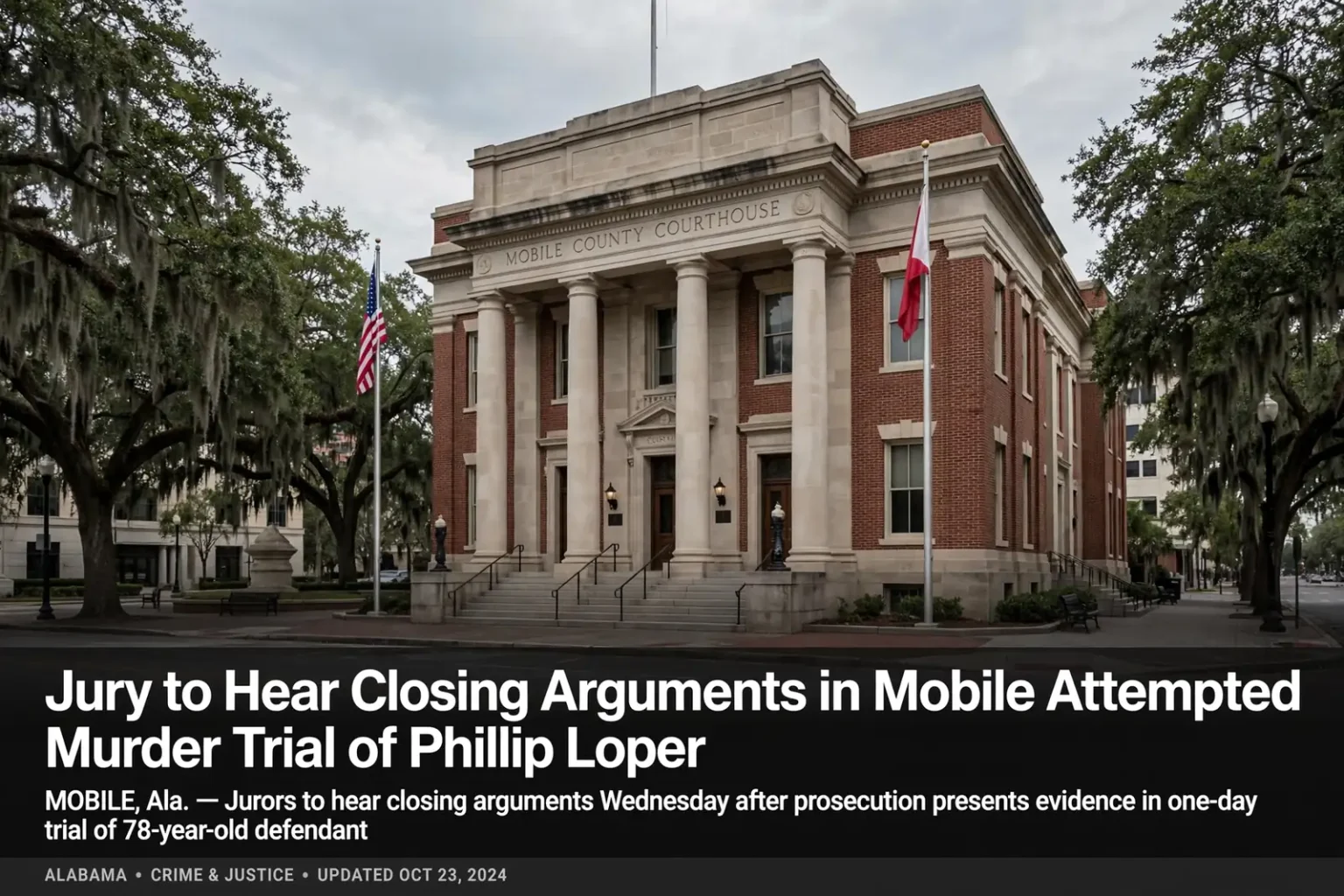
MOBILE, Ala. — Jurors in the Mobile attempted murder trial of Phillip Loper are scheduled to hear closing arguments Wednesday, less than a day after attorneys delivered opening statements in the case against the 78-year-old Mobile man.
Prosecutors needed only a few hours on Tuesday to present their evidence. They accuse Loper of punching a woman in the face multiple times, choking her and dragging her into a house, and they allege he told her she was going to “die today.” Loper is presumed innocent unless and until he is proven guilty in court.
What prosecutors allege
The case before the Mobile County jury centers on a violent encounter that prosecutors say put the victim’s life at risk. According to the state’s allegations, Loper:
- Punched the victim in the face multiple times
- Choked her
- Dragged her inside a house
- Told her she was going to “die today”
Those allegations form the basis of the attempted murder charge. In an attempted murder case, prosecutors generally must show not only that a defendant took steps toward killing someone, but that he acted with the specific intent to cause that person’s death. The words prosecutors say Loper used are likely to be an important part of the state’s argument about intent.
The woman was not named in the information available about the trial, and the nature of any relationship between her and Loper was not described.
The defense has the opportunity to challenge the state’s evidence and its interpretation of events. Details of the defense’s position were not outlined in the information available ahead of closing arguments.
A fast-moving trial and how cases get here
The pace of the trial has been notably quick. Opening statements were delivered Tuesday, and the state presented its case in a matter of hours. Closing arguments are set for Wednesday, less than 24 hours after the trial’s opening statements.
Short trials are not unusual when the evidence centers on a single incident and a limited number of witnesses. Many felony trials in state court last only a few days, especially when there is no complex forensic or financial evidence to walk jurors through. A brief trial does not signal any particular outcome. It simply reflects how much testimony and evidence each side chose to present.
Felony cases in Alabama generally travel a long road before reaching a jury. After an arrest, a defendant appears before a judge, who sets bond conditions. Felony charges are then typically presented to a grand jury, a panel of citizens that meets in private to decide whether there is enough evidence to formally charge a person through an indictment. Once indicted, the defendant is arraigned in circuit court and enters a plea. Many cases are resolved through plea agreements, but a defendant has the constitutional right to a jury trial, and cases that are not resolved by plea are set on a trial docket.
Before testimony begins, attorneys and the judge select jurors from a pool of county residents through a process known as voir dire. During that process, potential jurors are questioned about their backgrounds and any connections to the case or the people involved, and both sides may remove some prospective jurors from consideration. The goal is a panel of 12 jurors, often with alternates, who can decide the case fairly based only on the evidence presented in court.
Once the jury is seated, the trial follows a set sequence. Each side may give an opening statement previewing what it expects the evidence to show. The prosecution then presents its witnesses and exhibits, and the defense may cross-examine each witness. When the state rests, the defense may present its own evidence, although it is not required to do so. After both sides rest, the case moves to closing arguments.
What happens during closing arguments
Closing arguments give each side its final chance to speak directly to the jury before deliberations begin. Unlike testimony, closing arguments are not evidence. Instead, attorneys summarize what they believe the evidence showed and explain why jurors should reach the verdict they are requesting.
In Alabama criminal trials, the prosecution typically speaks first and also gets the last word in rebuttal, because the state carries the burden of proof. The order generally works like this:
- State’s opening close: A prosecutor reviews the evidence and argues that it proves each element of the charge beyond a reasonable doubt.
- Defense close: The defense attorney argues the state has not met its burden, pointing to gaps, inconsistencies or alternative explanations.
- State’s rebuttal: The prosecution responds to the defense’s arguments.
After closing arguments, the judge gives the jury its instructions, often called the jury charge. Those instructions explain the law that applies, define the elements of each offense jurors may consider and describe the standard of proof. In some cases, a judge may also instruct jurors on lesser offenses if the law and the evidence support it.
How the jury will decide
Once instructed, the jurors retire to deliberate in private. In Alabama, as in other states, a criminal conviction requires proof beyond a reasonable doubt, the highest standard of proof in the legal system. The defendant does not have to prove his innocence, and he is not required to testify.
A verdict in an Alabama felony trial must be unanimous. If all 12 jurors agree, they return a verdict of guilty or not guilty. If jurors cannot reach a unanimous decision after a reasonable period of deliberation, the judge may declare a mistrial, which can allow prosecutors to decide whether to try the case again.
There is no set time limit on deliberations. Some juries reach a verdict within an hour or two, while others take days, depending on the complexity of the case and how jurors view the evidence.
What an attempted murder charge means in Alabama
Under Alabama law, attempted murder is classified as a Class A felony, the most serious category of felony offense in the state. A conviction for a Class A felony carries a potential sentence ranging from 10 years to 99 years or life in prison. The exact sentence in any case depends on a number of factors, including the facts of the offense, the defendant’s criminal history and the judge’s decision at sentencing.
If a defendant is convicted, sentencing is usually not handed down immediately. In Alabama, the judge typically sets a sentencing hearing for a later date, which allows time for a presentence investigation report and for both sides to prepare arguments about an appropriate punishment. Victims also have the right under Alabama law to be heard at sentencing.
If a defendant is acquitted, he cannot be tried again for the same offense under the constitutional protection against double jeopardy.
Next steps in the case
The trial is being heard in Mobile County Circuit Court, which handles felony cases in the county. Closing arguments are expected Wednesday, after which the case will go to the jury.
Mobile County’s circuit courtrooms are located at Government Plaza in downtown Mobile. Criminal trials in Alabama are generally open to the public, so residents may watch proceedings from the gallery as long as they follow courtroom rules, which typically include passing through security, silencing phones and refraining from recording.
Because Loper is 78, the case stands out from many violent felony trials, which more commonly involve younger defendants. His age does not change the legal standards the jury must apply, but it could become a factor at sentencing if he is convicted, as judges may consider a defendant’s age and health along with the seriousness of the crime.
For now, the decision rests with the jury. Jurors will weigh the testimony and evidence presented Tuesday, the arguments delivered Wednesday and the judge’s instructions on the law before deciding whether the state proved its case beyond a reasonable doubt.