Foley to Extend Cedar Street Sidewalks, Creating 3-Mile Connected Walking Route
Foley approved an agreement with a developer to fund about 1,000 feet of new sidewalk on North Cedar Street, creating roughly 3 miles of connected sidewalk serving three schools and two parks.
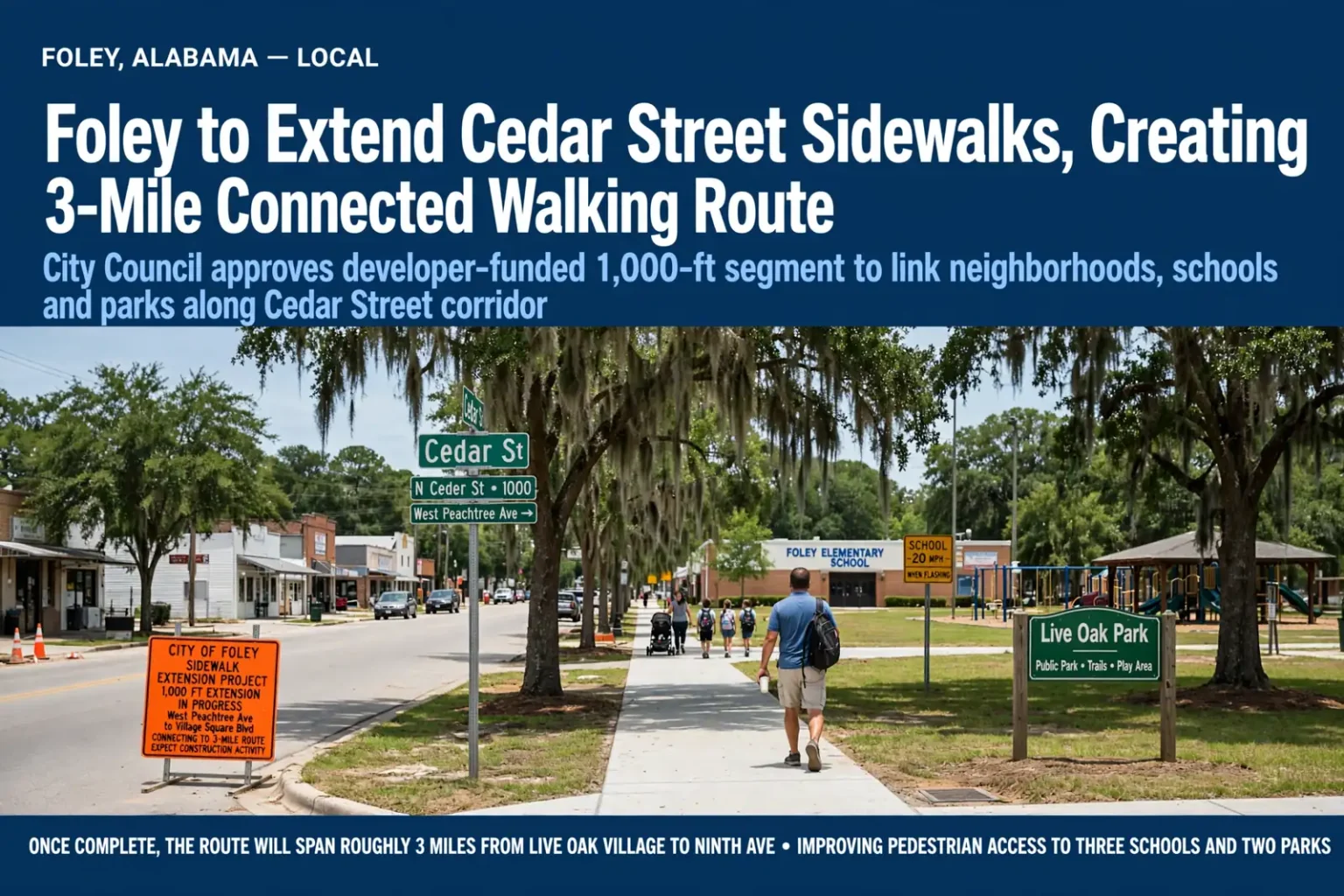
FOLEY, Ala. — Foley will extend the Cedar Street sidewalks by about 1,000 feet using money from a local developer, a move city leaders say will link neighborhoods, schools and parks along a key north-south corridor.
The Foley City Council approved a memorandum of understanding with the developer to help pay for the new stretch of sidewalk along North Cedar Street. The new section will run from West Peachtree Avenue to Village Square Boulevard.
Once it is built, the city expects to have roughly 3 miles of continuous sidewalk along Cedar Street, stretching from the Live Oak Village area to Ninth Avenue. According to city officials, that connected route will improve pedestrian access to three schools and two public parks.
How the agreement came about
The agreement is tied to a previously approved phase of a planned unit development within Live Oak Village. The developer’s contribution will help cover the cost of building the Cedar Street sidewalks as part of Foley’s ongoing push to make it easier and safer for residents to get around on foot.
City Engineer Taylor Davis explained that Foley’s Technical Design Manual requires developers to build sidewalks along the streets where their subdivisions are constructed. In this case, however, that rule would have placed the sidewalk along Baldwin County 24, next to the development, and city officials concluded that location would not serve pedestrians well.
County 24 is maintained by Baldwin County, not the city, and there are no other sidewalks along that stretch of road. Tying a sidewalk there into Foley’s existing pedestrian network would also have required a pedestrian bridge where County 24 crosses the Magnolia River near the airport, a significant additional expense.
The Magnolia River winds through south Baldwin County on its way toward Weeks Bay and is known locally for the neighboring town of Magnolia Springs, where mail has long been delivered by boat along the river. Building pedestrian crossings over waterways like it typically requires engineering, environmental review and construction costs well beyond those of a standard sidewalk.
Rather than build an isolated segment, the city and developer agreed to redirect the developer’s obligation toward Cedar Street, where the new sidewalk can connect to existing ones.
‘It would have gone nowhere’
Mayor Ralph Hellmich said the Cedar Street location offers residents a far more useful route than the alternative.
“If it had been built on 24, it would have gone from the northern entrance over to the bridge and stopped there. It would have gone nowhere,” Hellmich said. “This makes more sense for everybody.”
The mayor’s comment reflects a common challenge for growing cities. Development rules that require builders to add sidewalks along their own frontage can sometimes produce short, disconnected pieces of pavement that start and stop without linking to anything. Agreements like the one Foley approved give cities flexibility to put that investment where it will create a continuous path that people will actually use.
What is a memorandum of understanding?
A memorandum of understanding, often called an MOU, is a formal written agreement that spells out the responsibilities and expectations of each party involved in a project. Local governments frequently use MOUs with developers, other governments and organizations to document how costs will be shared, who will perform the work and what each side is committing to provide.
In this case, the MOU documents the developer’s financial contribution toward the Cedar Street sidewalks in place of building a sidewalk along County 24, as would otherwise have been required.
Understanding planned unit developments
The agreement is connected to a phase of a planned unit development, or PUD, within Live Oak Village. A PUD is a zoning tool that allows a developer to propose a master-planned project as a single unit, often mixing housing types, open space and other uses under a set of standards negotiated with the city rather than following conventional lot-by-lot zoning rules.
PUDs are typically built in phases, with each phase reviewed and approved by local planning officials. Conditions attached to those approvals can include infrastructure requirements such as roads, drainage and sidewalks. Foley’s agreement shows how those requirements can be adjusted when the standard approach would not produce a practical result.
Why connected sidewalks matter
Foley has grown rapidly along with much of south Baldwin County, one of the fastest-growing areas in Alabama. Once known mainly as a farming town and a stop on the way to the beaches of Gulf Shores and Orange Beach, the city has added new subdivisions, shopping and attractions, and its population has climbed steadily. That growth has put a premium on infrastructure that keeps pace with new neighborhoods, and the city has worked in recent years to expand its network of connected sidewalks and trails. Connected sidewalks offer several practical benefits for residents:
- Safer routes to school: Continuous sidewalks give students and families a way to walk or bike to school without sharing the road with traffic.
- Access to parks and recreation: Residents can reach public parks on foot rather than having to drive.
- Everyday mobility: People who do not drive, including children, some older adults and people with disabilities, depend on sidewalks to get around.
- Health and quality of life: Safe walking routes make it easier for residents to build physical activity into their daily routines.
The roughly 3-mile Cedar Street route will serve three schools and two public parks once complete, according to the city, creating a more useful network for residents traveling through the area on foot.
What happens next
With the memorandum of understanding approved, the next step is construction of the approximately 1,000-foot segment between West Peachtree Avenue and Village Square Boulevard. The city did not announce a construction timeline in connection with the council’s vote.
When the new section is finished, it will close a gap in the Cedar Street corridor and complete the continuous stretch of sidewalk from Live Oak Village to Ninth Avenue.
Residents with questions about the project, or about sidewalk and pedestrian improvements elsewhere in the city, can contact Foley’s engineering department at City Hall. Foley City Council meetings are open to the public, and agendas are posted in advance for residents who want to follow development and infrastructure decisions.