Mobile Firefighter CPR Rescue on Tennis Court Earns Firefighter of the Month Award
Mobile firefighter Justin Morris was named Firefighter of the Month after performing CPR on a man who went into cardiac arrest during a tennis match. The man is now doing well.
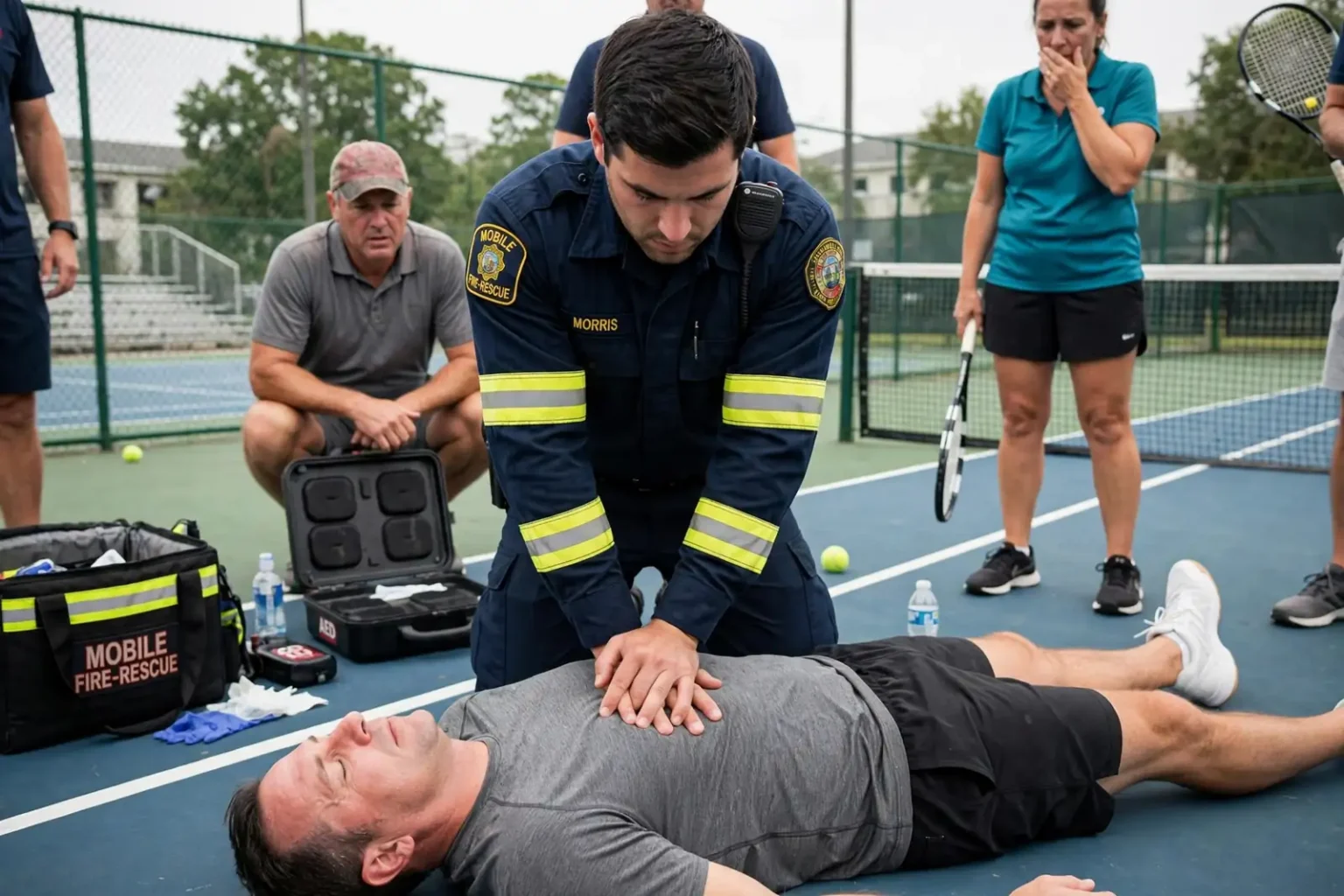
MOBILE, Ala. — A man who went into cardiac arrest during a tennis match is doing well today thanks in part to on-the-spot Mobile firefighter CPR, and the firefighter who performed it, Justin Morris, was honored Tuesday as Mobile Fire-Rescue’s Firefighter of the Month, with the fire crew that answered the emergency call standing alongside him at the Mobile City Council meeting.
Morris was on the tennis court himself when the emergency unfolded. A man fell and struck his head, and within moments, Morris said, the man had stopped breathing and had no pulse. Morris started CPR right away, and others who were at the court pitched in to help until emergency crews arrived.
The man was taken to a hospital, where he went into cardiac arrest several more times. Despite that difficult course, Morris said the man has since been doing well, and the two have spoken by phone.
A rescue that began on the tennis court
The story Morris described is one that emergency responders know well: a sudden collapse, no warning, and only minutes to act. In this case, the person who happened to be nearby was someone whose job is to respond to exactly this kind of crisis.
After the man fell and hit his head, Morris recognized that the situation was far more serious than a fall. When the man stopped breathing and Morris could not find a pulse, he began chest compressions immediately. Bystanders at the court helped as the effort continued, a team approach that mirrors what first responders are trained to do when every second counts.
Emergency crews then took over and transported the man to the hospital. Morris said the man suffered additional cardiac arrests after arriving there, underscoring how critical his condition was in the hours after the collapse.
Today, the outlook is much brighter. Morris said the man recently reached out to him directly.
“He called me not long ago, seems to be doing pretty good. I can’t wait to see him out there on the tennis court,” Morris said.
Firefighter of the Month recognition at City Hall
Morris received the Firefighter of the Month award during the Mobile City Council’s regular meeting on Tuesday, Oct. 20. The recognition is one of the ways the city publicly thanks first responders whose work stands out, and it gave council members and residents a chance to hear about a rescue that happened far from a fire station.
Morris was not alone at the podium. Members of the fire crew that responded to help the man attended the meeting to support him, and they were also recognized for their part in the rescue. Their presence highlighted a point emergency medical professionals often stress: survival from cardiac arrest depends on a series of links working together, from the first person who starts CPR to the crews who provide advanced care and the hospital teams who take over from there.
Jimmy Frank, chief of operations for Mobile Fire-Rescue, said Morris’ response was exactly what the department has come to expect from him.
“It didn’t surprise me. I mean, Justin does a good job every day. That’s what we get out of him every day he comes to work. So it didn’t surprise me at all,” Frank said.
Frank’s comments reflect a theme common to stories like this one. For firefighters and emergency medical workers, the skills used in a dramatic rescue are the same ones practiced and used routinely on the job. What made this case unusual was the setting: a recreational tennis match rather than a 911 call.
Understanding cardiac arrest and why CPR matters
Sudden cardiac arrest is often confused with a heart attack, but the two are different. A heart attack happens when blood flow to part of the heart is blocked. Cardiac arrest occurs when the heart suddenly stops pumping effectively, usually because of a problem with its electrical system. When that happens, blood stops flowing to the brain and other vital organs, and the person collapses, stops breathing normally and loses their pulse.
Without help, a person in cardiac arrest can die within minutes. That is why the American Heart Association emphasizes that bystanders should not wait for professionals to arrive before acting. According to the association, more than 350,000 cardiac arrests occur outside of hospitals in the United States each year, and immediate CPR can double or even triple a person’s chance of survival.
CPR works by manually pushing blood through the body, keeping oxygen moving to the brain and heart until a defibrillator can be used to restore a normal rhythm and paramedics can provide advanced care. Even when performed by someone with no formal medical background, effective chest compressions buy valuable time.
What to do if someone collapses
Health and emergency officials encourage everyone to learn the basic steps of responding to a cardiac emergency. The American Heart Association’s guidance for adults who suddenly collapse is straightforward:
- Check and call. If a person is unresponsive and not breathing normally, call 911 right away, or have someone else call while you start helping.
- Push hard and fast. Place your hands in the center of the chest and push down about 2 inches at a rate of 100 to 120 compressions per minute. Many people use the beat of the Bee Gees song “Stayin’ Alive” to keep the right pace.
- Find an AED. Automated external defibrillators are found in many gyms, schools, churches, airports and public buildings. They give spoken instructions and are designed to be used by people with no medical training.
- Keep going. Continue compressions until emergency responders take over, the person starts breathing normally or an AED is ready to use.
- Share the work. CPR is physically demanding. If others are around, take turns doing compressions so the quality stays high, just as the bystanders at the tennis court helped Morris.
Hands-only CPR, which involves chest compressions without mouth-to-mouth breaths, is recommended for untrained bystanders helping a teen or adult who suddenly collapses. Formal CPR classes, which also cover rescue breaths, infant and child CPR and choking response, are offered by organizations such as the American Heart Association and the American Red Cross, as well as many hospitals and community groups.
Why a bystander response can change the outcome
Emergency medical experts often describe survival from cardiac arrest as a “chain of survival.” The chain starts with recognizing the emergency and calling for help, continues with early CPR and quick use of a defibrillator, and then moves to advanced care by paramedics and hospital teams. A break in any link can reduce the odds that a patient survives.
In the Mobile case, several links appear to have held together. Morris recognized the man was not breathing and had no pulse, he started CPR immediately, other people at the court joined in, emergency crews responded and transported the man, and hospital staff cared for him through repeated cardiac arrests. Each step mattered in getting him to the point where he could pick up the phone and call the man who helped save his life.
Recreational settings such as tennis courts, ball fields, gyms and golf courses are places where sudden cardiac events can and do happen, sometimes to people who appeared perfectly healthy moments before. That is one reason many sports facilities keep AEDs on site and encourage staff and regular players to learn CPR.
Mobile Fire-Rescue’s role in the community
Mobile Fire-Rescue Department provides fire protection and emergency medical services to the city of Mobile. Much of the department’s daily work involves medical calls rather than fires, and its firefighters are trained to respond to emergencies such as cardiac arrests, traffic crashes and other life-threatening situations.
Recognitions such as Firefighter of the Month offer the department and the City Council a way to spotlight the people behind that work. In Morris’ case, the honor also served as a reminder that first responders carry their training with them wherever they go, including on their own time.
The department’s leadership made clear that the award recognized a pattern rather than a single moment. Frank’s description of Morris as someone who “does a good job every day” suggests that his colleagues saw the tennis-court rescue as an extension of how he approaches his work.
Looking ahead to a return to the court
For Morris, the best part of the story may still be ahead. He said he is looking forward to seeing the man he helped save back on the tennis court, a moment that would close the circle on a frightening day for everyone who was there.
The recovery also offers an encouraging message to anyone who has hesitated to learn CPR or worried about doing it wrong. Emergency officials consistently stress that doing something is far better than doing nothing when a person’s heart has stopped. The steps are simple enough to learn in a short class or even a brief online video, and they can make a lasting difference for a family, a friend or a stranger.
Residents interested in CPR training can check with local hospitals, the American Red Cross, the American Heart Association or community organizations for upcoming classes in the Mobile area. Learning where AEDs are located at the places you visit most, such as your workplace, church, gym or favorite tennis court, is another small step that could help in an emergency.
As Morris’ colleagues gathered with him at City Hall on Tuesday, the recognition belonged to more than one person. It honored a firefighter who acted without hesitation, the bystanders who helped him, the crew that carried the response forward and a patient who, by Morris’ account, is now doing well and has his sights set on getting back to the game.