Foley Students Called Their Germany Exchange Trip ‘The Experience of a Lifetime.’ Here’s What They Actually Did There.
Foley student delegates called their recent Germany exchange trip 'the experience of a lifetime,' returning home after weeks spent living with host families and attending school abroad.
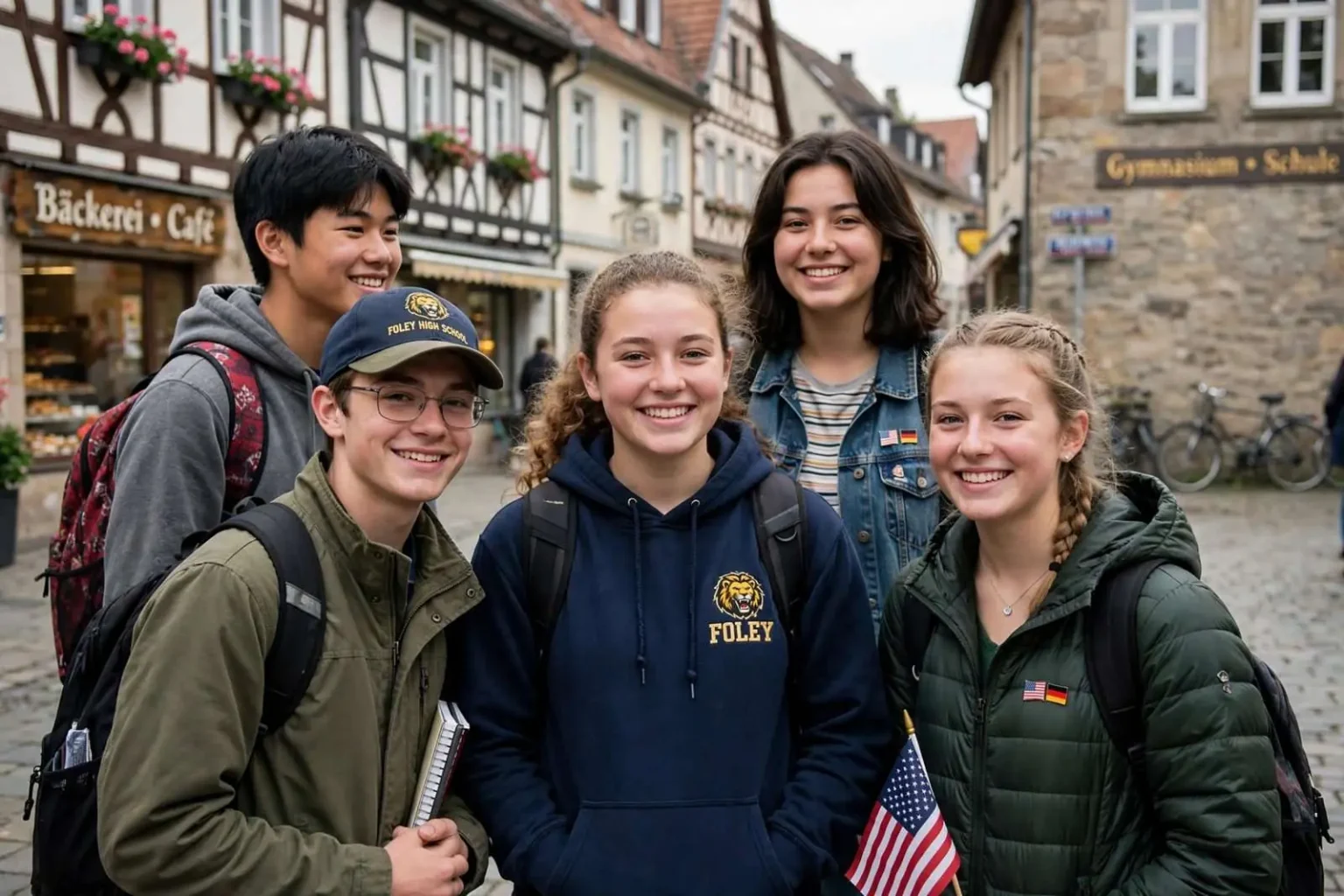
A group of Foley student delegates has returned from a exchange trip to Germany, describing the experience as one of the highlights of their high school careers after weeks spent living with host families and immersing themselves in a different culture and school system.
Coming home from abroad
The students arrived back in Baldwin County after weeks on the other side of the Atlantic, having done what exchange programs are designed to make possible: not touring Germany, but living in it. Delegates stayed with host families, attended school alongside their German counterparts, and organized their days around the rhythms of a household and a school week that were not their own.
That distinction — living rather than visiting — is the whole architecture of student exchange. A tour group sees cathedrals and capitals from a bus window; an exchange student learns how a family shops, how siblings argue, how homework is assigned and how weekends are spent. The delegates who made the trip describe it in exactly those terms, as an immersion in daily life and schooling that reshapes how a student understands both Germany and home.
For the students themselves, the return is usually the moment the experience snaps into focus. Jet lag fades, school resumes, and the weeks abroad begin to read as the milestone they are: the first sustained exposure to another way of life for most of the young people involved, and the kind of memory that defines a high school career long after graduation.
What the trip actually involved
Student exchange programs like this one typically pair American students with host families abroad, giving them a firsthand look at daily life, schooling and culture in another country rather than the more surface-level experience of a standard tour.
The host-family model does most of the work. Students sleep in a guest room, eat family meals, and get folded into the logistics of a German household — school commutes, weekend errands, birthday dinners. Host families volunteer precisely because they want the exchange, and many maintain contact with their American students for years afterward. On the school side, delegates shadow their host siblings through a class schedule that looks little like an American one: German secondary schools track students into different pathways, the school day often ends by early afternoon, and the rhythm of exams and coursework differs at every level.
For Foley students, the trip offered a chance to build relationships with German peers while comparing notes on everything from classroom structure to daily routines.
Those comparisons are where exchange education actually happens. Students return with answers to questions no textbook asks: whether German teenagers really have as much independence as their reputation suggests, how a country with nationwide apprenticeship programs thinks about careers, what a school lunch costs and who cooks it. The academic payoff — language practice under real conditions — rides along with the social one, and delegates who studied German in a classroom discover what the language does when it is simply the air they breathe for a month.
Baldwin County’s German thread
There is a historical resonance to a Foley-Germany connection that the students may not have fully appreciated until they landed. Baldwin County was one of Alabama’s great immigrant destinations in the early twentieth century, when agricultural colonies drew German and other European settler families into the county’s farmland — communities around Elberta and neighboring towns still bear the fingerprints of that migration in family names, churches and foodways.
Foley itself grew as a commercial center for that farming country, founded around the land development interests of John B. Foley of Chicago and built into the Baldwin County town that today anchors south Alabama’s fastest-growing region. A generation of local families can trace grandparents back to German-speaking farmsteads, which makes an exchange trip to Germany something closer to a homecoming for some Baldwin County students than a map would suggest.
Why districts invest in exchange
Exchange programs have long been valued by school districts for the cultural and language exposure they offer participating students, particularly in a district like Foley’s, where international travel opportunities can otherwise be limited for students without existing means to travel abroad independently.
That last clause carries the program’s real weight. International travel is a family-budget matter for most American students, and a delegation model — with group planning, host families on the far end and adult oversight — converts an experience available mainly to affluent families into one a school can offer to its students broadly. Students who could never have booked a flight to Frankfurt get the same immersion, and school districts that run such programs treat that equalizing effect as a core part of the mission.
The educational returns accrue on several levels. Language students get the immersion that classroom instruction cannot simulate; future college applicants get the kind of experience admissions offices read as evidence of independence; and all the participants get an early lesson in the practicalities of living inside a different culture — navigating unfamiliar norms, managing homesickness, and representing their home to people whose image of Alabama may be built entirely on television.
The home side of the exchange matters too. Host-family programs run on reciprocity, and Baldwin County households that receive German students later see their own children travel — a cycle that builds the relationships between schools and communities that keep programs alive across leadership changes and budget cycles.
What remains to be arranged
Organizers and participating students have not detailed the specific school or region in Germany involved in the exchange, nor whether reciprocal visits from German students to Foley are planned as part of the broader exchange relationship.
That reserve is typical in the early stages of an exchange partnership. Programs often begin with a single delegation and a handshake understanding, with formal reciprocity — German students traveling to Foley, attending classes, and staying in the homes of the same families — worked out after the first visit proves the model. Host communities in Baldwin County, with its tourist economy and its established appetite for international visitors, are well positioned for the return leg if it comes.
The longer arc of an exchange
The effects of a month abroad tend to surface years later. Exchange alumni consistently rank the experience among the most influential of their young lives, and the pattern shows up in their choices afterward: language study continued in college, international majors and careers, and a durable comfort with travel and difference that shapes how they vote, work and raise families. School districts rarely capture those outcomes in their own metrics, but the teachers and coordinators who chaperone these trips see them arrive — students who left as teenagers and returned as something closer to citizens of a wider world.
For Foley, a growing city whose schools serve one of Alabama’s most diverse and fastest-changing regions, the exchange also signals an orientation. Baldwin County’s economy runs on tourism, agriculture and international commerce moving through the Port of Mobile, and the students who understand Germany not as an abstraction but as a set of specific families, classrooms and dinners are the ones best equipped for the connected economy they will graduate into.
The delegates are back in their Baldwin County classrooms now, a few weeks of German daily life behind them and the school year ahead. Their host families, on the other side of the Atlantic, are presumably settling back into their own routines — with an American teenager’s photo on the refrigerator and, if the exchange does what exchanges do, a standing invitation that neither side intends to let lapse.
A day in the German school week
What surprised most American delegates, in programs like this one, is the structure of the German school day. Classes at the secondary level often begin around eight and end by early afternoon, with students heading home for lunch rather than to athletics and activities. Tracking means that the students a delegate shadows may be headed toward university, toward vocational training, or toward the dual-study pathways that combine classroom time with paid apprenticeships at German companies — a system American students usually know only as a statistic before they watch a classmate leave school at sixteen for a factory training floor.
The household routines differ just as much. Shopping happens in smaller, more frequent trips; bicycles carry real commuting weight; Sundays are for rest in a way American schedules rarely allow. Delegates report the small discoveries loudest — the first Sunday when every shop was closed, the school supplies that work differently, the foods that nobody warned them about — but the lasting lessons are the bigger ones about how a familiar goal, like growing up, can be organized in entirely different ways.
Preparing the next delegation
Programs that survive do so on preparation. Student delegates typically spend the months before departure on language practice, orientation sessions and host-family matching, and the coordination with the partner school abroad runs through teachers and coordinators on both continents. Fundraising — spaghetti lunches, sponsor solicitations, community donations — fills the gap between what families can pay and what the trip costs, which is what keeps the delegation representative of the whole student body rather than only its most comfortable families.
The students now back in Foley carry the experience into classrooms where teachers can put it to work: German language students find their accents and comprehension transformed, and social studies classes get a firsthand account of a federal parliamentary system from someone who just lived inside one. That ripple effect — one delegation improving the education of every classmate it reports back to — is the argument school districts have made for exchange programs for generations, and it is why a trip that directly touched a few dozen students will be felt in Foley’s classrooms for years.