Baldwin County Schools Is Down to Its Final Two Candidates for Superintendent
Baldwin County Public Schools has narrowed its superintendent search to two finalists as the school board conducts interviews to lead one of Alabama's fastest-growing districts.
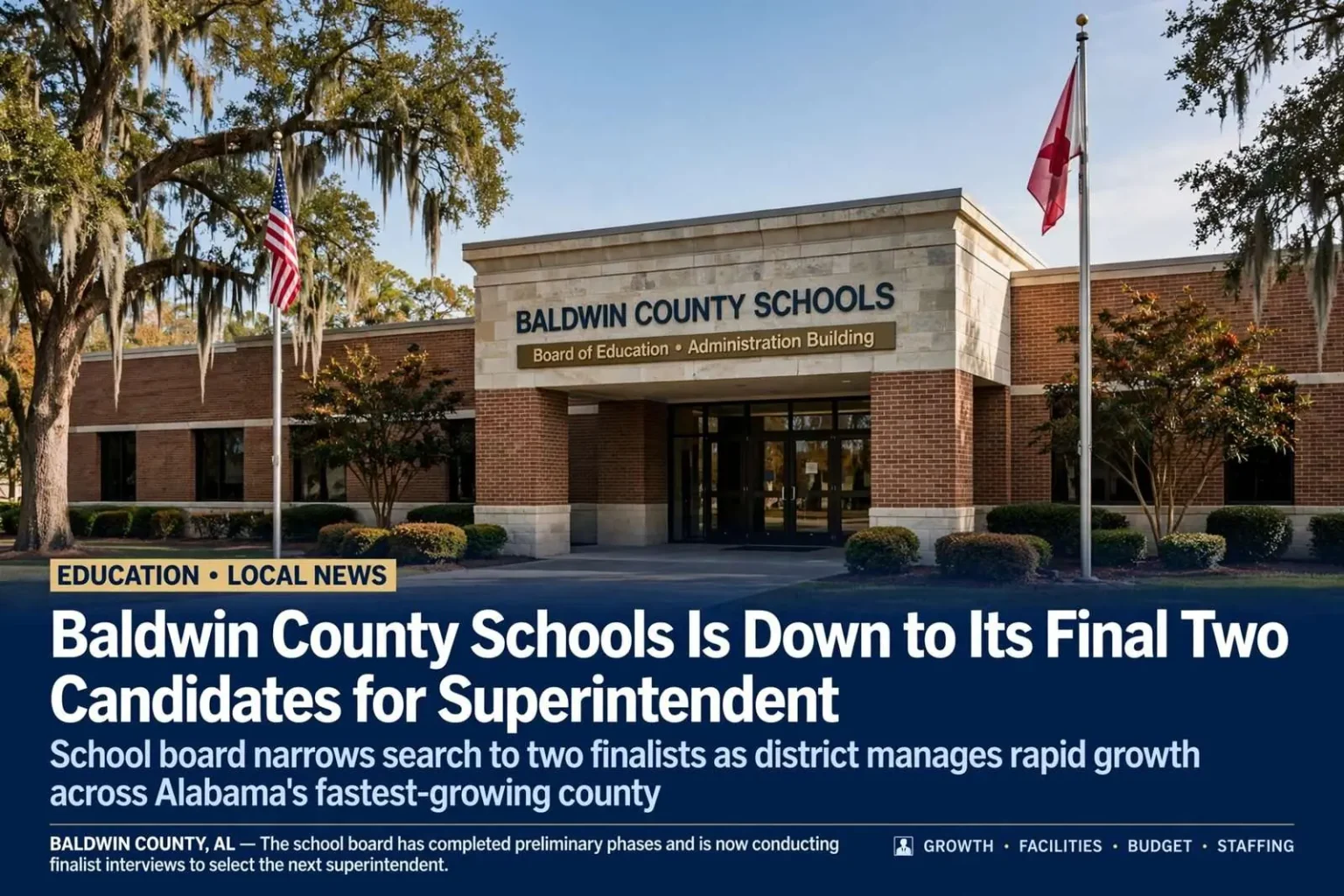
Baldwin County Public Schools has narrowed its search for a new superintendent to two finalists, as the school board conducts interviews to fill one of the most consequential positions in the fast-growing district. The finalist interviews mark a key stage in a superintendent search that carries significant weight for a district that has had to manage rapid enrollment growth alongside the facilities, staffing and budget pressures that come with it. Whoever the board selects will inherit a school system in the middle of one of the most dramatic expansions in Alabama, with every decision about land, buildings and personnel magnified by the pace of growth.
The stakes are easy to explain. Baldwin County, which stretches across the eastern side of Mobile Bay from the Florida line to the edge of the Mississippi border, has become one of the fastest-growing counties in the state. Its population boom in recent years — driven by new subdivisions spreading along the Interstate 10 and Highway 181 corridors, an influx of families relocating from Mobile, Florida and beyond, and the region’s appeal as a coastal destination — has made its school system one of the fastest-growing in Alabama. Each new roof in Daphne, Foley, Fairhope, Spanish Fort, Gulf Shores, Orange Beach or the county’s rural stretches translates into new students, and new students translate into urgent decisions about classrooms, teachers and buses.
Why the Choice Matters So Much
A superintendent in a district like Baldwin County is, in practical terms, the manager of a multimillion-dollar enterprise and the leader of one of the county’s largest employers. The position oversees instructional programs across a sprawling geographic area — Baldwin County is one of the largest counties in Alabama by land area, and its schools serve communities as different as the beach towns of the Gulf coast, the suburban corridors of the Eastern Shore and the agricultural interior. Enrollment growth does not just mean hiring more teachers; it means redrawing attendance zones, building or expanding campuses, acquiring land years before it is needed, and lobbying county commissioners and state legislators for the local and state funding that construction requires.
The pressures are particularly acute because Alabama’s school funding formula, while it provides more money for each additional student, does not automatically fund new buildings. Fast-growing districts must find ways to finance capital construction — through local tax votes, bond issues or the state’s limited capital outlay programs — while their existing schools fill up faster than planned. A superintendent who can build community support for growth-related investment, and who can plan facilities intelligently, shapes the district’s trajectory for decades. That is why school board superintendent searches typically involve multiple rounds of vetting before finalist interviews: community input sessions, application review and reference checks all come first, meaning the two remaining candidates have already cleared a substantial screening process before reaching this stage.
The Process Reaching Its Final Stage
The move to finalist interviews signals that the board has completed the preliminary phases. In a typical search of this kind, the board works with a search consultant or the Alabama Association of School Boards to advertise the position nationally, collect applications, screen credentials and gather public feedback about the qualities residents want in their next leader. Community input sessions in districts the size of Baldwin County often draw responses from parents, teachers, business leaders and municipal officials, and the themes that emerge — growth management, teacher pay and retention, school safety, career and technical education — tend to shape the interview questions the finalists face.
By the time candidates reach the finalist stage, the school board’s evaluation focuses on fit: how each candidate has handled growth, budgets and community relationships in previous roles, and how their leadership style matches a district that is simultaneously expanding and diversifying. Finalist interviews for a superintendency often span multiple sessions, sometimes including public portions, and board members typically probe specific scenarios — a rezoning fight, a construction delay, a personnel shortage — rather than abstract philosophy.
A final hiring decision is expected once the board completes its evaluation of both finalists, though a specific timeline for that decision was not detailed in initial reporting on the interviews. The board’s deliberations will close out a process that began months earlier and that will define the district’s leadership through the peak years of Baldwin County’s growth. Once a choice is made, the remaining steps are largely mechanical — negotiating a contract, setting a start date and planning a transition — but the significance of the vote is anything but routine. Superintendents in large Alabama districts serve at the pleasure of their boards, and the relationship a new superintendent builds with the seven-member board in the first year often determines whether ambitious plans survive.
The context for the hire includes the district’s recent history. Baldwin County voters and school leaders have grappled before with the consequences of growth, including past discussions about splitting the district or raising local taxes to fund construction, debates that drew intense public engagement across the county’s communities. The county has historically supported its schools through a combination of local property tax measures, and any future building program will almost certainly depend on the new superintendent’s ability to make the case for continued investment to a public that has been asked repeatedly to fund its fast-expanding system.
What the New Superintendent Will Face
Whoever takes the job will confront a familiar list of challenges that growing Southern districts know well. New residential developments fill classrooms faster than districts can build, forcing school leaders to use portable classrooms, adjust attendance lines and prioritize which campus gets the next addition. Teacher recruitment in a competitive Gulf Coast market — where neighboring districts in Mobile County and across the state line in Florida hire from the same pool — requires competitive pay and working conditions. Transportation grows more complex as students live farther from their zoned schools. And the district must balance the needs of established communities, whose schools may be aging, against the newest corridors where enrollment is climbing fastest.
At the same time, the growth is an asset. A district that is expanding can offer career opportunities that shrinking systems cannot, and Baldwin County’s tax base has broadened with its population, including the commercial development that follows rooftops along the Highway 98, 181 and 59 corridors and in the beach communities. The county’s schools have also built strong reputations in specific areas — from career and technical programs aligned with the region’s aerospace, tourism and healthcare industries, to extracurricular programs that benefit from strong community support. The new superintendent inherits both the pressures and the possibilities that come with being the school system of one of Alabama’s most dynamic counties.
What Comes Next
In the days after the finalist interviews conclude, the board is expected to deliberate and vote, and the district has historically announced superintendent selections publicly once a contract is agreed. Residents of Baldwin County — parents, teachers, and taxpayers in communities from Bay Minette to Gulf Shores — will be watching closely, because the decision shapes everything from where the next high school is built to how the district handles the next thousand students. The two finalists, having already survived application screening, reference checks and community review, now await a decision that will place one of them at the head of one of the most closely watched school systems in Alabama at the moment of its greatest expansion.
The superintendent search also unfolds against the backdrop of how Baldwin County’s school system is organized. Unlike some Alabama counties where a single district serves both city and county populations, Baldwin County’s system covers a vast and varied territory, and its board members are elected from districts that each carry their own priorities. A board member representing the Eastern Shore suburbs weighs different concerns than one representing the county’s northern agricultural communities or the coastal towns to the south. Managing those competing priorities is a core skill for any Baldwin County superintendent, and boards historically have sought leaders who can move comfortably between a chamber-of-commerce meeting in Fairhope, a booster club gathering in Bay Minette and a planning session in Foley.
The district’s scale reinforces the point. Baldwin County Public Schools operates an extensive network of elementary, middle and high schools spread across one of Alabama’s largest geographic counties, along with specialized programs and career academies that serve students from multiple communities. Its annual budget runs into the hundreds of millions of dollars, its workforce ranks among the county’s largest employers, and its construction program in recent years has included major campus expansions along the growth corridors. Decisions made at the superintendent’s desk ripple through every community in the county, which is why finalist interviews for the position attract attention well beyond the education community — city councils, county commissioners and economic development officials all have a stake in the strength of the school system that helps drive the county’s growth.
Timing and Transition
Because the board has not announced a specific timeline for its final decision, the practical question of when the new superintendent takes office remains open. Alabama superintendents frequently transition between districts on the school-year calendar, with new leaders arriving in the summer to prepare for the academic year ahead. If the board moves quickly, the incoming superintendent could be in place to influence the next budget cycle, the next round of construction planning and the hiring decisions that determine staffing for the coming school year — all periods when district leadership matters most. A longer process would leave the district operating under interim or holdover arrangements, which growing districts generally try to avoid.
For now, the finalists await the board’s evaluation, and the public waits with them. Searches at this scale rarely end quietly — whichever way the board goes, the announcement will be followed by scrutiny of the contract terms, the new leader’s plans and the community’s early impressions. What is certain is the moment: Baldwin County Public Schools, one of Alabama’s fastest-growing systems, is choosing the person who will lead it through the years when that growth is tested, managed and, if the district’s history is a guide, transformed into one of the state’s strongest school systems.