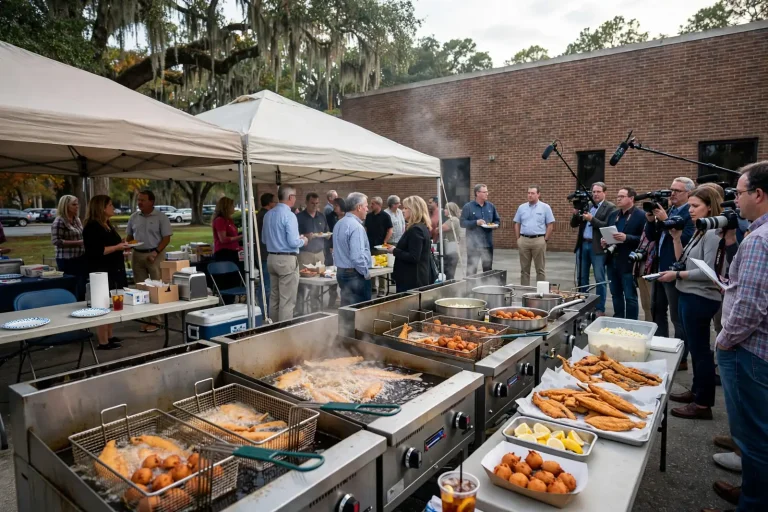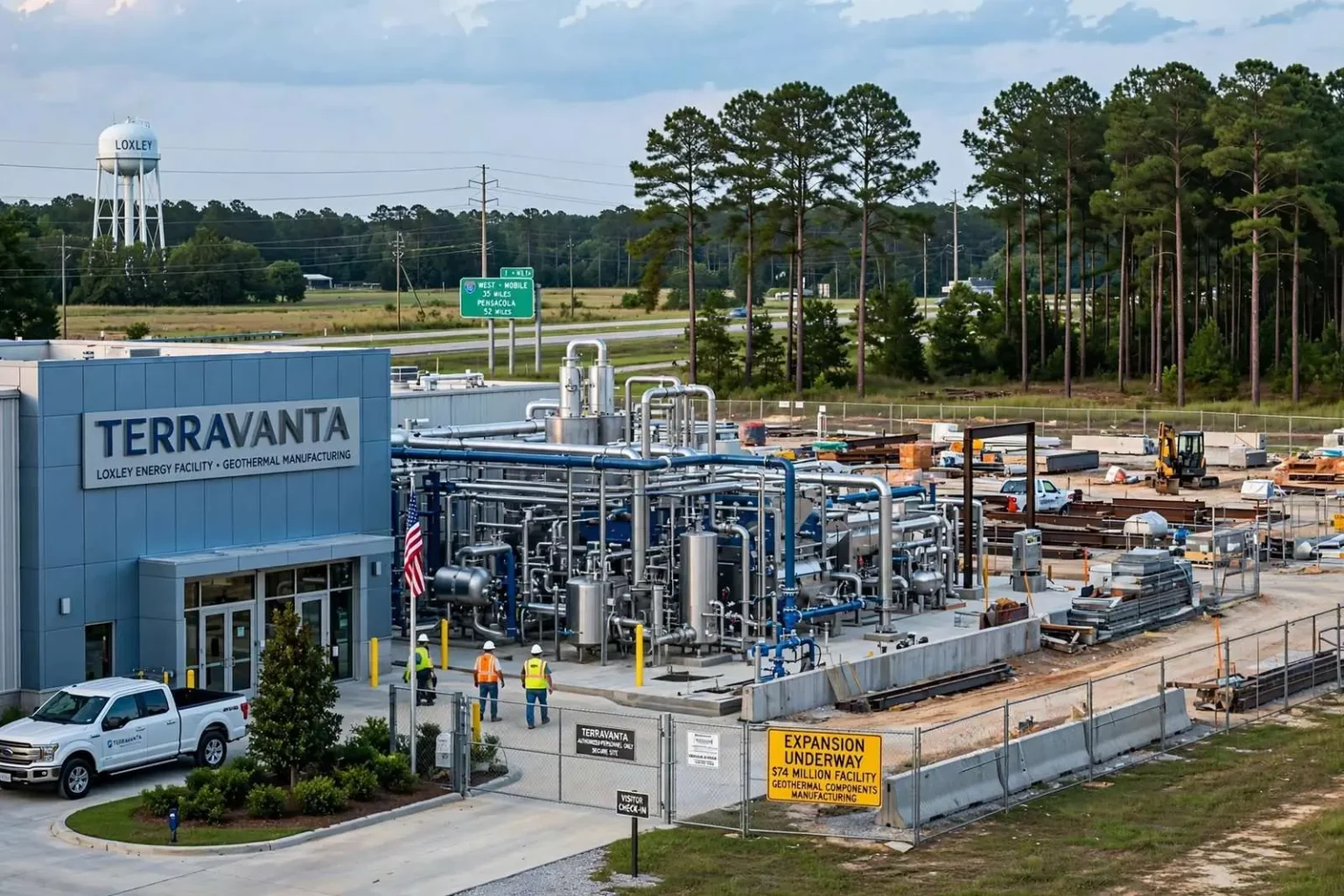
A Loxley energy facility operated by Terravanta is being highlighted as an example of reliable energy infrastructure investment in Baldwin County, as the fast-growing county continues to draw new industrial and energy projects.
Baldwin County’s rapid population growth in recent years has put sustained pressure on the region’s power infrastructure, making new generation and grid-reliability investments a recurring topic for county and state officials alike. Facilities like Terravanta’s Loxley operation are frequently cited by industry and government officials as evidence that the county’s energy infrastructure is keeping pace with residential and commercial growth.
Energy reliability has become an increasingly prominent talking point in Baldwin County development discussions, particularly as large-scale projects — including data centers and other power-intensive industrial facilities — have drawn interest to the broader South Alabama region. A facility like Terravanta’s serves as a concrete local example of the kind of energy infrastructure officials point to when arguing the region can support continued industrial growth.
A $74 Million Expansion Gets the Green Light
Since that recognition, new details have emerged about the scale of Terravanta’s expansion in Loxley. The Baldwin County Commission voted unanimously on July 21 to approve and recognize a local tax incentive tied to the company’s newest project: a $74 million facility that will manufacture parts for the geothermal energy production industry.
The commission’s action followed approval from the Loxley City Council on July 6, after the incentive was first requested by the Loxley Industrial Board. The sequence — industrial board request, city approval, county recognition — is the standard path for the kind of local incentive package Alabama municipalities assemble when competing for manufacturing investment, and its smooth progress through all three bodies signaled unified local support for the project.
Under the arrangement, the city of Loxley will provide Terravanta Power Systems an estimated $3.09 million in combined property and local sales tax breaks to help offset construction costs. Taxes earmarked for public education will still be collected in full, and the sales tax break applies only to purchases tied directly to building the facility.
That structure reflects the balance local governments strike when recruiting industry: the abatements lower the cost of entry for a company making a nine-figure investment, while the guarantees protect school funding and keep the tax relief narrowly tied to the construction itself rather than becoming an open-ended giveaway.
Why Loxley
Loxley’s rise as an industrial location is a product of geography. The town sits astride Interstate 10 in central Baldwin County, with rail access, available land and room to grow in a corridor that connects Mobile’s port to the Florida Panhandle. As the county’s population has surged, Loxley has transformed from a small agricultural community into one of the busiest interchanges along the Gulf Coast, with retail, logistics and now manufacturing all claiming space along the interstate.
The geothermal angle adds a distinctive note to the project. Geothermal energy — which draws heat from beneath the earth’s surface to generate power — has been a small but persistent part of the national energy mix, and a Baldwin County manufacturer supplying parts to that industry would put the region inside the supply chain for a growing segment of energy production. The facility’s $74 million price tag places it among the more significant industrial investments announced in the county in recent years.
Growth That Outpaces the Grid
The backdrop for all of this is Baldwin County’s demographic curve. The county has ranked among Alabama’s fastest-growing for years, with new subdivisions, schools and commercial centers spreading along the U.S. 98 and Alabama 181 corridors and the I-10 interchanges. Every new rooftop adds demand to the electrical grid, and every new industrial project adds more — a compounding pressure that utilities and local officials now factor into nearly every development decision.
Power reliability has moved from a technical concern to an economic one. Companies evaluating South Alabama for data centers, manufacturing plants and distribution hubs ask hard questions about generation capacity, transmission infrastructure and outage history before they commit, and the answers shape which communities win the projects. Energy investment, in other words, has become a prerequisite for every other kind of investment.
That is why officials point to facilities like Terravanta’s when making the case for the region. A working example of private energy infrastructure operating and expanding in Baldwin County does more for the county’s pitch than any brochure — it demonstrates to prospective employers that the fundamentals are being built out in step with demand.
What the Incentive Actually Does
The $3.09 million in combined abatements deserves unpacking, because incentive packages are often reduced to a single headline number. Property tax abatements reduce what the company pays on the new facility itself — the building, equipment and improvements — typically for a set period, allowing the investment to generate value before full taxation begins. Sales tax abatements on construction purchases trim the cost of the steel, concrete and machinery that go into the project.
The carve-outs matter as much as the breaks. School taxes flowing in full means the county’s education system — already managing growth-driven enrollment pressure — loses nothing to the deal. Limiting the sales tax relief to construction purchases prevents the abatement from ever applying to the company’s ongoing operations. The incentive is finite, targeted and tied to a project that will exist on the tax rolls long after the abatements expire.
For Loxley, the calculation is straightforward. A $74 million facility expands the town’s industrial base, generates construction activity immediately and manufacturing employment afterward, and strengthens the case for further investment along the I-10 corridor. The abatement costs a fraction of that, spread over years.
The County Commission’s Signal
The commission’s unanimous vote carried a message beyond the specific project. Unanimity on an industrial incentive is not guaranteed — such votes can split over the size of the breaks or the questions of who benefits — and a 100 percent endorsement sends prospective investors a clean signal about how Baldwin County treats manufacturing investment.
It also reinforces the division of roles that has defined the county’s economic development structure: the Loxley Industrial Board identifying and courting prospects, the city council acting on municipal incentives within its authority, and the county commission recognizing and ratifying the package at the county level. Each July vote added a layer of certainty to the project, moving it from proposal toward construction.
For residents, the practical effects will arrive in sequence: construction traffic and construction jobs first, then the facility itself, then whatever suppliers and service businesses follow a manufacturer to the area. In a town that has already watched the I-10 corridor reshape it, the Terravanta project represents the next stage of that transformation — this time with the county’s energy economy, not just its retail and rooftops, doing the growing.
Energy Infrastructure as Economic Strategy
The Terravanta project lands in a region where energy has become the connective tissue of economic development. South Alabama’s recent run of industrial recruiting — from shipbuilding expansion in Mobile to the data center and heavy industrial projects courting communities across the region — has made electricity supply a first-order question in nearly every negotiation. Counties that can demonstrate generation capacity and grid headroom enter those conversations with an advantage; counties that cannot watch projects settle elsewhere.
Baldwin County’s position is complicated by its own success. The population growth that drives its economy also drives its power demand, and the county’s infrastructure must serve both the subdivisions filling in along its corridors and the industrial sites taking shape along the interstates. Officials have repeatedly framed the challenge the same way: growth is welcome, but every megawatt of new demand has to be matched by new supply and reliability investment.
Against that backdrop, the recognition of Terravanta’s Loxley operation is part advocacy and part reassurance. The company’s presence gives county leaders a named, working example of private energy investment already in the field — something to point to when utilities, state agencies and prospective employers ask whether Baldwin County is serious about the power side of its growth story.
Geothermal’s Place in the Mix
The new facility’s product line — parts for the geothermal energy production industry — connects Loxley to a corner of the energy economy that rarely headlines in Alabama but has been growing steadily nationally. Geothermal systems tap the constant temperatures beneath the earth’s surface for heating, cooling and, at utility scale, electricity generation. The industry’s manufacturing needs — drilling components, heat exchangers, pumps and precision parts — are the kind of steady, specialized orders that anchor a plant’s production schedule for decades.
A Baldwin County manufacturer inside that supply chain would give the region exposure to energy markets beyond the Gulf Coast’s traditional oil-and-gas orbit. Whatever the ultimate scale of the geothermal industry, the parts it needs are made somewhere — and the incentives the county and city approved are designed to make that “somewhere” Loxley.
The project also fits the pattern officials describe when they talk about economic diversity. Baldwin County’s economy has long leaned on tourism, construction and retirement-driven growth; manufacturing investments like this one add a leg that behaves differently through economic cycles, providing steadier employment and a broader tax base.
What Comes Next
With both the city council’s July 6 approval and the commission’s July 21 vote in place, the incentive package is complete, and attention shifts to construction. A $74 million build brings months of site work, contracting and equipment purchases — the activity the sales tax abatement was designed to encourage — followed by the hiring that turns a facility into an employer.
The county, meanwhile, will keep managing the growth that makes projects like this necessary in the first place. New rooftops, new schools, new interchanges and now a new energy manufacturing plant all draw on the same infrastructure, and the reliability of that infrastructure — the subject that put Terravanta in the spotlight — will remain the measure by which Baldwin County’s growth strategy succeeds or falls short.
For now, the sequence of unanimous votes in Loxley’s council chambers and the county commission’s bay-minette chambers stands as the clearest recent statement of local economic policy: Baldwin County intends to grow, it intends to power that growth, and it is willing to invest public incentive where private capital will build the infrastructure to do both.