ALDI to Build $100 Million Regional Headquarters, Distribution Center in Loxley
ALDI plans to build a $100 million regional headquarters and distribution center on 148 acres in Loxley, a project expected to create about 200 jobs and support new store openings across the Gulf Coast.
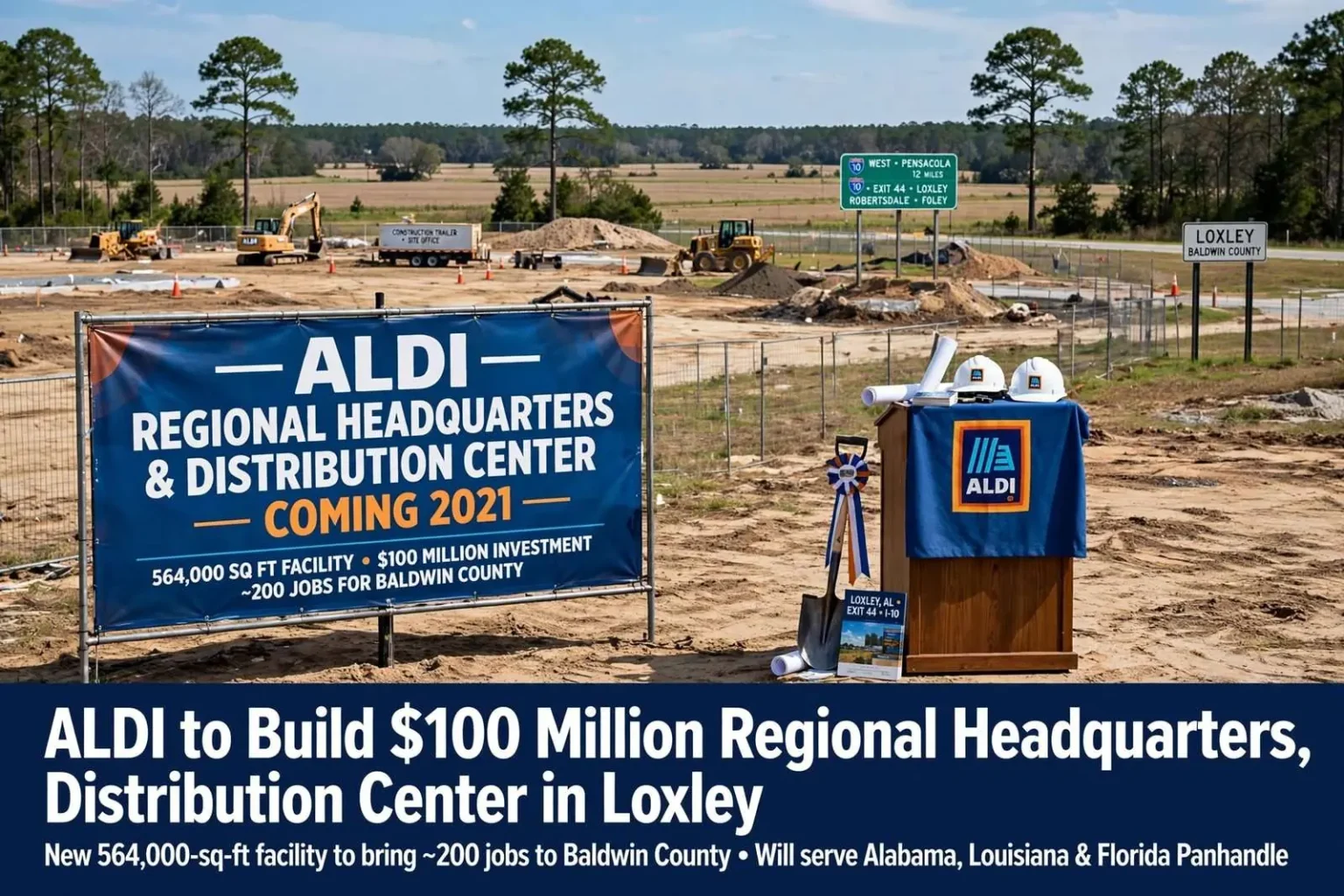
ALDI U.S. is planning to build a new regional headquarters and distribution center in Loxley, a major logistics investment that officials say will bring roughly $100 million in capital spending and about 200 jobs to Baldwin County.
The discount grocery chain has purchased 148.69 acres of land north of Exit 44 on Interstate 10 for the project, paying $3,345,525, or roughly $22,500 per acre, according to Joey Betbeze, who represented the sellers of the property. The site sits along one of the busiest highway corridors on the Gulf Coast, giving ALDI easy access to interstate shipping lanes for the stores it plans to supply throughout the region.
Exit 44 is the eastern gateway to Baldwin County’s boom — the interchange where I-10 traffic from the Pensacola side meets the growth corridors of Loxley, Robertsdale and Foley, and where warehouses and distribution buildings have been quietly assembling for years. ALDI’s purchase is the largest single parcel deal of its kind in the corridor, and its scale signals the company’s intentions: this is not a store site but the nerve center of a regional operation.
Plans call for a 564,000-square-foot facility, with construction expected to begin in early 2021. Once complete, the distribution hub will serve as both a regional headquarters and a supply base for new ALDI stores opening across southern Alabama, Louisiana and the Florida Panhandle.
The state’s welcome
Gov. Kay Ivey welcomed the announcement, saying the state is eager to see ALDI grow its footprint in Alabama. “We’re proud to stand behind ALDI’s commitment to bringing value to the people of Alabama and the Gulf Coast region, and we welcome the company’s plans for a regional headquarters and distribution hub in Loxley that will create jobs for our hard working citizens,” Ivey said.
The governor’s enthusiasm reflects the arithmetic of distribution-center economics. Two hundred direct jobs — warehouse operators, drivers, logistics managers, administrative staff — anchor a payroll that multiplies through trucking contracts, construction employment and the service businesses that follow any large facility. A $100 million capital investment in a single project ranks among the larger economic development announcements in Baldwin County’s history, a county whose industrial growth has historically trailed its residential boom.
ALDI has operated in the state for years, with 30 stores currently open across Alabama, but the company’s presence along the coast has been limited. It has already purchased smaller parcels of land in Fairhope, Spanish Fort and Foley in recent years, though those properties have not yet been developed.
The pattern of those smaller purchases now reads clearly as groundwork. Stores in Fairhope, Spanish Fort and Foley would sit within a short drive of most Baldwin County population centers, all supplied from the Loxley hub. The Loxley project marks the company’s first major infrastructure investment in Baldwin County and signals an aggressive push into the southern part of the state.
“We are ready to bring the ALDI difference to new markets in Alabama, like Baldwin County,” said Dan Gavin, ALDI’s vice president of real estate. Gavin said the company is ramping up its expansion plans to meet demand in the new markets it is entering across the Gulf South.
Why Loxley, and why now
The site selection follows a logic that logistics companies know well. A distribution center needs interstate access, available land at reasonable cost, and proximity to the stores it serves. Loxley offers all three: Exit 44 puts trucks on I-10 in minutes, the acreage was assembled at roughly $22,500 an acre, and the growth of the company’s planned store network across southern Alabama, Louisiana and the Panhandle clusters within a day’s drive of the interchange.
The timing reflects the grocery industry’s acceleration toward larger, more efficient regional hubs. A 564,000-square-foot facility of the kind ALDI plans — combining dry grocery, refrigerated and frozen storage under one roof — can supply dozens of stores on tight schedules, receiving full truckloads from manufacturers and shipping mixed pallets out to stores daily. Every mile between hub and store is a cost line, which is why the company concentrated its coastal expansion plans around a single central site before opening the stores.
Baldwin County itself supplies the demand curve behind the investment. The county has been one of the fastest-growing in Alabama for two decades, its population drawn by the beaches, the schools and the lower cost of living relative to Florida. Retail follows rooftops, and grocery follows retail. A chain that entered the state through Huntsville, Birmingham and Montgomery has now followed the population south to where the growth is steepest.
The ALDI model
The “ALDI difference” Gavin referenced is a business model that reshaped American grocery economics. The company stocks roughly 1,400 core items in a typical store — a fraction of the 30,000-plus carried by a conventional supermarket — mostly under its own exclusive labels. Stores are compact, labor is lean, customers deposit a quarter to unlock a cart and return it themselves, and shoppers bag their own groceries at a separate counter after checkout.
Each element strips cost from the supply chain, and the savings show up in shelf prices that routinely undercut conventional grocers by substantial margins. The model has made ALDI one of the fastest-growing grocery chains in the United States and has forced competitors — from national chains to regional players — to respond with their own discount lines and store-brand expansions.
A distribution hub is the engine room of that model. ALDI’s efficiency depends on private-label volume moving through its own network rather than through third-party wholesalers, which means the company builds warehouses wherever its store base grows. The Loxley facility therefore represents not just a bet on Baldwin County but the physical commitment that makes the planned store openings in Fairhope, Spanish Fort, Foley and beyond possible.
What it means for Baldwin County
For Loxley, a town of a few thousand residents that has watched the I-10 corridor transform its farmland into retail and logistics, the project is the largest economic development event in its history. Two hundred permanent jobs in a town that size reshapes the local labor market, and the construction phase alone — a 564,000-square-foot structure is more than a year’s work for hundreds of tradespeople — will circulate wages through the county’s contractors.
The jobs also fit the profile Baldwin County leaders have chased for years. The county’s economy has run heavily on tourism and construction; a distribution headquarters adds year-round, skilled logistics employment that survives the seasons. Workers with warehouse and transportation experience from Mobile’s port economy will find the commute across the bay shorter than the drive they make now, and Loxley’s growth corridor gains the anchor tenant that attracts complementary development — trucking yards, maintenance shops, supplier depots.
For shoppers across the coastal counties, the eventual effect will be competition. The grocers already operating in Fairhope, Spanish Fort, Foley, Gulf Shores and Daphne — from national chains to the region’s independent markets — will find ALDI’s price positioning in their trade areas, and the company’s habit of pricing staples aggressively forces a response from every competitor within a few miles of a new store. Consumers on fixed incomes, in particular, stand to gain from the expanded options.
The regional picture
The Loxley hub also slots into ALDI’s national map as the supply point for a three-state crescent — southern Alabama, Louisiana and the Florida Panhandle — a territory whose population centers from Baton Rouge to Panama City fall within an overnight run of the Baldwin County interchange. Regional headquarters operations mean the site will hold office staff alongside warehouse workers, deepening the local employment mix beyond the loading dock.
State economic development officials have long noted that southwest Alabama’s weakness has been the thinness of its large industrial base outside the port and chemical sectors. A $100 million facility with a national retailer’s name attached helps close that gap, and the governor’s office trumpeted the announcement accordingly — the phrase “hard working citizens” in Ivey’s statement carrying the standard cadence of a state that measures itself by recruiting wins.
The land deal itself tells the story of the corridor’s rise. Nearly 149 acres at $3,345,525 — about $22,500 per acre — represents the kind of price farmland at a growing interstate interchange commands once the logistics market discovers it. The sellers, represented by Betbeze, exited at a moment when Baldwin County’s commercial land values were climbing; ALDI entered at a moment when its Gulf Coast expansion required exactly this footprint.
Construction is expected to begin in early 2021, and when the facility opens it will stand as the largest single industrial building in the county’s western tier — the supply base for a grocery expansion that plans to reach, from its Loxley warehouse, every new store from the Mississippi line to the Florida state line and beyond.