24-Year-Old Atmore Man Killed in Single-Vehicle Crash Near Robertsdale
A 24-year-old Atmore man died early Sunday when his car left U.S. 90 near Robertsdale, struck a sign post and tree, and overturned, troopers say.
A 24-year-old Atmore man was killed early Sunday morning after his car left the roadway on U.S. Highway 90 near Robertsdale and overturned, according to the Alabama Law Enforcement Agency. The crash added Baldwin County’s eastern highway corridor to the summer’s list of rural-road fatalities and left investigators working to determine why the vehicle went off the highway in the first place.
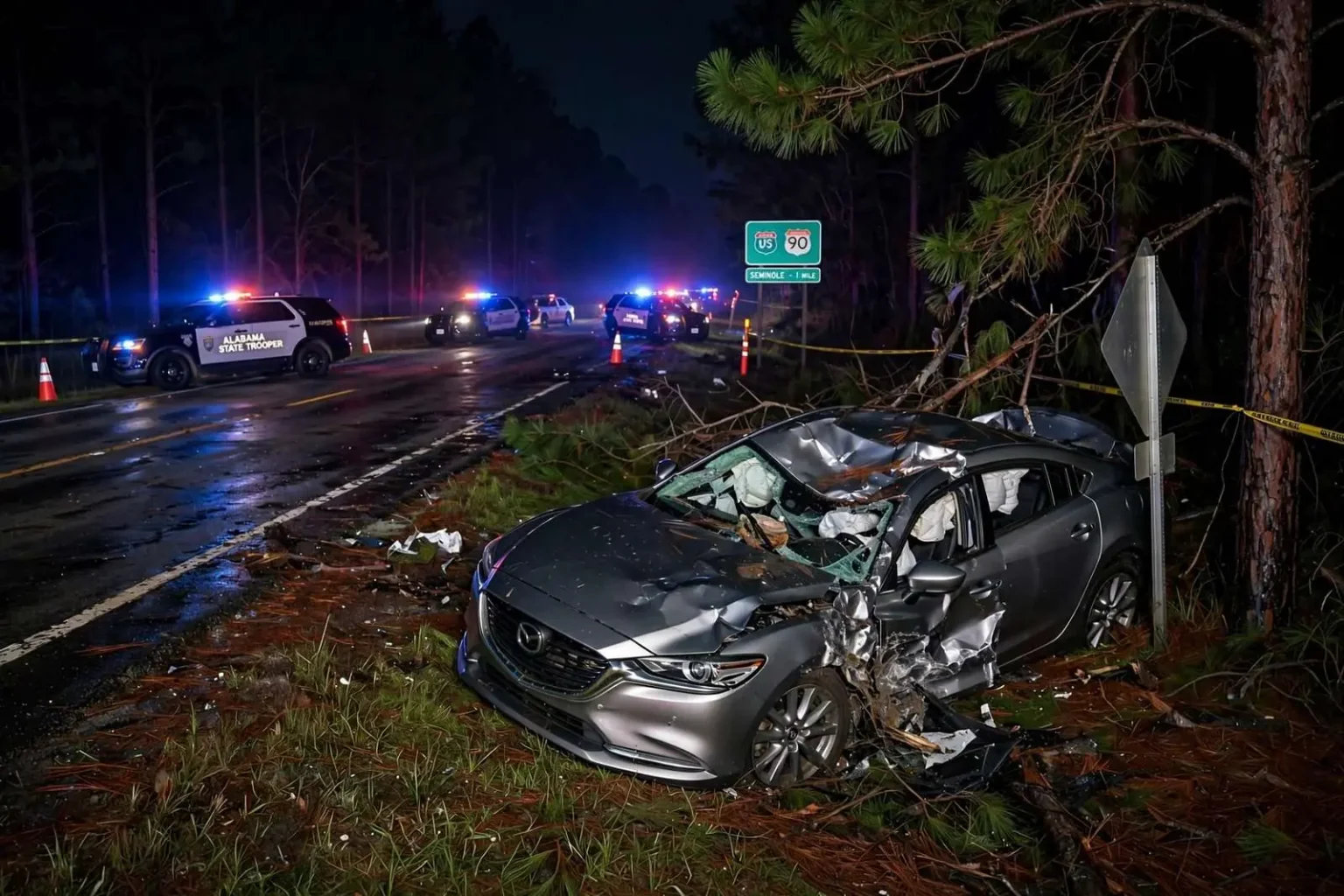
Cameron Joseph Turner was driving a 2015 Mazda 6 in Seminole, roughly 13 miles east of Robertsdale, at about 2:20 a.m. when he apparently lost control of the vehicle. State Trooper Jamie L. Maloy, a spokesman for the Alabama Law Enforcement Agency, said Turner’s car struck a sign post and a tree before flipping. Turner was pronounced dead as a result of the crash.
Troopers did not release additional details about what caused him to lose control, and the agency’s Highway Patrol Division continued to investigate the circumstances surrounding the wreck in the days that followed. The sequence described by troopers — a car leaving the pavement, striking fixed objects and overturning — is among the deadliest crash types on rural highways, where any departure from the road at speed can become fatal in seconds.
The 2:20 a.m. timing placed the wreck in the overnight window that traffic-safety researchers consistently identify as the most dangerous on rural highways. Darkness limits how far ahead a driver can see the road’s curves and edges, fatigue reaches its natural low point in the early morning hours, and the traffic volume that might otherwise summon help quickly is at its thinnest.
The Highway And Its History
U.S. 90 through Baldwin County carries a steady flow of traffic between Mobile and the Florida Panhandle, and the stretch near Seminole has seen periodic single-vehicle crashes over the years, particularly during overnight hours when visibility is limited and drivers may be more prone to fatigue. The highway parallels Interstate 10 to the north, absorbing local traffic, beach-bound travelers and cross-state drivers who use the older route through Baldwin County’s communities.
Seminole sits near the Florida state line, at the eastern end of the county where U.S. 90 runs through a mix of small commercial clusters, homes and pine forest. The corridor’s shoulder geometry, trees close to the right of way and stretches between streetlights are the kind of conditions troopers cite when a single moment of inattention carries a car off the pavement and into fixed objects.
State troopers routinely urge drivers on rural highways to slow down at night and remain alert for wildlife, road debris and the edges of the pavement, all of which can contribute to a vehicle leaving the roadway. Deer and other animals are a particular hazard on Baldwin County’s rural stretches after dark, and the instinct to swerve — rather than brake and hold the lane — is itself a common cause of the run-off-road crashes that follow.
Fatal single-vehicle crashes like this one are examined by ALEA’s Highway Patrol Division to determine contributing factors such as speed, road conditions or driver impairment, though such findings often take additional time to confirm. Investigators work from the vehicle’s path across the shoulder, the points of impact on the sign post and tree, the extent of the overturn and any physical evidence of braking or steering before reconstructing what happened.
The agency has not indicated whether charges are anticipated in connection with the crash. With no other vehicle involved and the driver killed, the investigation’s purpose is primarily determinative rather than punitive — establishing, for the record and for the family, the combination of factors that produced the wreck.
What Investigators Will Examine
The reconstruction will consider the questions that apply to any single-vehicle fatality: how fast the car was traveling, whether the driver was restrained, what the road surface and lighting conditions were, and whether alcohol, fatigue or a medical event played a role. Toxicology testing and evidence analysis extend over weeks, which is why ALEA’s public statements in the days after a crash typically stop short of cause.
The condition of the 2015 Mazda 6 after the overturn will also inform the findings, from seat-belt use to airbag deployment to any mechanical issues investigators uncover. Modern sedans of that model year are built to protect occupants in overturn events, and investigators document how the vehicle performed as part of the complete record.
Baldwin County’s Rural Road Toll
Baldwin County has continued to see a mix of traffic fatalities on its rural highways in recent years, prompting occasional calls from residents and local officials for additional signage, lighting or shoulder improvements along stretches of road that see higher-speed, cross-county traffic. The county’s explosive residential growth has put more drivers on roads that were engineered decades ago for far less volume.
The safety measures residents have asked for are the standard toolkit for rural corridors: clearer edge lines and reflectors that define the pavement at night, improved lighting at intersections and curves, and shoulder widening or mowing that gives a drifting driver room to recover instead of meeting a tree or a ditch. Fixed-object crashes — sign posts, trees, utility poles close to the road — account for a disproportionate share of rural fatality severity, because the impact energy goes into the vehicle itself rather than a recoverable slide.
U.S. 90’s role as the slower, older alternative to Interstate 10 gives it a mixed traffic character: commuters, students, agricultural vehicles, tourists and long-haul drivers all share a two-to-four lane route that passes directly through towns. That mix, layered over overnight darkness in stretches like Seminole, produces the conditions troopers describe when they warn drivers about the hours between midnight and dawn.
No further details had been released by ALEA as of the most recent update, and the investigation remains open. For Turner’s family in Atmore, the findings that arrive in the weeks ahead will close the official record on a crash that began, like so many on Alabama’s rural highways, with a car leaving the road in the dark — and ended within moments, a few hundred feet of shoulder away from everything familiar.
The crash scene itself required the standard overnight response to a rural fatality: troopers securing the highway, emergency medical crews confirming the driver’s condition, and investigators documenting the vehicle’s path before the road reopened to traffic. Evidence such as the tire marks leaving the pavement, the point where the car struck the sign post and the tree, and the final resting position of the overturned Mazda together form the record the reconstruction will rely on.
Atmore, Turner’s hometown, sits in Escambia County on the Mississippi border region of south Alabama, roughly an hour’s drive west of the crash site. Drivers from the area routinely travel U.S. 84, Alabama 113 and the interstate corridors toward Baldwin County and the coast, making the highway routes between Escambia and Baldwin counties familiar ground for weekend travel.
Fatigue is a factor investigators treat seriously in any 2 a.m. wreck. The body’s circadian low point falls in the hours before dawn, and safety studies have repeatedly found that driving after midnight carries impairment risks comparable to driving after drinking, because reaction time, attention and the ability to judge a curve all degrade together. A driver who falls asleep rarely brakes before leaving the road — the absence of skid marks is itself evidence investigators note.
Fixed objects along the roadside compounded the crash’s outcome. A vehicle that departs a rural highway at highway speed has little chance to shed energy before reaching the sign posts and trees that line so many older corridors, and the overturn that follows an impact can throw unrestrained occupants or collapse the roof structure. Those dynamics are why roadside clear zones — the buffer between pavement and fixed hazards — are a recurring request in Baldwin County road-improvement discussions.
The pattern of overnight run-off-road crashes has a national research base behind the local experience. Federal highway-safety data consistently shows that while only a fraction of travel happens between midnight and 6 a.m., that window produces a disproportionate share of fatal crashes, driven by fatigue, impairment and the absence of traffic that might slow a driver’s pace or summon help after a wreck. Rural two-lane and four-lane highways like U.S. 90 carry most of that risk because they lack the median barriers and lighting of interstate facilities.
Alabama’s response to its rural road toll has included the state’s participation in federal safety programs that fund edge-line rumble strips, guardrail upgrades at fixed-object hazards and high-visibility enforcement waves targeting speeding and impairment. Trooper presence along U.S. 90 in Baldwin County rises during holiday travel periods, and ALEA periodically announces nighttime enforcement details aimed specifically at the behaviors behind run-off-road crashes.
For families along the corridor, the safety conversation tends to sharpen after each fatality. Residents near Seminole and other U.S. 90 communities have previously raised concerns at county commission meetings about speed through commercial stretches, visibility at intersecting side roads and the condition of shoulders where pavement meets soft ground. Those requests compete with projects across a fast-growing county whose road network is being stretched by new rooftops.
The Highway Patrol Division’s findings in Turner’s case will eventually be transmitted as part of the official crash record, closing the investigative file with whatever the physical evidence, toxicology results and vehicle examination support. Until then, the wreck stands as the corridor’s latest reminder of how narrow the margin is on a dark rural highway — and how completely a single departure from the lane, at 2:20 on a Sunday morning, can end a 24-year-old life.