Alabama Gulf Coast Zoo gets a helping hand from community donors
Community donors gave $4,700 to the Alabama Gulf Coast Zoo in Gulf Shores as construction continues on a new, storm-resistant home four times its current.
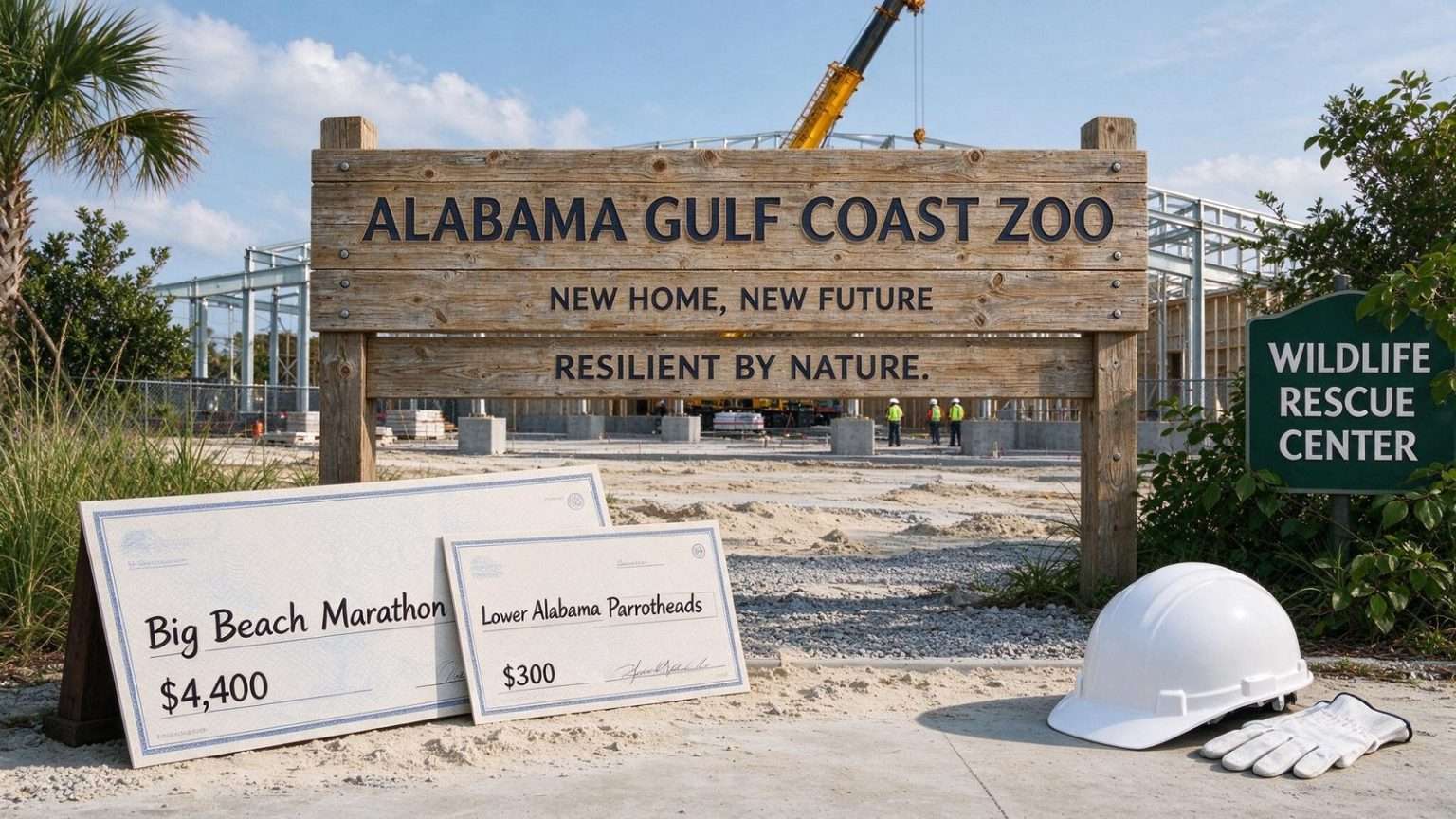
The Alabama Gulf Coast Zoo is a step closer to its new home in Gulf Shores, thanks to a pair of generous community donations. Zoo supporters presented $4,700 in gifts on March 29 as construction continued on the future zoo site off County Road 6, adding to the long list of local contributions that have carried the project from a dream to a construction site.
A $4,400 check came from the Big Beach Marathon, while the Lower Alabama Parrotheads contributed $300. The two gifts could not be more different in size or origin — one from a road race that draws hundreds of runners to the beaches each winter, the other from a Jimmy Buffett fan club chapter that fundraises for Gulf Coast causes — but together they reflect the same truth about the zoo: it belongs to the community, and the community keeps showing up for it.
Zoo Director Dr. Adam Langston said the effort is all about building a better home for the animals. “To build them a home in which they deserve, to be strong and resistant against weather and hurricane events, to provide shelter against the heat and cold is like no other,” Langston said. “These animals deserved a new home, and we needed to build them a new home.”
A zoo that knows about hurricanes
No zoo on the Gulf Coast has a more intimate understanding of what storms can do. The Alabama Gulf Coast Zoo earned national fame as “The Little Zoo That Could” after hurricanes repeatedly battered its previous location just a short distance from the Gulf, forcing full evacuations of the animal collection and years of rebuilding. The documentary that chronicled those efforts made the small zoo famous far beyond Baldwin County, and the name stuck as shorthand for the zoo’s resilience.
That history is written into the design of the new facility. The future site off County Road 6 sits farther inland, out of the most storm-vulnerable low-lying ground, and the plan calls for construction standards built to withstand hurricane-force conditions. For a collection of animals that cannot simply board up windows and leave, the difference between the old site and the new one is not cosmetic — it is the difference between a zoo that evacuates in the back of pickups before every major storm and one built to ride out the weather in place.
Langston’s description of the goal makes the priorities clear: strength and resistance against weather and hurricane events, and shelter against the Gulf Coast’s other climate extremes. Between summer heat and humidity and the occasional winter cold snap, coastal Alabama is hard on animals kept outdoors, and modern exhibit design addresses both — with climate-controlled night houses, shade structures and shelters that keep animals comfortable and safe year-round.
Four times the space
The new facility will be roughly four times larger than the current zoo and will feature all-new enclosures and exhibits. That multiplication of space changes what the zoo can do: more room for the animals it already houses, and space for species and exhibits that simply do not fit in the current footprint. Modern enclosure standards — with more natural substrates, room to roam, and enrichment built into the landscape — demand space that older, smaller zoos struggle to provide.
Larger exhibits are not only better for the animals; they are better for visitors. A zoo where animals have room to behave naturally is a far more engaging place to spend a day, and families from Gulf Shores, Foley, Orange Beach and across the region have been watching the new site take shape with that in mind. The zoo has long been one of the area’s most beloved family attractions, and the new campus is designed to grow that role.
Planners say the larger, sturdier design is meant to better protect the animals from storms and extreme temperatures along the Gulf Coast. That combination — size and strength — is the heart of the project. Any zoo can add acreage; few build with a hurricane checklist hanging over every decision, and that is precisely what makes the Alabama Gulf Coast Zoo’s new home a model worth watching as coastal institutions everywhere plan for stronger storms.
A community-funded project
The zoo has relied on neighbors and local groups to help fund the move, and supporters say more help will be welcome as the project moves toward completion. The March 29 presentation of $4,700 in gifts is a snapshot of how the funding has come together: not from a single deep-pocketed source, but from an accumulation of community gestures — a marathon’s charity proceeds here, a fan club’s fundraiser there, and countless individual donations in between.
The Big Beach Marathon’s $4,400 check ties the zoo to one of the Gulf Coast’s signature athletic events. The race, run along the scenic roads of Gulf Shores and Orange Beach, has made supporting local causes part of its identity, and the zoo’s relocation project is the kind of hometown investment that resonates with runners who return to the beach community year after year. Race proceeds directed toward the new zoo mean every mile logged in the event leaves something permanent behind.
The Lower Alabama Parrotheads’ $300 represents the other end of the fundraising spectrum, and it matters just as much. Buffett fan clubs across the country have long made charity work a core part of their identity — “Party with a Purpose,” as the clubs put it — and Gulf Coast chapters have a special affinity for causes tied to the coastal environment and its creatures. Small donations like theirs are the ones that signal a project’s grassroots support, the proof that ordinary residents, not just institutions, consider the zoo worth their own money.
What the new zoo means for Gulf Shores
For Gulf Shores, the zoo’s relocation represents an investment in the kind of attraction that diversifies a beach town’s appeal. Tourism along the Alabama coast has traditionally centered on the sand, but family attractions give visitors a reason to extend stays and to come in shoulder seasons when the water is too cool for swimming. A new, larger, modern zoo — minutes from the beach — adds exactly that kind of anchor, and its construction has been one of the most closely watched projects in the area.
The economic reach extends to jobs and education as well. A bigger facility means a larger staff of keepers, educators and support workers, and a stronger platform for the zoo’s education programs, which introduce thousands of schoolchildren each year to animals and conservation. Many coastal residents’ first close encounter with a lemur, kangaroo or sloth will happen at this zoo, and the new home is designed to grow those encounters.
For the animals, the move amounts to the upgrade Langston described: enclosures built to modern standards, shelters engineered for Gulf weather, and space to live well. That is what the $4,700 presented in late March helps buy — a few more steps toward a campus where the “Little Zoo That Could” becomes the zoo that finally got what it deserved.
How locals can help
As construction continues, the zoo’s fundraising effort remains open, and supporters stress that gifts of any size move the project forward. Donations large and small have built the relocation from the ground up, and the pattern established by the Big Beach Marathon and the Parrotheads — community groups choosing the zoo as their cause — is the model the project continues to rely on as it works toward completion.
Residents who want to follow the project can watch the new site take shape off County Road 6, where the outlines of the larger campus are increasingly visible. From evacuation pickups after Ivan to a storm-ready home four times the size, the distance the zoo has traveled is considerable — and with the community still behind it, the final stretch of the journey is well within reach.
A model for coastal animal care
The zoo’s rebuild arrives at a moment when coastal animal facilities everywhere are rethinking storm readiness. Gulf Coast institutions have watched hurricanes repeatedly test their facilities, and the lessons are consistent: buildings that survive, generators that run, enclosures that contain stressed animals, and evacuation plans that work. The Alabama Gulf Coast Zoo’s new design folds those lessons into the foundations rather than adding them after the fact, which is the far cheaper and safer way to do it.
Animal care standards have also risen sharply across the zoological world in recent decades, with accrediting bodies pushing for exhibits that give animals choice, space and stimulation. A collection housed decades ago in modest cages cannot be retrofitted into that standard easily; it has to be rebuilt. That is effectively what Gulf Shores is doing — replacing a beloved but aging little zoo with one built to today’s expectations, in a location that lets keepers stop worrying about the storm surge line.
The volunteers, donors and fans who have followed the zoo through its hurricanes and its rebuild have, in a real sense, been underwriting a case study in coastal resilience. When the gates open on County Road 6, the story of “The Little Zoo That Could” will have its final chapter — written in concrete, steel and shade, and funded one community check at a time.