Over 1,000 Native Plants Added to Fowl River Near Bellingrath in Restoration Project
More than 1,000 native plants have been added to Fowl River near Bellingrath Home as part of an ongoing marsh restoration and shoreline stabilization.
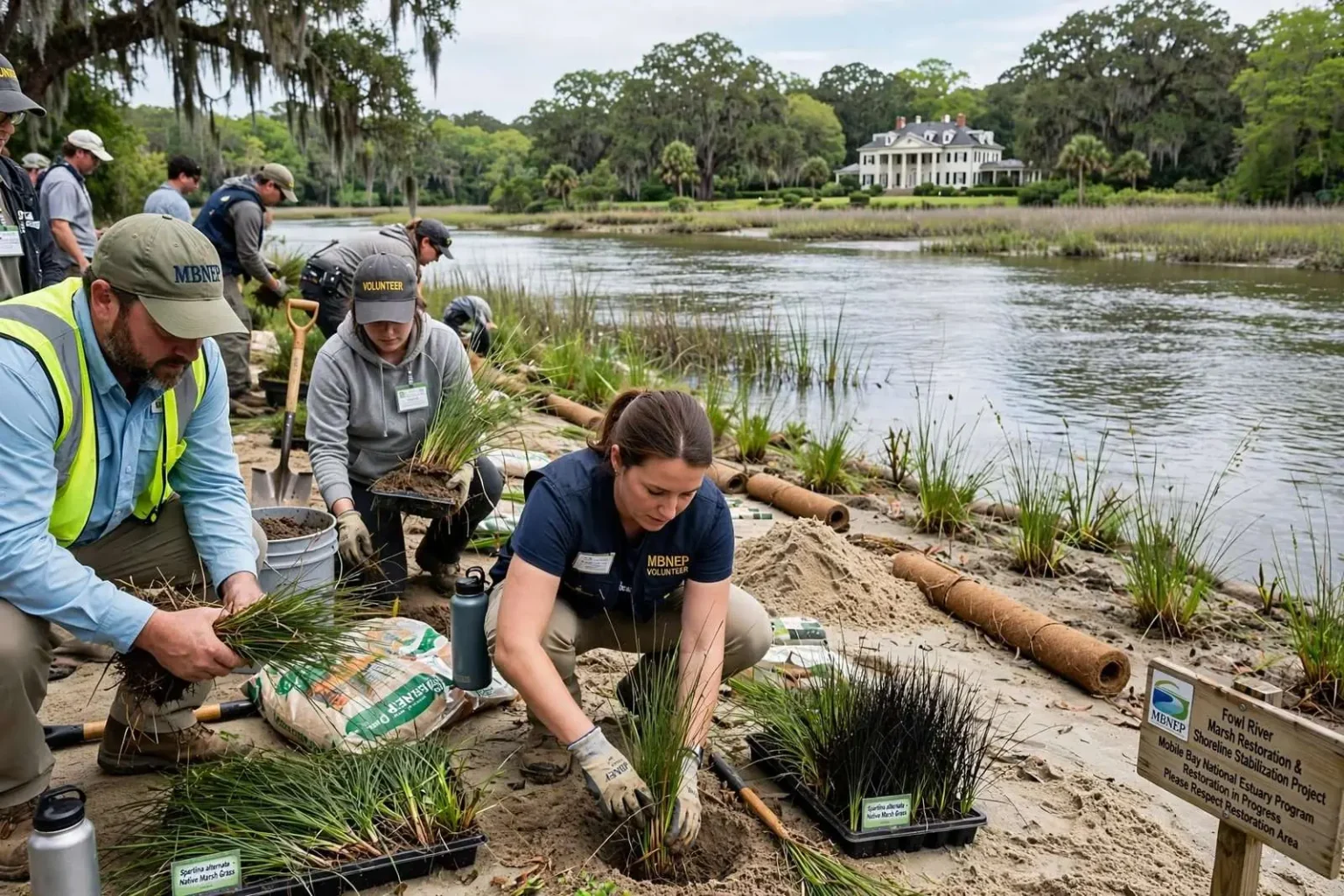
MOBILE COUNTY, Ala. — Volunteers and conservation workers planted more than 1,000 native plants along the banks of the Fowl River this week, part of a broader effort to rebuild eroding marshland across from the historic Bellingrath Home near Theodore.
The planting is the latest phase of the Fowl River Marsh Restoration and Shoreline Stabilization Project, an initiative led by the Mobile Bay National Estuary Program (MBNEP) and its partners to reverse decades of shoreline loss along one of Mobile County’s most ecologically significant waterways.
A Marsh Rebuilt From the Ground Up
The restoration work goes beyond simply adding vegetation. According to project organizers, crews have been redistributing a thin layer of sand back into the marsh to rebuild land mass that has been lost to erosion over time. That sand layer gives the newly planted native species a stable base to take root in, while also raising the marsh surface enough to help it keep pace with rising water levels.
Once the sand is in place, native marsh grasses and other plants are added to hold the soil together, slow wave energy, and begin restoring the natural function of the shoreline. It is a technique that has become increasingly common along the Gulf Coast, where marshes serve as a buffer between open water and upland areas like the Bellingrath property.
Cory Sparks, who has worked on the project, said the effort carries significance well beyond its environmental value.
“It’s important to the Mobile region because of its nature, historic nature. So, Bellingrath was built here in 1917, but as a camp for Mr. Bellingrath. But actually, the history of Bellingrath stretches back into the 1760s and so, this has been at the heart of Mobile for centuries and we want to make sure that our region knows that, knows about the French colonial heritage here, and Spanish colonial heritage, as well as the story of Mr. and Mrs. Bellingrath,” Sparks said.
Volunteers turned out to help with the planting, joining project staff in placing the new vegetation along the riverbank. Community volunteer involvement has been a consistent feature of the restoration project, giving area residents a direct hand in a piece of coastal land many of them have visited for generations.
Why Native Plants Matter for Shoreline Health
Native plant restoration is one of the most widely used tools in coastal and riverine erosion control, and for good reason. Unlike ornamental or non-native species, native marsh grasses and shrubs have evolved root systems specifically suited to holding wet, sandy, or silty soils in place. Their dense, fibrous roots bind sediment together, making the ground far more resistant to the erosive force of waves, boat wakes, and storm surge than bare or sparsely vegetated shoreline.
Above the waterline, the stems and leaves of marsh plants slow the speed of incoming water, causing suspended sediment to settle out rather than wash further inland or back out into open water. Over time, that trapped sediment helps rebuild elevation that erosion had stripped away, which is part of why restoration crews often pair sand placement with plantings rather than relying on either technique alone.
Native vegetation also filters pollutants and excess nutrients out of stormwater and runoff before they reach open water. Fertilizer runoff, sediment, and other pollutants that wash off nearby land are naturally filtered as they pass through marsh vegetation, which helps protect water quality in the river and, ultimately, in Mobile Bay itself. Because marshes sit at the interface between land and water, they function as a kind of natural filtration system for an entire watershed, catching pollutants before they can accumulate downstream.
Marsh habitat additionally provides nursery grounds for fish, shrimp, crabs, and other species that are commercially and recreationally important along the Gulf Coast, as well as feeding and nesting habitat for wading birds and waterfowl. Restoring degraded marsh does not just stabilize a riverbank — it rebuilds a functioning ecosystem that supports wildlife populations and local fisheries alike.
The Mobile Bay National Estuary Program’s Broader Mission
The Fowl River project is one of many undertaken by the Mobile Bay National Estuary Program, a nonprofit organization that works to protect and restore the Mobile Bay watershed, one of the largest and most biologically diverse estuary systems in the United States. The Mobile-Tensaw Delta and the bay it feeds into drain a watershed that stretches across much of Alabama and parts of neighboring states, making the health of local waterways like the Fowl River directly connected to the health of the bay as a whole.
The program’s work typically centers on the restoration of natural shorelines, oyster reefs, and marshland, alongside public education efforts aimed at helping residents understand the role these habitats play in flood control, water quality, and coastal resilience. Restoration projects funded and coordinated through programs like MBNEP often rely on a mix of public agency support, private philanthropy, and volunteer labor, which is part of why community turnout for events like this week’s planting matters to the program’s long-term success.
Shoreline restoration of this kind has taken on added urgency in recent years as coastal Alabama has faced more frequent heavy rain events, higher tides, and increased boat traffic, all of which accelerate erosion along waterways that were once buffered by intact marsh. Rebuilding that marsh is widely viewed by coastal scientists as one of the more cost-effective ways to protect adjacent property and infrastructure, since living shorelines can adapt and grow over time in a way that hardened structures like seawalls cannot.
Bellingrath’s Place in the Region’s History
The site of this week’s planting sits directly across the Fowl River from Bellingrath Gardens and Home, one of coastal Alabama’s most recognized attractions. The estate was developed beginning in 1917 as a fishing camp for Walter and Bessie Bellingrath before growing into the sprawling gardens and historic home that draw visitors from across the country today. The property has long been promoted as a showcase of the natural beauty of the Mobile-Tensaw Delta region, with its gardens, waterways, and wildlife serving as a major draw for tourism in Mobile County.
As Sparks noted, though, the story of the land predates the Bellingraths by well over a century. The Mobile area’s roots as a French colonial outpost date back to the early 1700s, with the region later passing to Spanish and then British and American control before Alabama statehood. That layered colonial history, encompassing French, Spanish, and eventually American periods, is part of what makes the stretch of land along the Fowl River significant to local historians as well as environmental advocates. Restoration organizers have pointed to that history as a reason for treating the surrounding land and water with particular care, since the same shoreline that shaped centuries of settlement is now vulnerable to modern erosion pressures.
Because Bellingrath Gardens remains an active tourist destination, the health of the Fowl River shoreline across from the property carries practical as well as historical weight. Erosion along the riverbank can affect water clarity and shoreline views enjoyed by visitors, while a stable, well-vegetated shoreline helps preserve the setting that has drawn generations of visitors to the gardens.
Wetland Loss Along the Gulf Coast
The Fowl River project fits into a much larger regional pattern. Coastal wetlands along the northern Gulf of Mexico, including the marshes that fringe Mobile Bay and its tributaries, have been shrinking for decades because of a combination of natural subsidence, sea-level rise, altered freshwater flow, and development along once-undisturbed shorelines. When a marsh erodes faster than it can naturally rebuild itself, the buffer it once provided against storms and flooding disappears along with it, leaving upland property more exposed to wave action and tidal surge.
That pattern has made living shoreline projects, the kind used along the Fowl River, an increasingly common tool for coastal managers across Alabama, Mississippi, Louisiana, and the broader Gulf region. Rather than armoring a shoreline with concrete or rock, a living shoreline approach relies on sediment placement and native vegetation to rebuild a marsh’s natural structure, allowing it to continue functioning as habitat while still providing storm and erosion protection. Because these systems are made of living plants and natural sediment rather than fixed structures, they can, in many cases, adjust over time to changing water levels in a way that a seawall or bulkhead cannot.
Restoration ecologists generally point to several advantages of this approach: it tends to cost less over the long run than repeatedly rebuilding hardened structures damaged by storms, it preserves habitat value for fish and wildlife that a seawall eliminates, and it can be scaled up incrementally as funding and volunteer labor allow. That incremental, community-supported model is reflected in the Fowl River project itself, which has relied on repeated rounds of sand placement and plantings, with local volunteers contributing labor alongside program staff.
What Comes Next
Organizers have indicated that the Fowl River Marsh Restoration and Shoreline Stabilization Project will continue to rely on a combination of engineered sand placement, native plantings, and volunteer participation as it moves forward. Restoration projects of this scale typically require ongoing monitoring after planting to ensure new vegetation takes root successfully, with follow-up plantings sometimes needed in areas where initial growth is slow or where storms disturb newly placed sediment.
For now, project leaders and volunteers are counting this week’s planting as a milestone in an effort they say is about more than shoreline stabilization alone. It is also, as Sparks put it, an opportunity to remind the region of the deep history embedded in the land along the Fowl River, from its French and Spanish colonial roots to its more recent identity as the backdrop for one of Alabama’s best-known gardens.