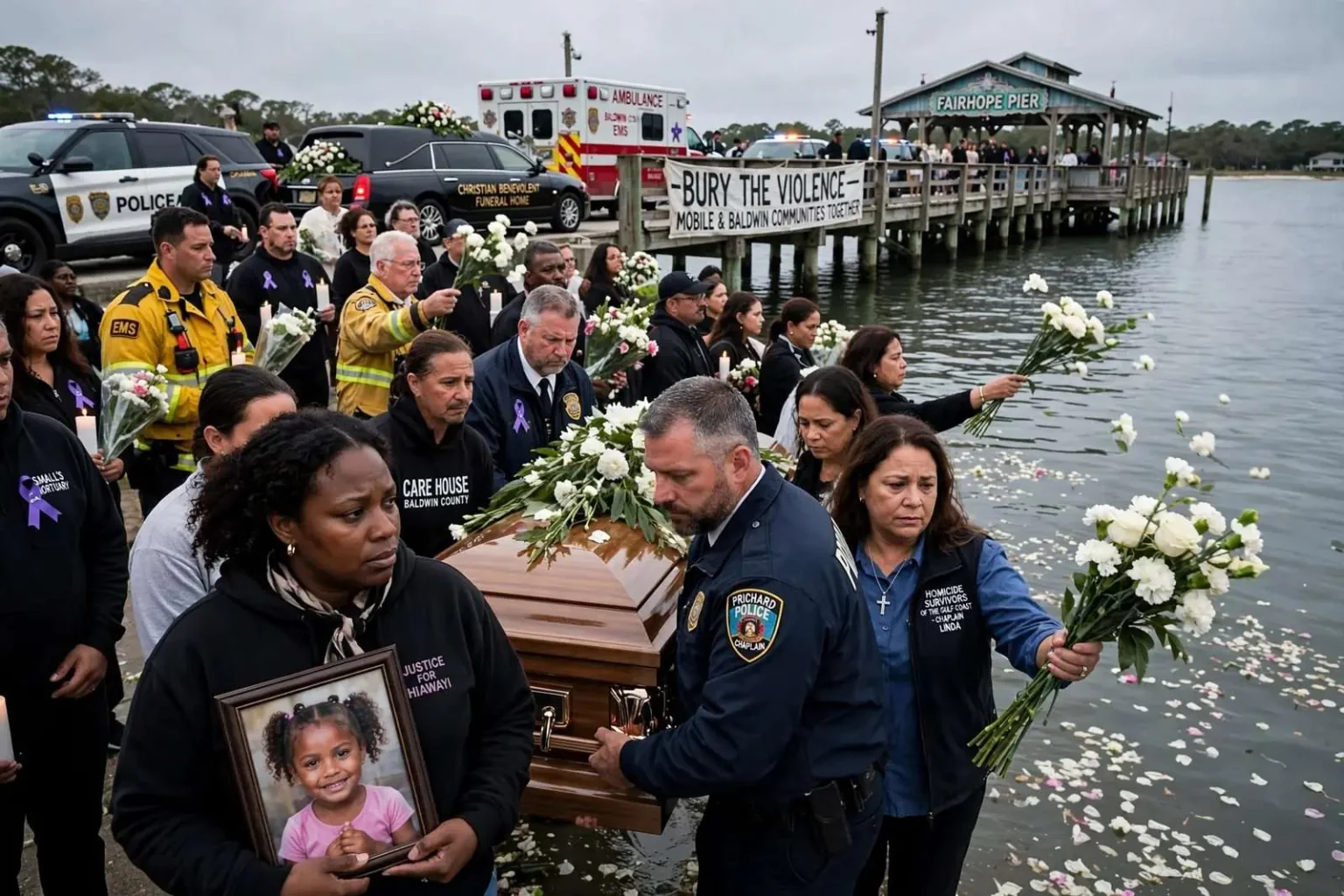
A solemn procession of police cars, ambulances and hearses wound through Mobile and Baldwin counties before stopping at the Fairhope Pier, where mourners carried a casket to the water’s edge and threw flowers into the bay while chanting “Bury the violence.”
The event, called Bury the Violence, brought together law enforcement, emergency responders and funeral home representatives to call attention to the toll violent crime takes on communities across the region.
“Every city is impacted in some kind of way from violent crimes,” said Prichard Police Department Chaplain Patrick Munnerlyn, who helped organize the event. “There’s nothing that happens crime wise that does not end up violently in death. It’s coincidental but a right order that the lineup today consists of law enforcement, fire and rescue ambulances and then funeral directors. That’s just what happens when there’s a violent crime.”
Representatives from several local organizations took part, including Christian Benevolent Funeral Home, the Care House Baldwin County Child Advocacy Center, Penelope House, Small’s Mortuary and the Alabama State Constables. Linda Pearce, director and chaplain of Homicide Survivors of the Gulf Coast, also attended, telling attendees the group hoped the event would serve as a deterrent against future violence.
“The incidents have escalated over the years and we just want to stop it,” Pearce said. “So this is an opportunity to bring the awareness to the community in hopes that we can at least be a deterrent to end violence in our community.”
Among those in attendance was Yosha Populus, whose 8-year-old daughter Hiawayi Robinson was reported missing in Prichard in September and whose body was later found near an abandoned building days later. No arrests have been made in that case. Munnerlyn described Hiawayi as the event’s “poster child,” saying her death helped galvanize community support for the Bury the Violence effort.
“It’s hard because it’s the last thing on my mind when I go to sleep at night and the first thing on my mind when I wake up in the morning: Who and why? That’s the closure I need right now to help me,” Populus told reporters after the ceremony. “Every day, who and why? Why? She was just an innocent child. So why?”

Organizers said they hope events like the Fairhope Pier procession will continue to bring Mobile and Baldwin county residents together around shared grief and a shared commitment to reducing violent crime in the region.
Baldwin County sits directly east of Mobile County across Mobile Bay and is the largest county in Alabama by land area. It encompasses the Eastern Shore communities of Daphne, Fairhope, Spanish Fort, and Foley and stretches south to the beaches of Gulf Shores and Orange Beach along the Gulf of Mexico.
Long among the fastest-growing counties in the state, Baldwin blends suburban development near the bay with tourism-driven coastal economies. Its proximity to Mobile and its position on the Eastern Shore make it a recurring subject of regional news covering growth, infrastructure, schools, and the balance between development and coastal preservation.
Mobile is the county seat of Mobile County in southwest Alabama and the state’s only saltwater port. Situated where the Mobile River meets Mobile Bay near the northern Gulf of Mexico, the city has long served as a commercial and cultural gateway between Alabama and the wider Gulf Coast. Founded in 1702 as Fort Louis de la Louisiane and ruled in turn by France, Britain, and Spain before joining the United States in 1813, Mobile carries a layered heritage distinct from the rest of the state.
Today Mobile anchors a metropolitan area spanning Mobile County and neighboring Baldwin County, and it remains a center for shipping, aerospace, healthcare, and higher education in the region. Its downtown and waterfront have seen sustained revitalization, while historic neighborhoods preserve architecture from its colonial and antebellum past. The city’s identity is shaped as much by its working port and industrial base as by its festivals and food culture, making it a frequent focal point for news about growth and change in southern Alabama.
The Gulf of Mexico borders Alabama’s southern edge and defines much of the state’s coastal identity. Alabama’s Gulf coastline, centered on Dauphin Island, Gulf Shores, and Orange Beach, supports a tourism industry built around beaches, charter fishing, and marine recreation, while offshore waters host shipping lanes and energy interests.
The Gulf’s warm, shallow shelf and exposure to hurricanes make weather and disaster preparedness recurring concerns for communities from Mobile to Baldwin County. The marine environment also underpins commercial seafood harvests that have sustained Gulf Coast families for generations, tying the region’s economy and culture closely to the water.
Alabama is a state in the southeastern United States bordered by Tennessee, Georgia, Florida, the Gulf of Mexico, and Mississippi. Often called the Heart of Dixie, it spans Appalachian foothills in the north and flat coastal plains in the south. Its largest cities include Birmingham, Montgomery, Huntsville, and Mobile.
Alabama’s history encompasses Indigenous roots, Spanish and French colonial settlement, a cotton-plantation economy, the Civil War and Reconstruction, and the Civil Rights Movement of the 1950s and 1960s, followed by a shift toward manufacturing, aerospace, and technology. Local news across the state frequently reflects this mix of tradition and change.
Local law enforcement across South Alabama is carried out by municipal police departments, county sheriff’s offices, and state agencies that together cover a mix of urban, suburban, and rural territory. City departments handle policing within municipal limits, while sheriff’s offices provide courthouse security, jail operations, and patrol in unincorporated areas.
Cooperation among these agencies, and with federal partners, is central to tackling problems that cross jurisdictional lines, from drug trafficking to violent crime. Joint task forces that pair federal agents with local officers have become a standard mechanism for sharing information and concentrating resources on threats that no single agency could address alone.
Public-safety agencies in the region also contend with staffing, training, and community-relations challenges common to departments nationwide. How they allocate patrols, respond to calls, and engage neighborhoods is a regular subject of local oversight and news coverage, particularly where residents expect both accountability and visible protection.
The economy of the Mobile region is diversified across shipping and logistics, aerospace and shipbuilding, healthcare, tourism, and manufacturing. The Port of Mobile is one of the nation’s busiest seaports and a cornerstone of the local and state economy.
Major employers in aviation and defense contribute to a skilled workforce, while economic-development organizations aim to attract investment and jobs through incentives and infrastructure improvements. Small businesses, from restaurants to professional services, form the backbone of neighborhood commerce.
The health of the regional economy is a frequent subject of public discussion and reporting. Workforce development, recruitment of industry, and the fortunes of local retailers all feed into a broader picture of how the Gulf Coast competes and adapts in a changing national economy.
Local government in the Mobile area operates through a combination of mayor-council or commission structures at the municipal level and a county commission in Mobile County, with elected officials handling budgets, public safety, infrastructure, and zoning. Baldwin County has its own commission and a collection of incorporated municipalities.
Decisions made in council chambers and commission meetings affect roads, school funding, economic development, and quality of life, which is why coverage of local government is a staple of regional journalism. The interplay between city, county, and state authorities often determines how effectively the area can address shared challenges.
Because many services residents rely on are delivered at the local level, the choices of elected officials have direct, everyday consequences. Budget priorities, in particular, reveal a community’s values and shape the trajectory of growth and public welfare for years to come.
The natural environment is central to life on the Gulf Coast, where barrier islands, bays, rivers, and wetlands support fisheries, recreation, and storm protection. Coastal Alabama faces challenges common to low-lying regions, including hurricane exposure, erosion, and the management of fragile ecosystems.
The Mobile-Tensaw Delta, one of the largest river deltas in the country, is a particularly significant natural asset. Conservation efforts, fisheries regulation, and shoreline restoration are frequent points of collaboration among state agencies, federal bodies like the Army Corps of Engineers, and environmental groups.
How the region plans for growth while protecting its natural assets is a recurring theme in local reporting. The tension between development pressure and ecological stewardship plays out in zoning fights, infrastructure projects, and disaster-recovery decisions that shape the coast for generations.
Probate courts in Alabama handle matters distinct from the trial courts that hear criminal and civil cases, including wills, estates, guardianships, and involuntary commitments for mental-health treatment. In Mobile County the probate judge is an elected official with broad administrative and judicial duties.
Cases involving involuntary psychiatric commitment require the court to balance an individual’s liberty interests against concerns for their safety and the safety of others, a sensitive legal threshold that has drawn scrutiny in many jurisdictions. The procedures governing such hearings, including who must appear and testify, are set by state law and local rule.