Alabama State Government Alabama Port
Foley Launches Master Campus Plan for Coordinated City Office Development and Infrastructure
Foley is developing a master campus plan to coordinate future city facility construction, streetscapes, and infrastructure as the city continues to grow.
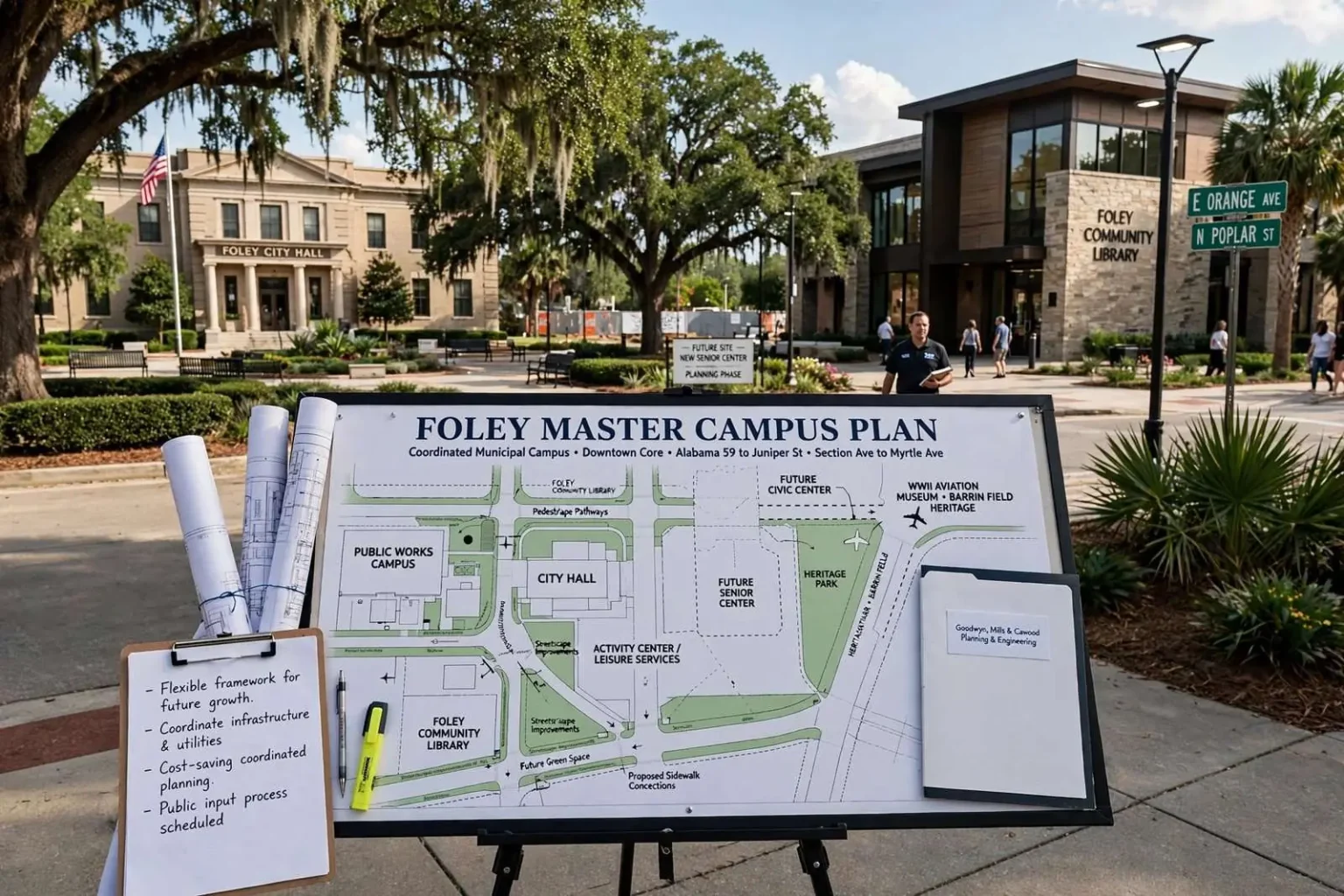
The City of Foley is moving forward with a master plan intended to guide the coordinated development of its municipal campus, after the Foley City Council approved a proposal from Goodwyn, Mills and Cawood to prepare the plan. Rather than locking the city into a single rigid blueprint, officials say the effort is designed to create a flexible framework that will help coordinate future facility construction, streetscapes, public spaces, and infrastructure as the city’s needs continue to evolve.
A Framework, Not a Fixed Blueprint
Mayor Ralph Hellmich said the plan is intended to give city leaders a guiding framework rather than a rigid set of requirements. “This gives us a framework for how future buildings, sidewalks, lighting, streetscapes and other improvements can work together,” Hellmich said. “It is not intended to lock the city into one plan, but to give us guidance as needs and opportunities change.”
Hellmich also emphasized the financial logic behind planning ahead of individual construction projects rather than approving each new facility in isolation. “Coordinating these investments ahead of time can help us avoid unnecessary costs and make better use of taxpayer dollars,” he said. “Good planning now can save the city significant money in the future.” That kind of upfront coordination is intended to prevent the kind of costly rework that can occur when infrastructure like utility lines, sidewalks, and lighting is installed piecemeal, only to be dug up and redone again a few years later to accommodate a new facility that wasn’t part of the original planning.
What Area the Plan Covers
According to Cian Harrison, Foley’s executive director for general government and administration, the plan encompasses a large portion of the city’s downtown core, with the planning area extending from Alabama 59 east to Juniper Street and from Section Avenue south to Myrtle Avenue. “This will establish a shared vision for the campus, and that framework will guide future decisions related to building placement, campus expansion, public spaces, streetscapes, pedestrian connections, wayfinding and potential property needs, while also supporting long-term capital planning and budgeting,” Harrison said.
That geographic scope places several of the city’s most important civic and administrative functions within a single coordinated planning zone, rather than leaving each facility’s surrounding infrastructure to be planned independently as it’s built.
Facilities Already in Place
Several new city facilities have already opened within the planning area. The Public Works Campus — which houses the Engineering Department, city garages, and other facilities — opened in July on a 14-acre site at the intersection of North Poplar Street and East Section Avenue. The Foley Community Library opened in August on East Orange Avenue, with the new two-story building offering roughly twice as much space as the structure it replaced.
The Foley Activity Center, housed in the former National Guard armory on East Jessamine Avenue, contains offices for Leisure Services, Parks and Recreation, and the Communications Department. The city is also planning to renovate the former library building next to City Hall into administrative offices, while the municipal site used by Public Works since the 1990s — located between East Orchid Avenue and East Marigold Avenue — will be adapted for use by the Parks Department.
What’s Still to Come
Additional projects are planned for the downtown area covered by the master plan. The city intends to build a new Senior Center behind City Hall, near the Activity Center, and a new Civic Center is also planned for property north of Heritage Park. The current Civic Center opened in the 1970s, when Foley’s population was fewer than 4,000 residents; today, the city is home to about 32,000 people, and officials say a larger, more modern facility is needed to serve a population that has grown roughly eightfold since the existing center was built.
Also planned for the area north of Heritage Park is a museum honoring Foley’s role in Navy aviation training during and after World War II. The National Park Service has designated Foley as an American World War II Heritage City, a distinction limited to one community per state or territory. The planned museum will highlight Foley’s contributions to the war effort and the history of Barin Field, the Navy aviation training center that opened in 1942 and trained thousands of naval aviators before and during the war.
Why Cities Commission Master Plans
Municipal campus master plans like the one Foley has commissioned have become an increasingly common tool for fast-growing cities trying to manage a wave of new facility construction without ending up with a disconnected patchwork of buildings, parking lots, and infrastructure improvements that don’t work well together. By hiring a planning and engineering firm like Goodwyn, Mills and Cawood to study the full planning area at once, a city can identify shared infrastructure needs — like drainage, lighting, or pedestrian connections — that might otherwise be duplicated or overlooked if each new facility were designed and built independently over a period of years.
That kind of coordinated approach also gives city officials a clearer basis for long-term capital budgeting, since a master plan typically identifies not just what needs to be built, but roughly when and in what sequence, allowing the city to plan bond issuances, grant applications, and annual budget allocations around a known pipeline of projects rather than reacting to needs as they arise.
A City Reshaping Its Historic Core
Foley’s push to modernize its municipal campus comes amid a broader wave of growth across Baldwin County, where several cities have seen rapid population increases over the past decade as new residents move to the Gulf Coast region. That growth has put pressure on municipal governments to expand services and facilities faster than many were originally designed to accommodate, a dynamic reflected directly in Foley’s plans for a larger Civic Center to replace one built when the city’s population was a fraction of its current size.
City officials have described the master planning process as an opportunity not just to add new buildings, but to reinforce Foley’s historic downtown character even as the city grows, coordinating new construction with the streetscapes, public spaces, and pedestrian connections that give the downtown core its identity. Goodwyn, Mills and Cawood is expected to work with city staff and, potentially, the public over the coming months to develop the full master plan before it returns to the City Council for further consideration and eventual adoption.
Coordinating With Regional Growth Pressures
Foley’s planning effort does not exist in isolation from the rest of Baldwin County’s growth trajectory. Neighboring cities including Fairhope, Daphne, and Gulf Shores have each grappled with similar questions about how to expand municipal infrastructure and civic facilities fast enough to keep pace with population growth that, in some cases, has outstripped the original design capacity of decades-old city halls, libraries, and public works facilities. Regional planning officials have noted that coordinated, forward-looking master plans — rather than reactive, one-off facility replacements — tend to produce better long-term outcomes for fast-growing municipalities, both in terms of cost efficiency and in maintaining a cohesive civic identity as a city’s built environment expands.
For Foley specifically, the timing of this master planning effort follows several years of steady population growth driven by the broader migration of new residents to coastal Alabama, a trend that shows few signs of slowing according to regional demographic projections. City officials have said they view the master plan as a way to get ahead of that growth curve rather than continuing to respond to capacity problems only after they become acute, a lesson many fast-growing Sun Belt cities have learned the hard way after allowing municipal infrastructure to lag years behind residential and commercial development.
Public Input and Next Steps
While the City Council’s approval of the Goodwyn, Mills and Cawood proposal represents a significant step, the master planning process typically includes opportunities for public input before a final plan is adopted. City officials have indicated that residents, business owners, and other stakeholders within the planning area will likely have opportunities to weigh in as the plan takes shape, a step municipal planners generally consider essential for building community buy-in around a document that will guide development decisions for years, if not decades, to come.
Once finalized, the master plan is expected to return to the City Council for formal adoption, after which it would serve as the guiding reference document for future capital planning decisions, grant applications, and individual project approvals within the designated downtown planning area. City officials have not announced a specific timeline for when the full planning process, including any public engagement components, is expected to conclude.
Why the World War II Museum Matters to Foley’s Identity
Among the projects folded into the broader master planning effort, the planned museum honoring Foley’s Navy aviation training history stands out as a project tied less to municipal service delivery and more to civic identity and heritage tourism. Foley’s designation as an American World War II Heritage City — a distinction the National Park Service limits to a single community per state or territory — gives the city a rare opportunity to build a heritage attraction with genuine national significance, rather than a purely local historical marker.
Barin Field, the Navy aviation training center that operated in Foley beginning in 1942, trained thousands of naval aviators during and after World War II, making the city an important, if lesser-known, contributor to the nation’s wartime aviation training infrastructure. City officials have suggested that a well-executed museum on this history could draw visitors beyond the immediate Baldwin County area, adding a heritage-tourism dimension to a downtown planning effort that is otherwise focused primarily on municipal service delivery and civic infrastructure.