Atmore Woman Killed After SUV Overturns on Escambia County Road
A 43-year-old Atmore woman died Friday after her SUV left the roadway and overturned on Robinsonville Road in rural Escambia County, troopers said.
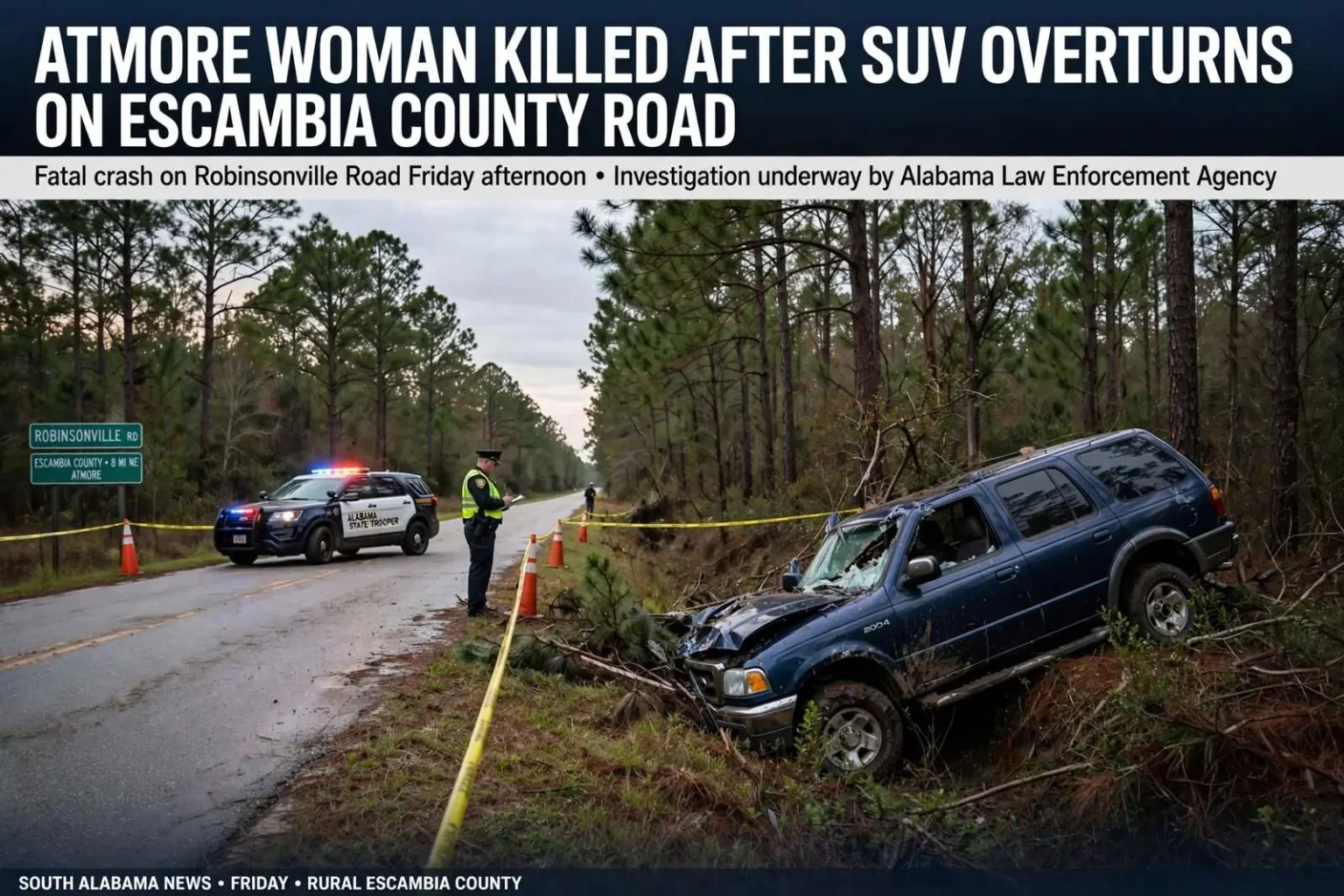
An Atmore woman died Friday afternoon after the sport-utility vehicle she was driving left the roadway and overturned in a rural stretch of Escambia County, according to preliminary information released by state troopers. The crash closed out a week of hazardous travel conditions across South Alabama’s secondary roads, where narrow shoulders, sharp curves and fading daylight combine to make even routine trips dangerous.
Alabama Law Enforcement officials said 43-year-old Janice Harris of Atmore was behind the wheel of a 2004 Ford Ranger on Robinsonville Road, roughly eight miles northeast of Atmore, when the vehicle ran off the road shortly before 4 p.m. The SUV overturned, and Harris was killed as a result of the crash, troopers said.
Investigators with the Alabama Department of Public Safety have not released additional details about what caused the vehicle to leave the roadway. As with most fatal crashes in the state, the preliminary report reflects only the barest outline of events — the location, the vehicle, the time — with the fuller picture awaiting the completion of the troopers’ reconstruction and witness interviews.
Robinsonville Road is a two-lane rural route that winds through wooded, sparsely populated sections of northeastern Escambia County. It is the kind of road found across much of South Alabama: no centerline lighting, minimal shoulders and long stretches between homes, where a driver who drifts off the pavement may travel several feet through soft ground before any obstacle stops the vehicle.
Troopers said the investigation into the crash remains open, and no further information was immediately available regarding contributing factors such as road conditions, speed or possible mechanical issues with the vehicle. Officials emphasized that single-vehicle overturns in rural areas can stem from any combination of those elements, and that it is premature to assign a cause before the evidence is reviewed.
The road and the terrain
The corridor where the crash occurred sits among the pine flats and mixed hardwood stands that characterize inland Escambia County. Roads in this part of the county were laid out decades ago to serve farms, timber operations and scattered rural homesteads, and many follow the natural contours of the land rather than modern engineering standards. Curves can tighten without warning, and after heavy rains the shoulders along such routes soften and erode.
Drivers who travel Robinsonville Road regularly know it as a connector between the Atmore area and the smaller rural communities to the northeast. Traffic volumes are light compared with the region’s U.S. and state highways, but the absence of congestion does not translate into safety. Unlit pavement at dusk and darkness, combined with deer and other wildlife moving near the timber edge, makes rural night driving one of the most persistent hazards in the county.
An area where single-vehicle crashes on unlit roads are not uncommon, particularly as fall daylight hours shorten, the northeastern corner of Escambia County sees its share of run-off-the-road collisions each year. Emergency responders in rural counties often face long response distances as well, which can stretch the interval between a crash and advanced medical care.
Volunteer fire departments and county EMS units cover wide territories in Escambia County, and a wreck deep along a rural route can pull resources from multiple stations. Residents in those communities have long understood that the first minutes after a crash depend on whoever is nearby, which is why local officials have repeatedly encouraged rural households to know their exact road names and mile markers when calling for help.
Rollovers remain the deadliest crash type
Fatal single-vehicle crashes on rural county roads remain one of the more common causes of traffic deaths in this part of South Alabama, according to state crash data, with rollovers frequently cited among the deadliest crash types on roads without medians or guardrails. Vehicles that leave the pavement at highway speed can trip on an embankment, ditch or soft shoulder and roll before the driver can correct, and older pickups and SUVs without modern stability control are especially vulnerable.
Safety engineers have noted for years that the vehicles most common on rural Southern roads — older full-size pickups, mid-1990s and 2000s-era SUVs — predate the widespread adoption of electronic stability control that has since been standard on new vehicles. A driver in such a vehicle who overcorrects after dropping one wheel off the pavement faces a much higher rollover risk than a driver in a newer model, one reason troopers repeatedly urge motorists to ease off the gas and steer straight when a wheel leaves the road rather than jerking back toward the pavement.
Seat belt use, meanwhile, remains the single most decisive factor in whether occupants survive a rollover. State and federal safety campaigns across Alabama have hammered the point for decades, and crash reviews in the region consistently find that unbelted occupants are far more likely to be fully or partially ejected in an overturn — an outcome that turns a survivable crash into a fatal one.
How these investigations proceed
When a crash involves a fatality, Alabama Law Enforcement Agency troopers respond to the scene, document the roadway and vehicle, and typically reconstruct the sequence of events before releasing a final determination. The process can take weeks. Investigators examine skid and gouge marks, the resting position of the vehicle, mechanical components and any available witness accounts, and their findings may ultimately reference driver condition, speed, roadway factors or a combination of causes.
Until that work is complete, officials generally decline to speculate, which is why the information available after Friday’s crash remained limited to the time, place and vehicle involved. The Escambia County coroner’s office handles matters of death certification in cases like this, and the findings from the crash investigation are typically forwarded to the district attorney’s office for review once finalized.
For families in rural communities, the practical reality of such investigations is a waiting period with few answers. Local news reports of fatal crashes across South Alabama frequently carry the same caution — that the investigation remains open — and troopers ask that drivers reserve judgment about fault until the official findings are issued.
Troopers urged area drivers to use caution on rural roads, particularly during evening and nighttime hours when visibility drops sharply along unlit routes like Robinsonville Road.
Atmore and its rural crossroads
Atmore, home to roughly 8,000 residents in northern Escambia County near the Alabama-Florida state line, sits along a corridor of rural highways that connect the city to smaller surrounding communities. The city serves as a commercial anchor for the surrounding countryside, with residents of communities across the northeastern county making regular trips into town for work, school and shopping along those two-lane routes.
The roads threading that landscape carry a mix of local traffic, logging trucks and commuters, and their condition has been a recurring topic at Escambia County Commission meetings over the years. Local officials have periodically called for improved signage and shoulder maintenance on some of the area’s older county roads, though funding for such upgrades in rural Escambia County has often lagged behind more heavily traveled corridors near Atmore’s town center.
County road departments across Alabama operate under tight budgets, and the math is unforgiving: resurfacing, clearing and re-marking hundreds of miles of low-traffic roadway competes with the higher volumes on state routes and city streets. When grant money or state aid appears, it tends to flow first to the busiest corridors, leaving routes like Robinsonville Road to be maintained on a slower cycle.
Advocates for rural road improvements point out that the safety payoff is nonetheless significant. Wider shoulders, mowed sight lines, reflective curve signage and guardrails at known trouble spots all reduce run-off-the-road crashes, and even modest investments — clearing brush from curve approaches, repainting faded edge lines — can meaningfully cut the risk on routes where a moment’s drift ends in a ditch or a tree line.
For now, the stretch of Robinsonville Road where Friday’s crash occurred remains as it has been: a quiet, wooded two-lane whose hazards are invisible until the moment they matter.
A community’s loss
Fatal crashes of this kind ripple through small communities in ways that urban wrecks rarely do. In Atmore and the rural settlements around it, a 43-year-old neighbor lost on a Friday afternoon is a name known at church, at work and in the school car line, and the days after such a crash typically bring an outpouring of support for the family left behind.
What drivers can do on rural roads
Safety officials who work the roads of South Alabama offer a consistent set of recommendations for the kinds of routes where Friday’s crash occurred. The advice begins with speed: rural two-lane roads demand speeds that leave room for reaction, particularly through curves where the pavement ahead cannot be seen. A speed that feels comfortable on a straight stretch can be far too fast at the next bend.
Headlights matter even in daytime. Running lights make a vehicle visible over cresting hills and through timber shadows, and at dusk — the hour when unlit rural roads are most deceptive — drivers should treat darkness as arriving earlier than it appears to.
Drivers are also urged to respect the edge of the pavement. If a wheel drops off onto a soft shoulder, the correct response is to ease off the accelerator, hold the wheel steady and let the vehicle slow before easing back onto the road. Overcorrection at speed is a leading recipe for the rollovers that make rural crash data so grim.
Attention to the calendar helps as well. Fall brings shortened daylight, fog in the low places, and increased deer movement along the tree lines of Escambia County and its neighbors, a combination that turns the evening commute on rural routes into the most dangerous driving of the week.
Buckling up remains the simplest step of all. In an overturn, the belt is what keeps an occupant inside the protective frame of the vehicle, and crash data across Alabama year after year show the difference it makes between walking away and not.
Troopers said anyone with information about Friday’s crash may contact the ALEA highway patrol post that covers Escambia County. The investigation into Janice Harris’s death remains open, and authorities said additional details will be released when the review is complete. For a community that has lost another neighbor on one of its own roads, the reminders about caution on rural routes carry a weight that statistics never quite convey — and the hope that the next warning arrives before, rather than after, another name is added to the list.