University of South Alabama Atmore
Atmore’s Only Hospital Enters Chapter 11 Restructuring While Emergency Room Stays Open Around the Clock
Atmore Community Hospital has entered Chapter 11 restructuring in federal bankruptcy court, but the 49-bed facility says its emergency department, staff and appointments will continue without interruption.
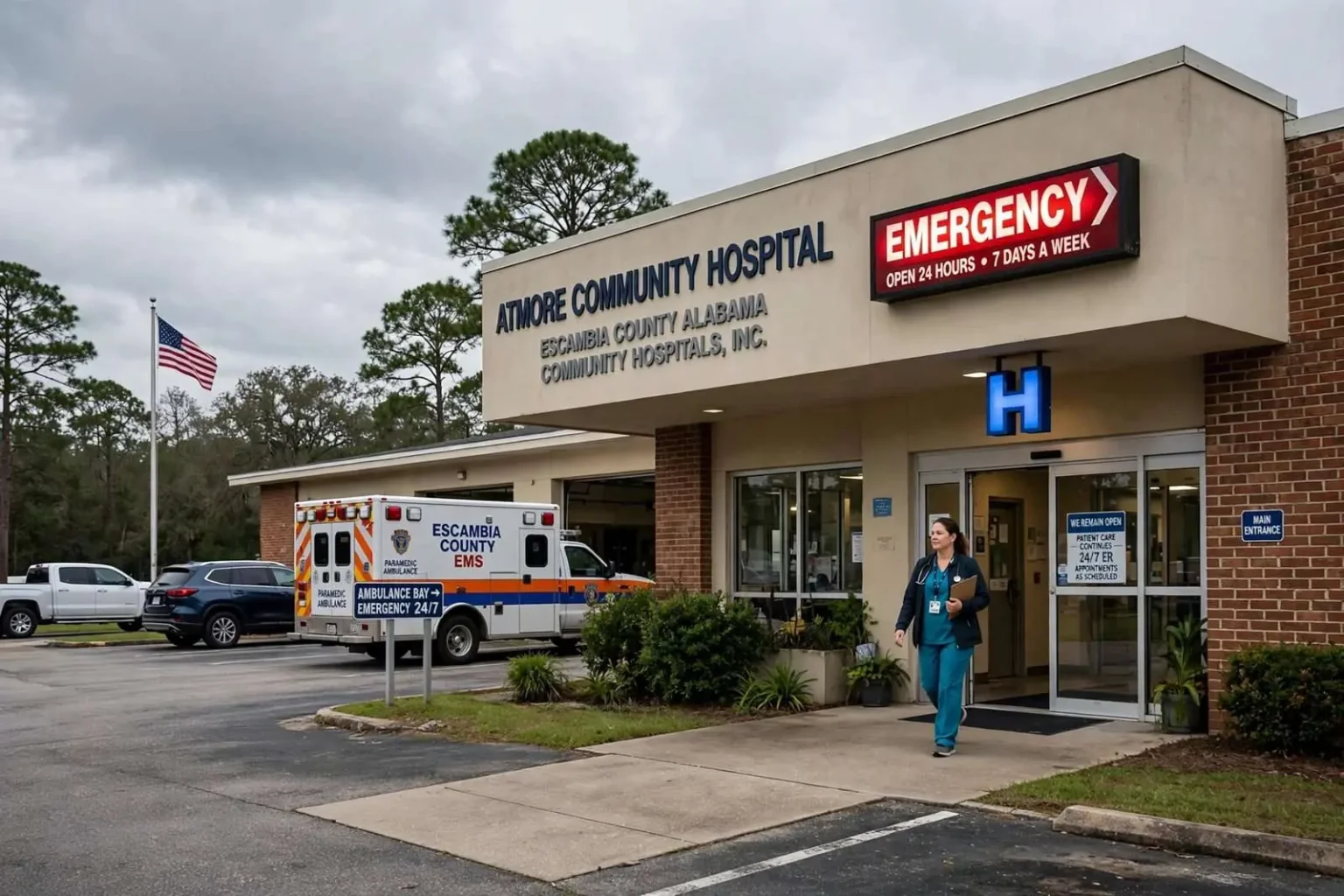
The nonprofit that runs Atmore’s only hospital has placed the 49-bed facility into Chapter 11 restructuring, a move its board describes not as a shutdown but as a legal reset intended to keep the doors open for the roughly 30,000 residents of Escambia County and the surrounding communities who depend on it.
Escambia County Alabama Community Hospitals, Inc. (ECACH), the nonprofit that manages Atmore Community Hospital, filed a voluntary petition on Friday, July 10, 2026, in the U.S. Bankruptcy Court for the Southern District of Alabama. Court records list estimated assets of between $10 million and $50 million against estimated liabilities of between $1 million and $10 million — a balance sheet that, on its face, suggests a hospital with real value on the books but a cash and obligations problem it could not solve outside of court.
What Chapter 11 Actually Means for Patients
Chapter 11 is often confused with liquidation. It is not. Chapter 7 closes a business and sells off its parts; Chapter 11 keeps the business running while a court supervises the reorganization of its debts. For a rural hospital, that distinction is the difference between a community keeping its emergency room and losing it.
Hospital leadership has been explicit that day-to-day care continues unchanged:
- Emergency services: The Emergency Department remains open 24 hours a day, seven days a week.
- Staffing: The same physicians, nurses and clinical teams remain on staff.
- Appointments: Patients are urged to keep all scheduled appointments, procedures and tests.
- Insurance: The hospital continues to accept existing insurance plans, including Medicare and Medicaid.
“This decision was not made lightly,” said Debbie Rowell, chair of the ECACH Board of Directors. “After carefully evaluating all available options, our Board approved this action because it is the best path to stabilize the hospital’s financial future and preserve local access to healthcare for the Atmore community.”
A Slide That Began Well Before the Filing
In 2024, the hospital closed its surgery department — a significant contraction for a facility of its size, and one that removed a meaningful revenue line at the same time it reduced what local patients could get without driving to Mobile, Pensacola or Brewton.
Hospital officials point to the familiar arithmetic that has been closing rural hospitals across the Southeast for a decade: operating costs that climb every year, chronic staffing shortages that force expensive contract labor, and reimbursement rates that have not kept pace with either. Alabama’s decision not to expand Medicaid has left rural facilities in the state absorbing a larger share of uncompensated care than their counterparts in expansion states, and hospitals serving low-income and elderly populations feel that gap most acutely.
The Tax Revenue Fight at the Center of the Case
What separates Atmore’s situation from a routine rural hospital squeeze is an unresolved dispute over local tax money — and the Chapter 11 filing is aimed squarely at what the nonprofit calls “legacy financial obligations” tied to it.
Since April, ECACH has been in litigation against the Escambia County Health Care Authority, the entity responsible for distributing local tax revenue to healthcare providers in the county. The nonprofit’s complaint alleges that the Health Care Authority and its chief financial officer disproportionately steered property tax revenue toward D.W. McMillan Memorial Hospital in Brewton, the county’s larger facility, at Atmore’s expense.
The complaint further alleges that the Health Care Authority blocked ECACH from accessing financial records, leaving hospital leadership unable to fully assess its own financial position. The nonprofit argues that the resulting funding disparity pushed Atmore Community Hospital to what it describes as the “precipice of financial insolvency and collapse.”
That fight is not incidental to the bankruptcy — it is arguably its engine. A Chapter 11 proceeding gives ECACH the protection of an automatic stay against creditors while the underlying revenue question is litigated, buying the hospital time it did not otherwise have.
USA Health’s Role
The hospital was not left to navigate the crisis alone. In January 2026, executive leadership from USA Health — the University of South Alabama’s health system and the region’s largest academic medical provider — was placed onsite in Atmore. USA Health has been working alongside the local board to assess the hospital’s finances and develop a long-term plan that could eventually expand, rather than contract, healthcare access in the area.
That relationship matters. Rural hospitals that survive restructuring almost always do so by attaching themselves to a larger system that can absorb administrative overhead, negotiate better reimbursement rates and supply specialist coverage. A hospital going into Chapter 11 with an academic health system already embedded in its leadership is in a materially stronger position than one going in alone.
Why This Reaches Well Beyond Atmore
Atmore Community Hospital is not only Atmore’s hospital. It serves a broad rural catchment that includes Poarch, Canoe, Huxford, Freemanville, McCullough, Nokomis, Flomaton and residents across the North Escambia area, many of whom live 40 minutes or more from the next nearest emergency room.
For patients experiencing a heart attack, a stroke or a serious traffic injury on U.S. 31 or Interstate 65, that travel time is not an inconvenience — it is a clinical variable. Emergency medicine measures survival in the “golden hour,” and rural hospital closures have been repeatedly linked to worse outcomes for time-sensitive conditions in the communities left behind.
Beyond care, the hospital is an economic anchor. Rural hospitals are typically among the largest employers in their counties, and their presence factors into decisions by employers, retirees and families weighing whether to locate in a community at all.
What Comes Next
The Chapter 11 process will now unfold under the supervision of the U.S. Bankruptcy Court for the Southern District of Alabama. ECACH will be required to file schedules of assets and liabilities, and ultimately to propose a plan of reorganization laying out how it intends to satisfy creditors and emerge as a sustainable operation. Creditors will have the opportunity to be heard. The parallel litigation against the Escambia County Health Care Authority remains pending.
While the case is pending, ECACH operates as what the Bankruptcy Code calls a “debtor in possession”: its existing board and management keep running the hospital, but significant decisions outside the ordinary course of business, such as selling major assets or taking on new financing, require the bankruptcy judge’s approval. Because the debtor is a health care business, federal bankruptcy law also directs the court to appoint a patient care ombudsman to monitor the quality of patient care during the case, unless the judge finds that an ombudsman is not needed to protect patients.
For patients in the meantime, hospital officials are asking for one thing above all: do not stay away. Rural hospitals in restructuring are frequently damaged less by the court process than by the perception of one, as patients preemptively take their care elsewhere and the revenue the hospital needs to recover walks out the door with them.
The emergency room is open. The clinics are open. The appointments stand.